Fishing Cat: Who Eats Whom? Food Chain Lesson Plan (Grade 2)
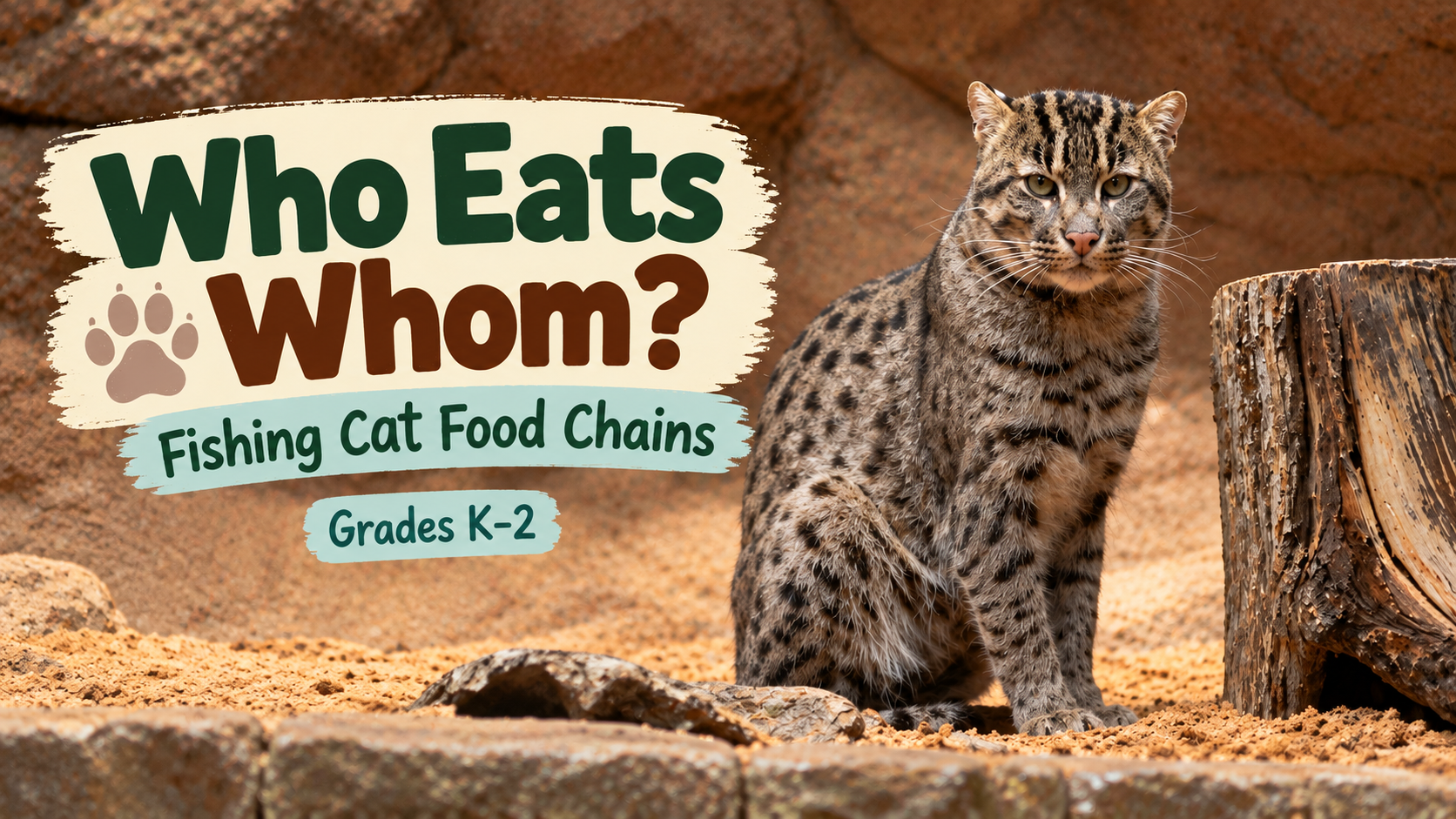
Students begin with the video, collecting evidence about what the fishing cat eats and how it hunts. They then become the food chain themselves, passing yarn from the sun to a plant to an animal to the fishing cat, and build the chain with picture cards and arrows. In the final session they observe plants and animals in a schoolyard habitat, compare it with the fishing cat's wetland, and write a short explanation that pulls the whole lesson together. Because every chain starts with plants, classes that want a deeper look can add the optional plant needs investigation, where students plan and carry out a simple fair test and record observations in a science journal for about a week.
Essential Question
How do plants help the fishing cat live?
How is the fishing cat's wetland like and unlike a habitat near us?
Optional extension question: What do plants need to grow?
Grade(s):
- 2
Recommended Technology:
- Device with internet access and a large display or SMART board for whole-class viewing.
- Speakers/audio for clear playback.
- Optional: document camera to project the card chain or a plant cup for the class.
- Optional: a tablet or camera to photograph the cups each day for a class slideshow.
Other Instructional Materials or Notes:
- Printable cards: Fishing_Cat_Food_Chain_Cards_Grade2 (organism cards, Be the Chain badges, word cards, arrow cards). Print on cardstock or laminate to reuse.
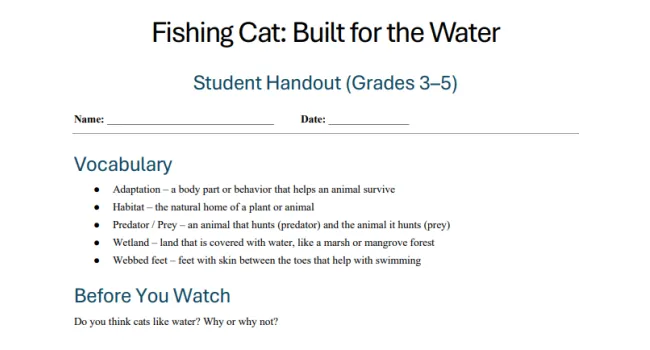
- Student handout: Fishing_Cat_Food_Chain_Student_Handout_Grade2.
- For the optional plant investigation: seeds (grass, radish, or bean), three clear cups per group or class set, paper towels, water and spoon, a cardboard box or closet for the dark cup, rulers in centimeters.
- A ball of yarn, scissors, glue sticks, crayons, chart paper, clipboards, and hand lenses for the habitat walk.
- Anchor chart: "The arrow points to the one that gets the energy."
- Teacher note: predation is a natural part of the ecosystem. For students who are sensitive about animals being eaten, keep the focus on how plants and animals get what they need.
Lesson Progression
| Session | Segment | What Happens |
|---|---|---|
| 1 (30 min) | Video | Predict, learn vocabulary, watch the video, and discuss what the fishing cat eats and why it needs plants. |
| 2 (35 min) | Food Chain Model | Chant, Be the Chain, build chains with cards and arrows, label producers and consumers, exit ticket. |
| 3 (40 min) | Habitat Comparison and Explanation | Schoolyard walk, compare habitats, write the final explanation. |
| Optional | Plant Needs Investigation | Set up three cups, check daily for about a week, draw and measure, then conclude with evidence (2-LS2-1). |
Teacher Background
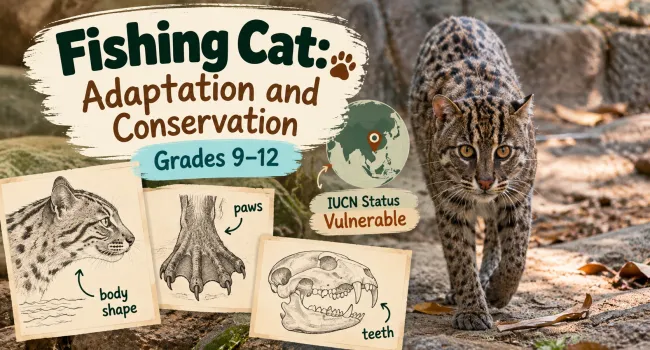
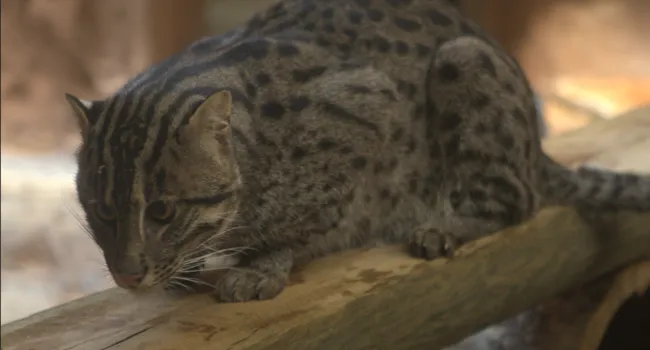
The fishing cat lives in wetlands in South and Southeast Asia and is listed as Vulnerable by the IUCN. Fish are its main food, but it also eats crabs, frogs, snails, snakes, rodents, and birds, and it is mostly active at night. Please confirm which animals the video names so the class chain matches the footage.
About the optional plant investigation: seeds contain stored food, so seeds kept in the dark will still sprout. The seedlings, however, are usually pale, thin, and weak because plants need light to make their own food. Seeds given no water usually do not sprout at all. Students may be surprised that the dark cup sprouts at first. That is useful evidence to discuss: what the seed already has versus what the plant needs to keep growing.
Session 1: The Video (30 minutes)
Before Watching (5 minutes)
Ask: "What did you eat for lunch? Where did that food come from?" Follow one example back to a plant (bread came from wheat, which grew in sunlight). Then ask: "What do you think the fishing cat eats?" Have students predict on the handout, then share. Chart predictions to revisit later.
Vocabulary Preview (5 minutes)
Introduce food chain, energy, producer, consumer, predator, and prey with pictures, gestures, and the word wall.
Viewing Guide (8–10 minutes)
- What does the fishing cat eat?
- How does the fishing cat catch its food? (Look at its paws and how it moves in the water.)
- Where does the fishing cat live? Name two other living things that might share that home.
Pause the video when the fishing cat is hunting or eating so students can name what they see and add it to their handout.
After Watching – Discussion (8–10 minutes)
- What did the fishing cat eat? Does that match our predictions?
- What do you think the fish eat? (Plants and tiny things in the water.)
- The fishing cat does not eat plants. Why might it still need plants? (The animals it eats need them.)
- What do plants need to grow? (Sunlight and water.) How could we find out for sure? (Optional extension.)
- Where does the energy come from at the very start? (The sun.)
Session 2: Build the Food Chain Model (35 minutes)
Chant (2 minutes)
- The sun shines down on the water plants. (arms up, wiggle fingers down)
- The plants grow tall in the sun. (crouch, then rise)
- Small fish nibble, nibble, nibble! (pinch fingers)
- Fishing cat pounces — splash, splash, SPLASH! (pounce)
- Energy goes from the sun to the cat. That's a food chain, just like that!
Be the Chain (8 minutes)
- Four volunteers hold or wear badges from the Grade 2 cards (Sun, Water Plants, Small Fish, Fishing Cat). Mix them up and have the class help put them in order.
- Give the end of a ball of yarn to the Sun. The Sun passes it to the Water Plants and the class says, "The sun gives energy to the plants." Continue down the line.
- Look at the yarn together: "The energy goes THIS way." Show that an arrow points the same direction as the yarn.
- Repeat with the five-step challenge chain (Sun, Water Plants, Water Insect, Frog, Fishing Cat) so more students take a turn.
Build It With Cards (12 minutes, partners)
- Partners use organism cards and arrow cards to build the main chain (Sun → Water Plants → Small Fish → Fishing Cat) and glue or place it on the handout.
- Use the word cards to label the Producer and the Consumers. Circle the Predator and underline the Prey in one link.
- Challenge: build a second chain using the Snail or Crab (for example, Sun → Water Plants → Crab → Fishing Cat), and a five-step chain with the Water Insect and Frog.
- Discuss: "Which animal is both predator and prey?" (In the five-step chain, the frog hunts the insect, and the fishing cat hunts the frog.)
Exit Ticket (5 minutes)
On the handout: "The arrow points to the one that gets the ______." Students also circle the producer in their chain.
Session 3: Habitat Comparison and Final Explanation (40 minutes)
Schoolyard Habitat Walk (12 minutes)
In pairs with clipboards, students visit one spot outside (grass, garden, trees, a puddle or pond if available). They record on the handout three plants, three animals or signs of animals (insects, birds, tracks, nests), and whether there is water and a place to hide. If the weather is poor, use classroom plants, photos, or the 360 Habitat Tour.
Compare the Habitats (13 minutes)
Students fill in the comparison chart for the fishing cat's wetland and the schoolyard (plants, animals, water, hiding places) and finish the sentences: "One thing that is the same is ___. One thing that is different is ___." Discuss patterns: both habitats have plants, but the kinds of plants and animals differ.
Final Explanation (15 minutes)
Students write a short explanation on the handout using the sentence frames, a labeled food chain, and evidence from the plant journal. Students who are not ready to write may dictate to an adult or draw and label.
Optional Extension: What Do Plants Need to Grow? (2-LS2-1, about one week)
Use this investigation to fully meet 2-LS2-1. Set it up any time after Session 2, ideally early in the week so the Day 7 check does not fall on a weekend, and hold the conclusion before or after Session 3. Students complete the Optional Extension page at the end of the handout.
Launch (15 minutes)
Connect to the chain: "Our chain starts with plants. If the water plants could not grow, what would happen to the fish and the fishing cat?" Then ask: "What do plants need to grow?" Students predict on the handout (sunlight, water, soil, air, space).
Show three clear cups with the same seeds (grass seed, radish, or bean) on damp paper towel. Ask: "How can we test just one thing at a time?" Guide the class to this plan:
| Cup | What We Give the Seeds | What We Test |
|---|---|---|
| A | Light and water | This is our comparison cup: the plant gets both. |
| B | Water, but NO light (inside a box or closet) | Do plants need light? |
| C | Light, but NO water added | Do plants need water? |
Label the cups, set up A and C in a sunny window and B in the dark, and give A and B the same amount of water each day (for example, one spoonful). Cup C gets none.
Daily Checks (5 minutes each day for about 7 days)
- Water cups A and B the same amount. Look at all three cups.
- On Days 1, 3, 5, and 7, students draw what they see and measure any plant in centimeters on the handout. They also note the color.
- Keep paper towels damp but not soggy to limit mold. Discard seeds when the investigation ends.
Conclusion (20 minutes, Day 7 or 8)
- Compare the cups side by side. Which plants grew? Which did not? What color were they?
- Make a claim with evidence: "Plants need ____ and ____ to grow. We know because ____."
- Connect back: "What would happen to the fish and the fishing cat if the water plants did not get sunlight?"
Teacher Notes
The core lesson addresses 2-LS4-1 (habitat observation and comparison). The optional Plant Needs Investigation is the full match for 2-LS2-1; without it, the lesson only touches on what plants need through discussion.
Builds on: K-LS1-1 (what plants and animals need to survive), K-ESS3-1 (how needs relate to where living things live), and Grade 1 work on how young animals learn survival behaviors from their parents. Looks ahead to Grade 5 (5-PS3-1 and 5-LS2-1), where students formally model energy and matter in food chains and food webs.
Teacher Notes
- Arrow direction is the biggest stumbling block, even for older students. Use the yarn: it moves from the food to the eater, and the arrow points the same way.
- Keep the language concrete. "Energy" at this age means what food gives you so you can run, grow, and play.
- If you do the optional plant investigation, start it early in the week so the Day 7 check does not fall on a weekend. Doing the Session 2 model first helps students see why plants matter before they test them.
- In the plant extension, expect the dark cup to sprout and look pale. Do not rush to correct student ideas; use the observations as evidence and ask what the seed already had stored.
- The habitat walk can be done in any outdoor spot or on a screen. The goal is observation and comparison, not identification of exact species.
- Many students will say the fishing cat only eats fish. That is fine for this lesson; if you want to extend, mention it also eats crabs, frogs, and other animals.
Science Practices Used
- Developing and using a model (the food chain with arrows).
- Making observations and comparing two habitats.
- Constructing an explanation from evidence and communicating it in writing.
- Optional extension: asking questions, planning and carrying out a fair test (changing one thing at a time), and recording data in centimeters.
Vocabulary
- Food chain – a line that shows who eats whom
- Energy – what living things get from food so they can grow, move, and stay warm
- Producer – a living thing, like a plant, that makes its own food using sunlight
- Consumer – a living thing that eats other living things for energy
- Predator – an animal that hunts other animals
- Prey – an animal that is hunted by other animals
- Habitat – the place where a plant or animal lives and gets what it needs
- Wetland – land that is covered with water, like a marsh
- Investigation – a test that helps us find an answer to a question (used in the optional extension)
- Observe – to look closely and notice details
Build a word wall with a picture for each word. An animal can be both predator and prey (the frog hunts insects, but the fishing cat hunts the frog), so introduce those two words as roles, not as permanent labels.
Differentiation
Struggling Students
- Pre-teach "sun," "plant," "eat," and "energy" with real objects (a potted plant, a flashlight for the sun, a picture of a fish).
- Start with a three-card chain (Sun, Plant, Fish) before adding the Fishing Cat, and put numbers 1–4 on the back of the cards so students can self-check.
- If you do the plant extension, use a partially filled plant journal (the Day labels and measurement boxes already prepared) and a conclusion with a word bank.
- Post the anchor sentence: "The arrow points to the one that gets the energy."
English Language Learners
- Pair every vocabulary word with a picture and a gesture, and keep the word wall visible during every session.
- Provide sentence frames: "The ___ eats the ___." "Plants need ___ and ___ to grow." "One thing that is the same is ___."
- Allow drawings labeled in the home language first, then in English.
- Pair with a bilingual peer for the habitat walk and the optional investigation, and accept pointing or oral responses.
Students with IEPs / 504 Plans
- Allow the video to be paused as often as needed, and post a picture schedule of the session steps.
- Offer large laminated or magnetic cards, and a pre-made chain mat, for students who have trouble cutting or gluing.
- In the plant extension, give each student a job in the investigation (water-measurer, ruler-reader, recorder, or photographer) that matches their strengths.
- Accept pointing, picture selection, dictation, or a communication device for the final explanation. Provide preferential seating and noise-reducing headphones if needed.
Advanced / Gifted Learners
- In the plant extension, design a second fair test (for example, soil vs. paper towel, or a different amount of light) and explain what stays the same.
- Add a decomposer link to the chain: what happens to the plants and animals when they die, and how do nutrients return to the wetland?
- Explain why the fishing cat needs plants even though it never eats them.
- Use the "draw your own" cards to add a second predator to the wetland and predict what changes.
More Extensions
360 Habitat Tour: I Spy
Watch the Fishing Cat 360 Habitat Tour and have students spy things a fishing cat needs: water, plants, and a place to hide. Chart what they find and compare with the schoolyard chart.
Food Chain Mini-Book (Writing Connection)
Students fold a paper into a four-page book with one link of the chain on each page (sun, plant, fish, fishing cat), using a sentence on each page: "The ___ gives energy to the ___."
My Lunch Food Chain
Students draw a short food chain for something they ate (for example: sun → wheat → bread → me) with arrows, and share with a partner.
Decomposer Peek
Look closely at a decaying leaf or log outside (or a photo of a mushroom). Introduce the idea that some living things break down dead plants and animals, returning nutrients so new plants can grow.
Ask the Zoo
Students write one question for a zookeeper about what a zoo fishing cat eats and why.
Fishing Cat | Zoo Minutes
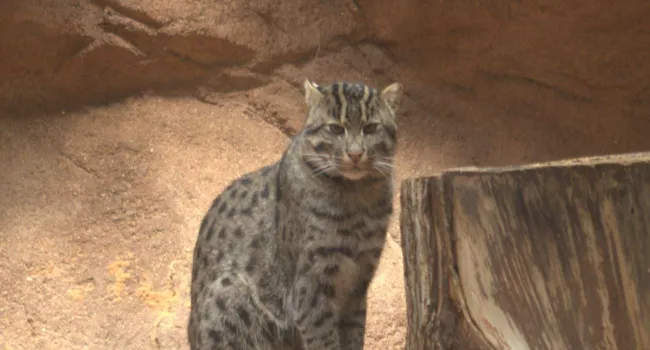
Meet Kayuma, a fishing cat whose story at Riverbanks Zoo and Garden is part of a much larger effort to protect his species. Discover the adaptations that make fishing cats at home around water and how...
View AssetFishing Cat: Built for the Water - K-12 Science Standards
This is a list of all applicable South Carolina K-12 science standards that can be applied to the Fishing Cat video and science materials and lessons.
View AssetFishing Cat: Built for the Water (Grades 3-5) Handout
This handout goes along with the "Fishing Cat: Built for the Water (Grades K-5)" lesson.
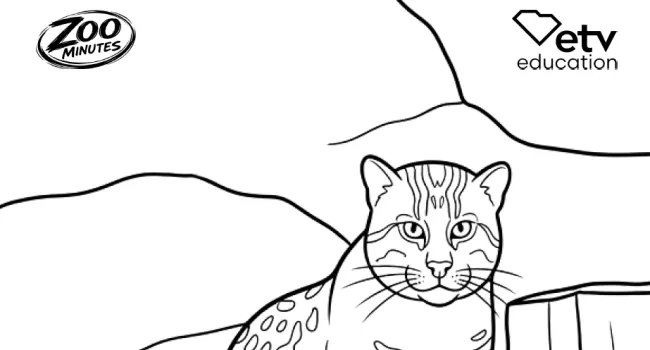
View AssetFishing Cat Coloring Sheet
Color a fishing cat and discover what makes this water-loving feline unique.
View AssetThe Fishing Cat: A Master of Water (Gr 4-5)
Students explain how the fishing cat's adaptations supports its survival and why protecting the species is important.
View LessonStandards
Assessments
Assessment / Check for Understanding
1. Formative Checks
- Session 1: viewing notes and predictions on the handout.
- Session 2: the exit ticket and the card chain (arrows pointing the right way).
- Optional extension: the plant journal (drawings, measurements, and the conclusion sentence).
2. Final Explanation Rubric
| Criteria | 3 – Got It | 2 – Almost There | 1 – Not Yet |
|---|---|---|---|
| Food chain model | Chain is in the correct order (sun, plant, animal(s), fishing cat) with arrows pointing the right way | Mostly correct, but one link or arrow is wrong | Order is wrong or arrows are missing |
| Plant needs | Names sunlight and water as what plants need and connects them to the food chain (with evidence from the investigation if completed) | Names one need, or does not connect it to the food chain | Does not name what plants need |
| Habitat comparison | Gives at least one similarity and one difference using observations | Gives only a similarity or only a difference | No comparison from observations |
| Communication | Uses at least three vocabulary words correctly in complete sentences (spoken or written) | Uses one or two vocabulary words correctly | Few vocabulary words |
Scoring: 10–12 points = Got It; 7–9 = Almost There; 4–6 = Not Yet. Score the thinking, not the handwriting. Spoken, drawn, and dictated responses all count.