Fishing Cat: Who Eats Whom? Food Chain Lesson Plan (Grades 4–5)
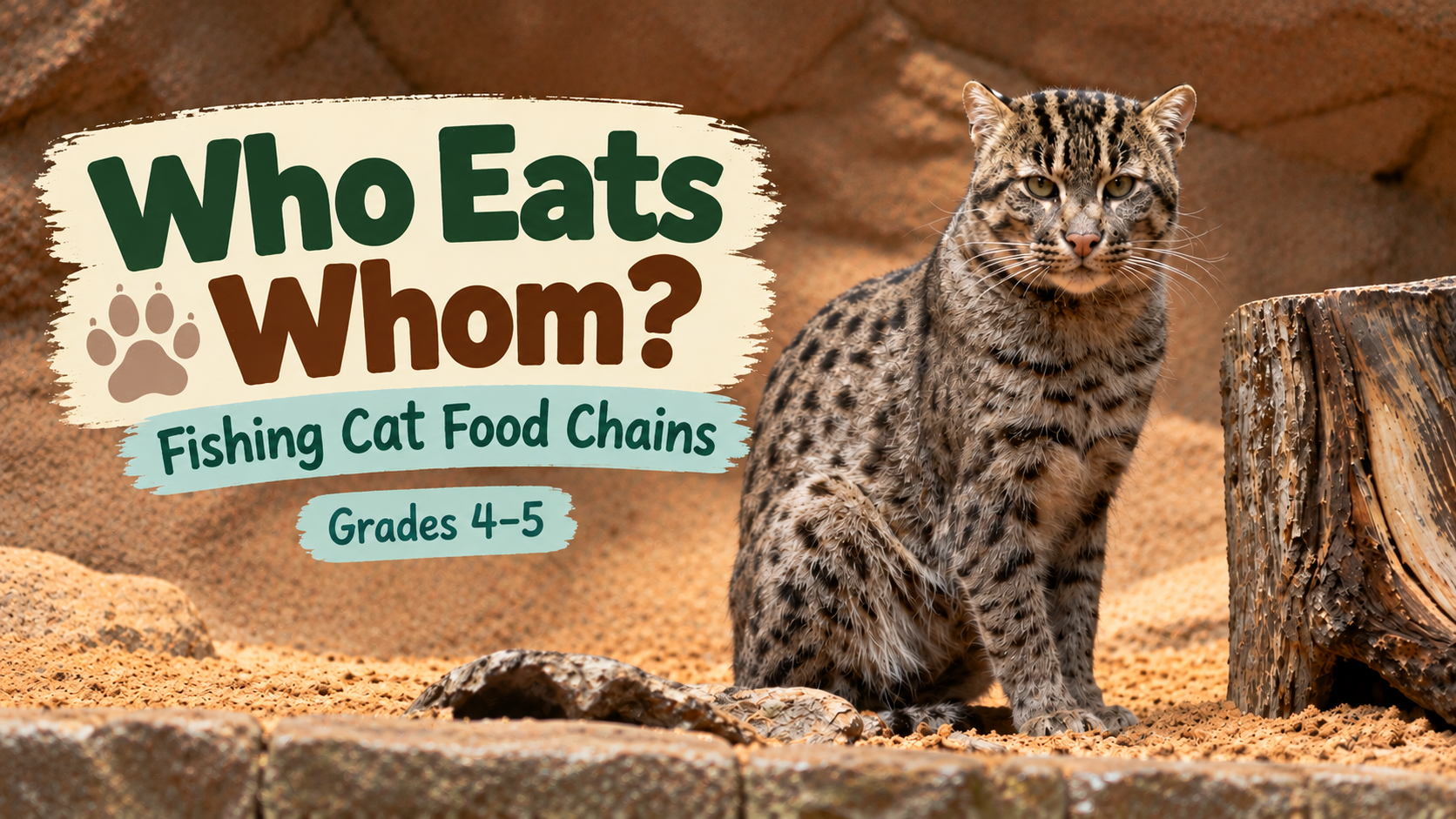
Students begin by predicting what the fishing cat eats, then watch the video to gather evidence about its prey and hunting style. Using illustrated organism cards from a wetland habitat, they build a food chain that starts with the sun and ends with the fishing cat, using arrow cards to show the direction energy moves. They then expand the chain into a food web, classify each organism (producer, consumer, decomposer; herbivore, carnivore, omnivore), and use the model to predict what happens to other organisms when one card is removed. The lesson ties to conservation by showing why protecting a whole habitat, not just one animal, matters.
Essential Question
Where does the fishing cat get its energy, and what happens to the whole habitat if one link in the food chain is lost?
Grade(s):
- 4
- 5
Subject(s):
Recommended Technology:
- Device with internet access and a large display/projector or SMART board for whole-class viewing.
- Speakers/audio for clear playback.
- Optional: digital whiteboard for building a class food web with movable cards.
- For the 360 Habitat Tour Extension, a display large enough for the whole class to see features clearly.
Other Instructional Materials or Notes:
- Printable cards: (12 organism cards, 15 arrow cards per page, 3 "draw your own" cards, 9 role label cards). Print on cardstock or laminate. Print two or three copies of the arrow page per group.
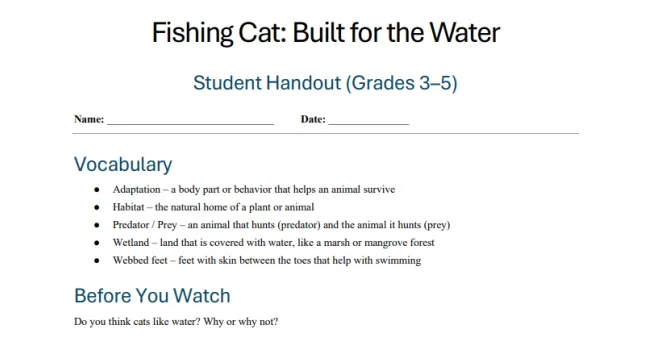
- Student handout.
- Chart paper (one sheet per group), scissors, glue sticks, markers.
- Anchor chart: "The arrow points to the one that gets the energy."
- Teacher note: predation is a natural part of the ecosystem. For students who are sensitive about animals being hunted, frame the lesson around energy and balance rather than "who gets eaten."
Lesson Progression
| Time | Segment | What Happens |
| 5 min | Before Watching | Predict what the fishing cat eats. Trace a student's lunch back to a plant or the sun. Chart responses. |
| 4 min | Vocabulary Preview | Introduce food chain, energy, producer, consumer, predator/prey with pictures and gestures. |
| 8–10 min | Viewing | Show Fishing Cat: Zoo Minutes. Students watch for what the cat eats and how it catches food. |
| 6–8 min | Discussion | Guide students from "what it eats" to "where the food got its energy" and why arrows point to the eater. |
| 15–18 min | Build the Model | Part 1: build a chain. Part 2: build a food web and sort roles. Part 3: remove a card and predict. |
| 5 min | Assessment | Exit ticket and rubric scoring. |
| Extension (optional) | Diet Graph / 360 Tour / SC Chain / Mural / Ask the Zoo | Students complete one or more extension activities. |
Teacher Background: The Fishing Cat's Diet
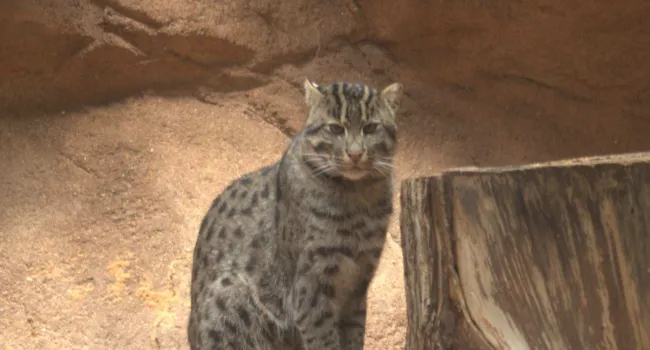
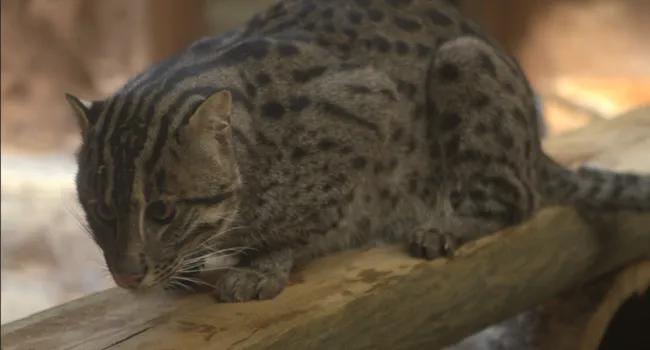
The fishing cat is a wetland specialist found in South and Southeast Asia, and the IUCN lists it as Vulnerable. Fish are its main food, but it is a flexible hunter. Published diet studies and conservation sources list crabs, frogs, snails and mollusks, snakes, rodents, water insects, and birds as additional prey, and the mix varies by region and season. It is mostly active at night and generally hunts alone. Adults have few natural predators, though they share range with larger cats such as tigers and leopards. Major threats include wetland loss, pollution, and overfishing that reduces its prey. Please confirm which prey animals the video itself names so the class chain matches the footage.
Before Watching
Ask students: "What do you think the fishing cat eats? Where do you think that food gets its energy?" Chart predictions. Then ask: "What did you eat today? Can we trace it back to a plant or the sun?" Revisit the chart after viewing.
Viewing Guide
- What does the fishing cat eat?
- How does the fishing cat catch its food? Which body parts or behaviors help?
- Where does the fishing cat live, and what other living things might share that home?
- How do baby fishing cats learn to hunt?
After Watching – Discussion
- What did the fishing cat eat in the video? Were you surprised? (Fish is the main food, but it also eats other animals.)
- Where did the fish get its energy? Where did the food the fish ate get its energy? (Guide students back to the sun.)
- Which way should the arrow point: from the fish to the cat, or from the cat to the fish? Why? (Arrows show where the energy goes.)
- What would happen to the fishing cat if the fish in its wetland disappeared?
Hands-On Activity: Build the Model
Students work in partners or groups of three with the Grades 3–5 printable cards (12 organism cards, arrow cards, role label cards) and the student handout.
Part 1 – Food chain (8 minutes): Students choose cards to build at least one food chain that starts with the Sun and ends with the Fishing Cat, using arrow cards between each pair. Arrows point from the food to the eater. Example: Sun → Algae & Water Plants → Small Fish → Fishing Cat.
Part 2 – Food web (8 minutes): Students glue all the organism cards onto a sheet of chart paper and connect them with arrows to show every "who eats whom" link they can justify. They then sort role label cards (producer, consumer, decomposer; herbivore, carnivore, omnivore) onto the organism cards and complete the role table on the handout.
Part 3 – Remove a card (5 minutes): Teacher announces: "A wetland is drained for farmland and the Small Fish disappear." Students remove that card and use their arrows to predict what happens to the fishing cat and to every organism that ate or was eaten by the fish. They record two or three sentences in the handout.
Teacher Notes
- Arrow direction is the biggest stumbling block. Many students draw arrows from the eater to the food ("the cat eats the fish"). Repeat the anchor phrase often: the arrow shows where the energy goes.
- Energy starts with the sun. Make this explicit; the web's single Sun card is what connects every chain.
- The fishing cat is not only a fish-eater. Use that to show why a food web is a better model than one chain, and why losing wetland habitat affects more than just the fish.
- Decomposers are easy to skip but complete the cycle (5-LS2-1). Show that nutrients return to the water for plants to use again.
- The organism cards represent a typical Asian wetland and may not match the exact species in the video. Keep your discussion consistent with the footage.
- The Remove a Card step connects to the conservation message in the secondary lessons without requiring genetics or IUCN vocabulary.
Vocabulary
- Food chain – a line of living things that shows who eats whom and how energy moves from one to the next
- Energy – what living things need to grow, move, and stay warm; in a food chain it starts with the sun
- Producer – a living thing, like a plant or algae, that makes its own food using energy from the sun
- Consumer – a living thing that gets energy by eating other living things
- Predator / Prey – an animal that hunts (predator) and the animal it hunts (prey)
- Herbivore / Carnivore / Omnivore – a consumer that eats plants / eats other animals / eats both
- Decomposer – a living thing, like bacteria or fungi, that breaks down dead plants and animals and returns nutrients to the ecosystem
- Food web – many food chains linked together in one habitat
- Wetland – land that is covered with water, like a marsh or mangrove forest
Differentiation
Struggling Students
- Pre-teach "producer" and "consumer" with real examples (an apple tree vs. a student eating lunch) before the video.
- Provide a partially built chain (e.g., Sun → Algae → ___ → Fishing Cat) so students fill in the missing link.
- Reduce the food web to six cards (Sun, Algae & Water Plants, Small Fish, Frog, Water Insect, Fishing Cat) and give a color-coded role table.
- Post the anchor sentence: "The arrow points to the one that gets the energy."
English Language Learners
- Pair every vocabulary word with a picture or gesture (sun, plant, fish, arrow = "gives energy to").
- Provide a bilingual picture glossary where available for producer, consumer, predator, prey, and decomposer.
- Offer sentence frames: "The ___ eats the ___." and "The energy goes from the ___ to the ___."
- Allow card labels in the home language alongside English, and pair with a peer for the discussion.
Students with IEPs / 504 Plans
- Allow the video to be paused when prey or hunting is shown, giving processing time to name what is happening.
- Offer tactile cards (laminated or magnetic) so students can sequence without cutting or gluing.
- Accept the exit ticket as a verbal response, a card sequence, or a matching task.
- Provide extended time, a visual schedule of the lesson steps, and preferential seating near the screen. Consider noise-reducing headphones for sensitive students.
Advanced / Gifted Learners
- Add a second chain that includes a decomposer and explain how nutrients return to the wetland for plants to use again.
- Explain why a food web is a more accurate model than a single chain, using the fishing cat's varied diet as evidence.
- Use the "draw your own" cards to add a second predator to the web and predict how it would change what happens when a card is removed.
- Complete the diet data graph in the Extension section and write a conclusion about what the data shows.
Extensions
Fishing Cat Diet Graph (Math Connection)
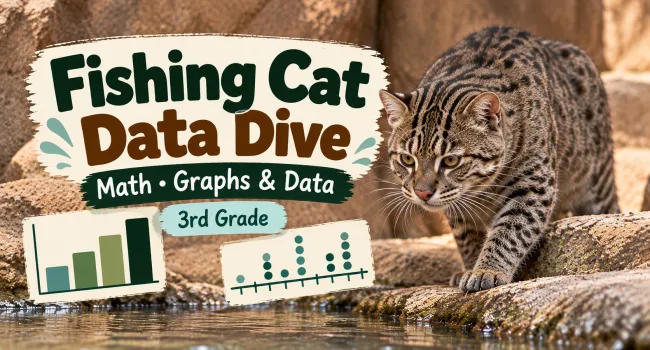
Give students data from a published fishing cat diet study in the Godavari Delta, India (percent of prey items found in scat samples): fish 36.6%, crabs 17.8%, rodents 16.8%, birds 14.8%, snakes 11.4%, other (mollusks, insects) 2.5%. Students make a bar graph and write one conclusion. Discuss that this is one study in one place, and that diets differ by region and season. Source: "Fish on the platter! Investigating the dietary habits of fishing cats in the Godavari Delta, India" (bioRxiv preprint, 2023).
360 Habitat Tour: What Supports the Food Chain?
Watch the Fishing Cat 360 Habitat Tour. Have students look for habitat features that a fishing cat's wild food chain depends on (water, plants, places for prey to live) and discuss how the zoo's feeding plan stands in for wild hunting.
My South Carolina Food Chain
Students build a food chain from a South Carolina habitat such as a saltmarsh (sun → marsh grass → small fish or crab → a larger predator) and compare it with the fishing cat's wetland. Discuss what is the same (energy starts with the sun, a producer comes first) and what is different (the animals).
Wetland Mural: Protect the Web
In small groups, students draw one part of a wetland food web on a class mural, then add a "Protect the Web" idea (keep wetlands clean, avoid overfishing) to show how people help every link in the chain.
Ask the Zoo
Students write questions for a zookeeper about what a zoo fishing cat eats and why, then compare the zoo diet with the wild diet from the video.
Answer Key
| Organism | Producer / Consumer / Decomposer | Herbivore / Carnivore / Omnivore |
| Sun | Energy source (not a living thing) | — |
| Algae & Water Plants | Producer | — |
| Snail | Consumer | Herbivore (eats algae) |
| Water Insect | Consumer | Herbivore or omnivore (accept either with reasoning) |
| Small Fish | Consumer | Omnivore (algae, tiny insects) |
| Crab | Consumer | Omnivore (plants, snails, dead matter) |
| Frog | Consumer | Carnivore (eats insects) |
| Rodent | Consumer | Herbivore or omnivore (plants, seeds, insects) |
| Snake | Consumer | Carnivore (eats frogs, rodents, fish) |
| Water Bird | Consumer | Carnivore (eats fish, insects, frogs); accept omnivore with reasoning |
| Fishing Cat | Consumer (top predator) | Carnivore |
| Bacteria & Fungi | Decomposer | — |
Sample accepted arrows (energy flow): Sun → Algae & Water Plants; Algae & Water Plants → Snail, Water Insect, Small Fish, Crab, Rodent; Water Insect → Frog, Small Fish, Water Bird; Snail → Crab; Small Fish → Water Bird, Snake, Fishing Cat; Frog → Snake, Water Bird, Fishing Cat; Rodent → Snake, Fishing Cat; Crab → Fishing Cat; Snake → Fishing Cat; Water Bird → Fishing Cat; every organism → Bacteria & Fungi when it dies. Accept any accurate links that students can justify.
Sample chains: Sun → Algae → Small Fish → Fishing Cat. Sun → Water Plants → Water Insect → Frog → Fishing Cat. Sun → Plants → Rodent → Snake → Fishing Cat.
Remove a Card (Small Fish removed): the Fishing Cat, Water Bird, and Snake lose one food source and must rely more on frogs, crabs, rodents, or other prey; algae may grow more because fewer fish eat it. Accept reasoned predictions that follow the arrows.
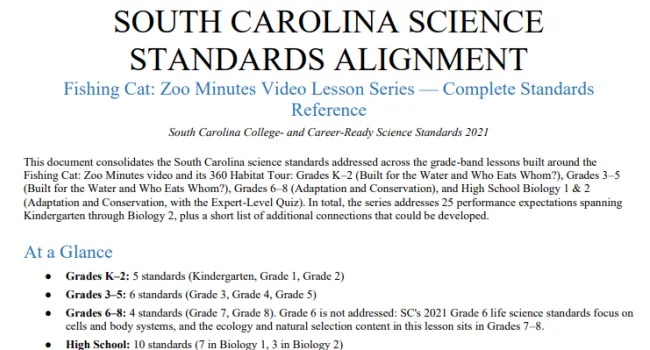
Fishing Cat: Built for the Water - K-12 Science Standards
This is a list of all applicable South Carolina K-12 science standards that can be applied to the Fishing Cat video and science materials and lessons.
View AssetFishing Cat: Built for the Water (Grades 3-5) Handout
This handout goes along with the "Fishing Cat: Built for the Water (Grades K-5)" lesson.
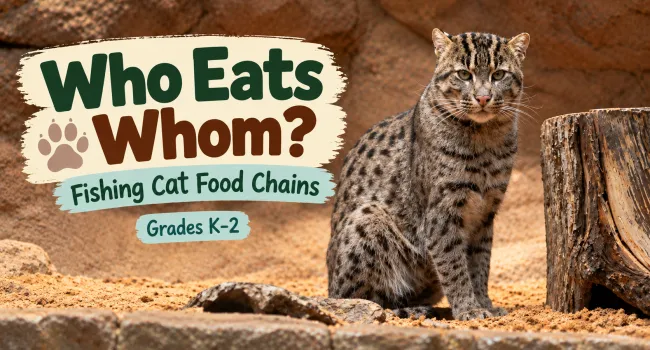
View AssetFishing Cat: Who Eats Whom? Food Chain Lesson Plan (Grades K–2)
This lesson uses the fishing cat to introduce the idea that living things get what they need from other living things, and that the chain of "who eats whom" starts with the sun and plants. Students...
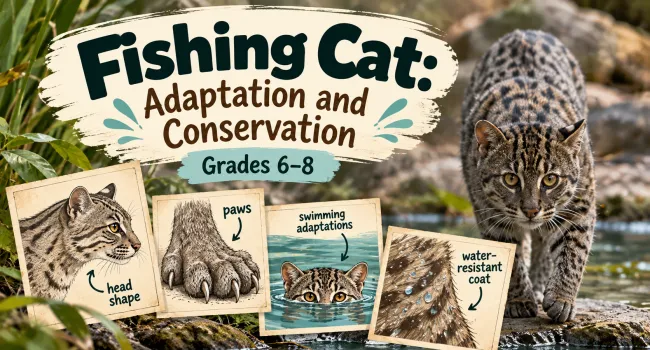
View LessonFishing Cat: Adaptation and Conservation (Grades 6–8)
This lesson introduces middle school students to the connection between an organism's physical structures and behaviors and its ability to survive in a specific habitat, using the fishing cat as a...
View LessonThe Fishing Cat: A Master of Water
Students explain how the fishing cat's adaptations supports its survival and why protecting the species is important.
View LessonStandards
- 5-PS3-1 Use models to describe that energy in animals food (used for body repair, growth, motion, and to maintain body warmth) was once energy from the sun.
- 5-LS2 Ecosystems: Interactions, Energy, and Dynamics
- 5-LS1-1 Support an argument with evidence that plants obtain materials they need for growth mainly from air and water
- 4-LS1-1. Construct an argument that plants and animals have internal and external structures that function together in a system to support survival, growth, behavior, and reproduction.
Assessments
1. Exit Ticket
"Explain in 2–3 sentences where the fishing cat's energy first came from. Use the words sun, producer, and consumer."
Grade 5 option (CER): "Claim: The fishing cat depends on the sun. Support your claim with evidence from your food web and explain your reasoning."
2. Simple 3-Point Rubric
| Score | Criteria | Example Response |
| 3 – Clear Understanding | Shows the correct order (sun → producer → consumer(s) → fishing cat), arrows or wording show energy moving toward the eater, and names the sun as the original energy source | "The sun's energy goes into algae, a small fish eats the algae, and the fishing cat eats the fish." |
| 2 – Partial Understanding | Order mostly correct, but missing the sun/producer, or arrows point the wrong way, or roles are vague | "The fishing cat eats fish and the fish eat plants." (no sun, no direction) |
| 1 – No Clear Understanding | Names animals but no food chain relationship, or the order is inaccurate | "The fishing cat lives near fish." |
Score the content, not the format. Verbal, drawn, or card-sequence responses all count.