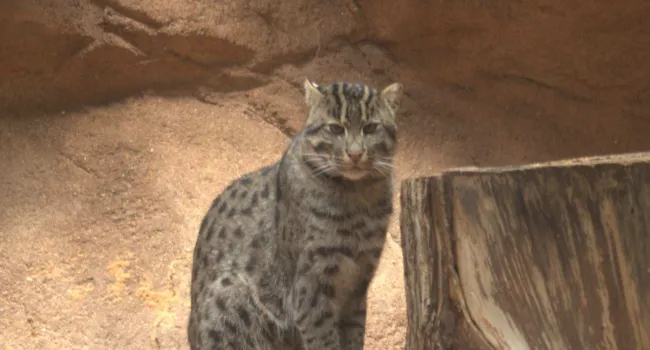
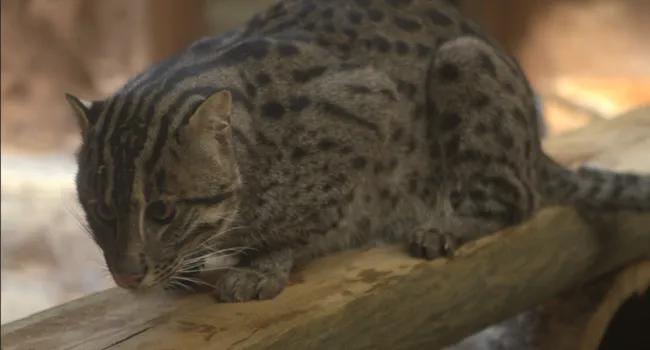
Meet Kayuma, a fishing cat whose story at Riverbanks Zoo and Garden is part of a much larger effort to protect his species. Discover the adaptations that make fishing cats at home around water and how zoos work together to support conservation.
Meet Kayuma, a fishing cat whose story at Riverbanks Zoo and Garden is part of a much larger effort to protect his species. Discover the adaptations that make fishing cats at home around water and how zoos work together to support conservation.
Standards
- K-LS1-1. LS1.C: Organization for Matter and Energy Flow in Organisms
- K-ESS3-1 Use a model to represent the relationship between the needs of different plants or animals (including humans) and the places they live.
- 1-LS1-2 Obtain information from multiple sources to determine patterns in parent and offspring behavior that help offspring survive.
- 2-LS2-1 Plan and conduct an investigation to determine what plants need to grow.
- 2-LS4-1. Make observations of plants and animals to compare patterns of diversity within different habitats.
- 3-LS4-2. Use evidence to construct an explanation for how the variations in traits among individuals of the same species may provide advantages in surviving and producing offspring.
- 3-LS4-3. Construct an argument with evidence that in a particular habitat some organisms can thrive, struggle to survive, or fail to survive.
- 3-LS4-4. Make a claim about the effectiveness of a solution to a problem caused when the environment changes and affects organisms living there.
- 4-LS1-1. Construct an argument that plants and animals have internal and external structures that function together in a system to support survival, growth, behavior, and reproduction.
- 5-PS3-1 Use models to describe that energy in animals food (used for body repair, growth, motion, and to maintain body warmth) was once energy from the sun.
- 5-LS2 Ecosystems: Interactions, Energy, and Dynamics
- 7-LS2-1. Analyze and interpret data to provide evidence for the effects of resource availability on organisms and populations of organisms in an ecosystem
- 7-LS2-2 Construct an explanation that predicts patterns of interactions among organisms across multiple ecosystems.
- 8-LS1-4 Use arguments, based on empirical evidence and scientific reasoning, to support an explanation for how characteristic animal behaviors and specialized plant structures affect the probability of successful reproduction of animals and plants respectively.
- 8-LS4-4 Construct an explanation based on evidence that describes how genetic variations of traits in a population increase some individuals probability of surviving and reproducing in a specific environment
- B-LS2-1. Use mathematical and/or computational representations to support explanations of biotic and abiotic factors that affect carrying capacity of ecosystems at different scales.
- B-LS2-7 Design, evaluate, and refine a solution for reducing the impacts of human activities on biodiversity and ecosystem health.
- B-LS3-2. Make and defend a claim based on evidence that inheritable genetic variations may result from (1) new genetic combinations through meiosis, (2) viable errors occurring during replication, and/or (3) mutations caused by environmental factors.
- B-LS4-1. Communicate scientific information that common ancestry and biological evolution are supported by multiple lines of empirical evidence.
- B-LS4-2 Construct an explanation based on evidence that the process of evolution primarily results from four factors: (1) the potential for a species to increase in number, (2) the heritable genetic variation of individuals in a species due to mutation and sexual reproduction, (3) competition for limited resources, and (4) the proliferation of those organisms that are better able to survive and reproduce in the environment.
- B-LS4-4. Construct an explanation based on evidence for how natural selection leads to adaptation of populations
- B-LS4-5 Evaluate the evidence supporting claims that changes in environmental conditions may result in (1) increases in the number of individuals of some species, (2) the emergence of new species over time, and (3) the extinction of other species.
- B-LS2-6. Evaluate claims, evidence, and reasoning that the complex interactions in ecosystems maintain relatively consistent numbers and types of organisms in stable conditions but changing conditions may result in a new ecosystem.
- B-LS2-8 Evaluate evidence for the role of group behavior on individual and species chances to survive and reproduce.
- B-LS4-6 Create or revise a simulation to test a solution to mitigate adverse impacts of human activity on biodiversity.
Resources
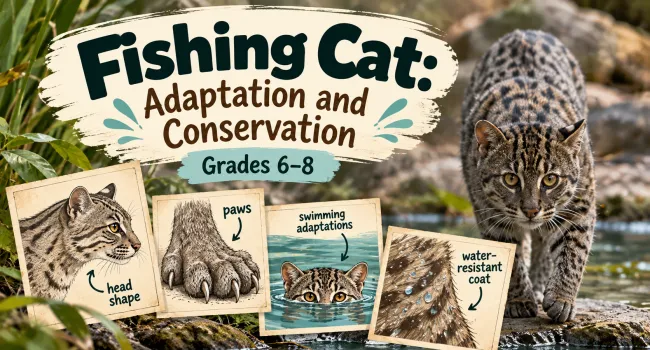
Fishing Cat: Adaptation and Conservation (Grades 6–8)
This lesson introduces middle school students to the connection between an organism's physical structures and behaviors and its ability to survive in a specific habitat, using the fishing cat as a...
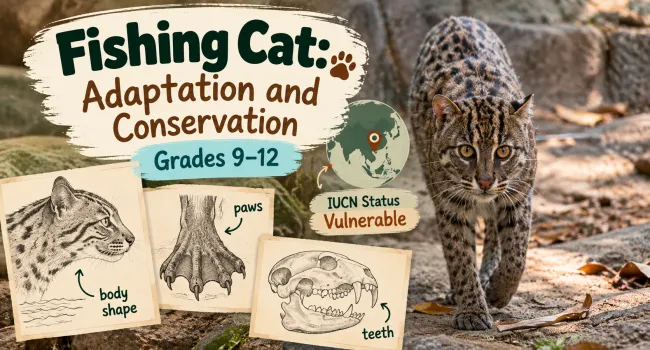
View LessonFishing Cat: Adaptation and Conservation (Grades 9-12)
This lesson uses the Fishing Cat: Zoo Minutes video and companion 360 Habitat Tour to help students connect structure-function relationships to natural selection and ecosystem interdependence...
View LessonThe Fishing Cat: A Master of Water (Gr 4-5)
Students explain how the fishing cat's adaptations supports its survival and why protecting the species is important.
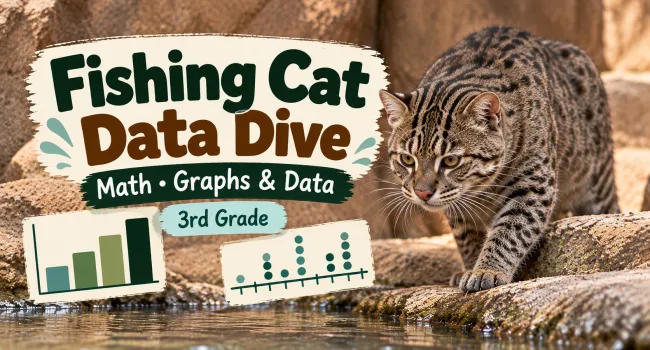
View LessonFishing Cat Data Dive (Gr 3)
In this hands-on, zoo-themed math lesson, students will analyze and interpret four distinct data representations—a dot plot, a data table, a scaled picture graph, and a bar graph—focusing on the...
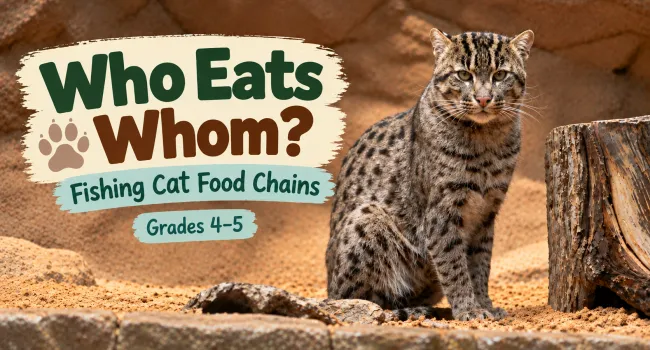
View LessonFishing Cat: Who Eats Whom? Food Chain Lesson Plan (Grades 4–5)
Students begin by predicting what the fishing cat eats, then watch the video to gather evidence about its prey and hunting style. Using illustrated organism cards from a wetland habitat, they build a...
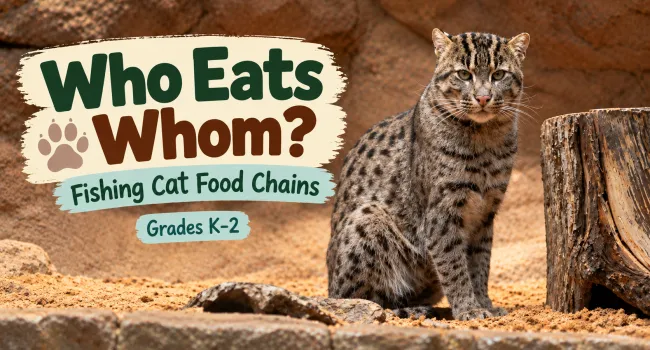
View LessonFishing Cat: Who Eats Whom? Food Chain Lesson Plan (Grades K–2)
This lesson uses the fishing cat to introduce the idea that living things get what they need from other living things, and that the chain of "who eats whom" starts with the sun and plants. Students...
View LessonFishing Cat Ratios, Rates, & Unit Rates (Gr 6)
Students investigate the foraging efficiency and diet of the fishing cat ( Prionailurus viverrinus) using real-world observational data inspired by SCETV's Zoo Minutes. By analyzing hunting success...
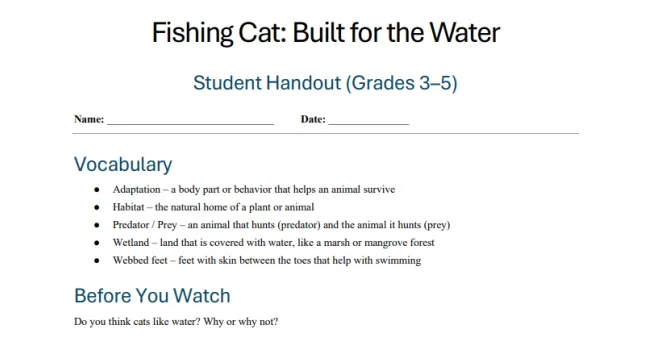
View LessonFishing Cat: Built for the Water (Grades 3-5) Handout
This handout goes along with the "Fishing Cat: Built for the Water (Grades K-5)" lesson.
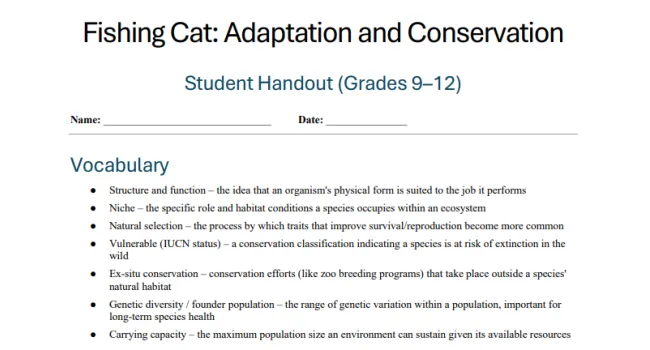
View AssetFishing Cat: Adaptation and Conservation Student Handout (Grades 9–12)
This handout goes along with the lesson "Fishing Cat: Adaptation and Conservation (9-12)".
View AssetFishing Cat: Built for the Water - K-12 Science Standards
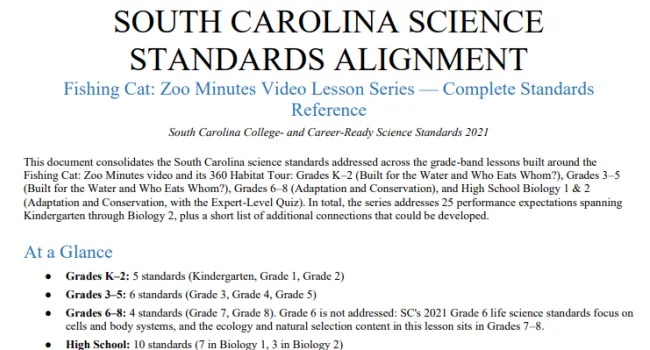
This is a list of all applicable South Carolina K-12 science standards that can be applied to the Fishing Cat video and science materials and lessons.
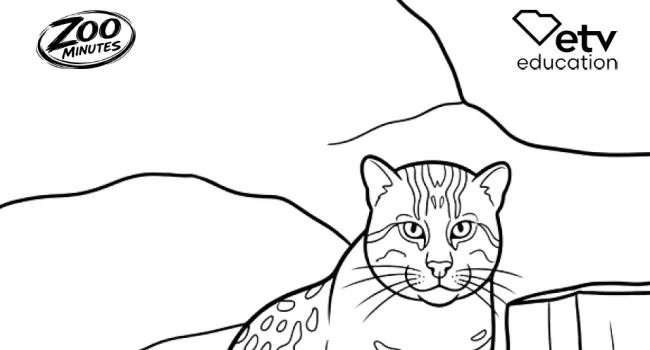
View AssetFishing Cat Coloring Sheet
Color a fishing cat and discover what makes this water-loving feline unique.
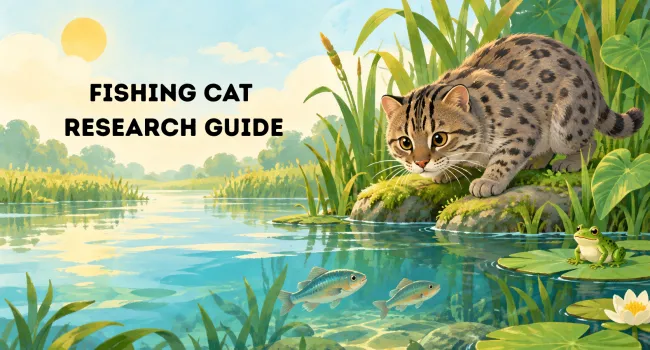
View AssetFishing Cat Research Guide (Grades 1-2)
Use this research guide as you learn about Fishing Cats.
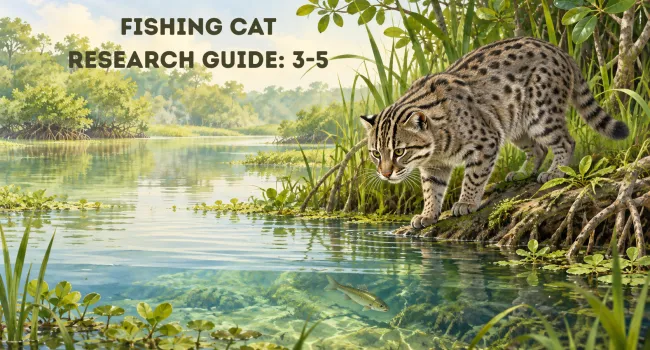
View AssetFishing Cat Research Guide (3-5)
Use this research guide as you learn about Fishing Cats.
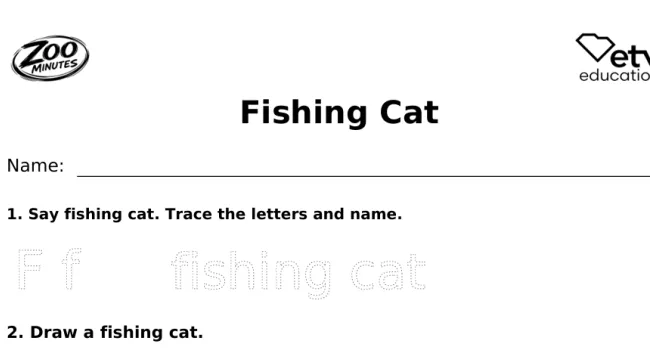
View AssetFishing Cat Early Writing
Practice early writing skills with this Zoo Minutes activity page. Learners trace letters and the words “fishing cat,” draw a fishing cat, and share what they know through writing or dictation.
View Asset