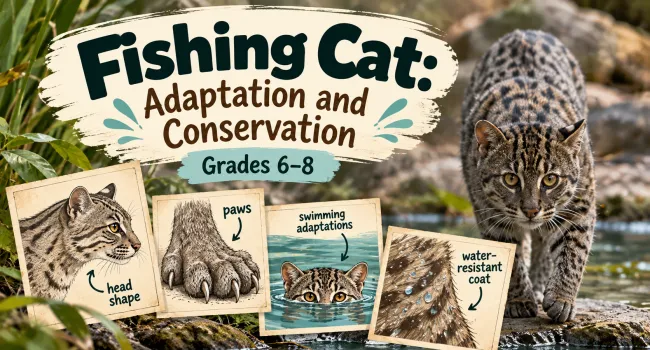
Fishing Cat: Adaptation and Conservation (Grades 9-12)
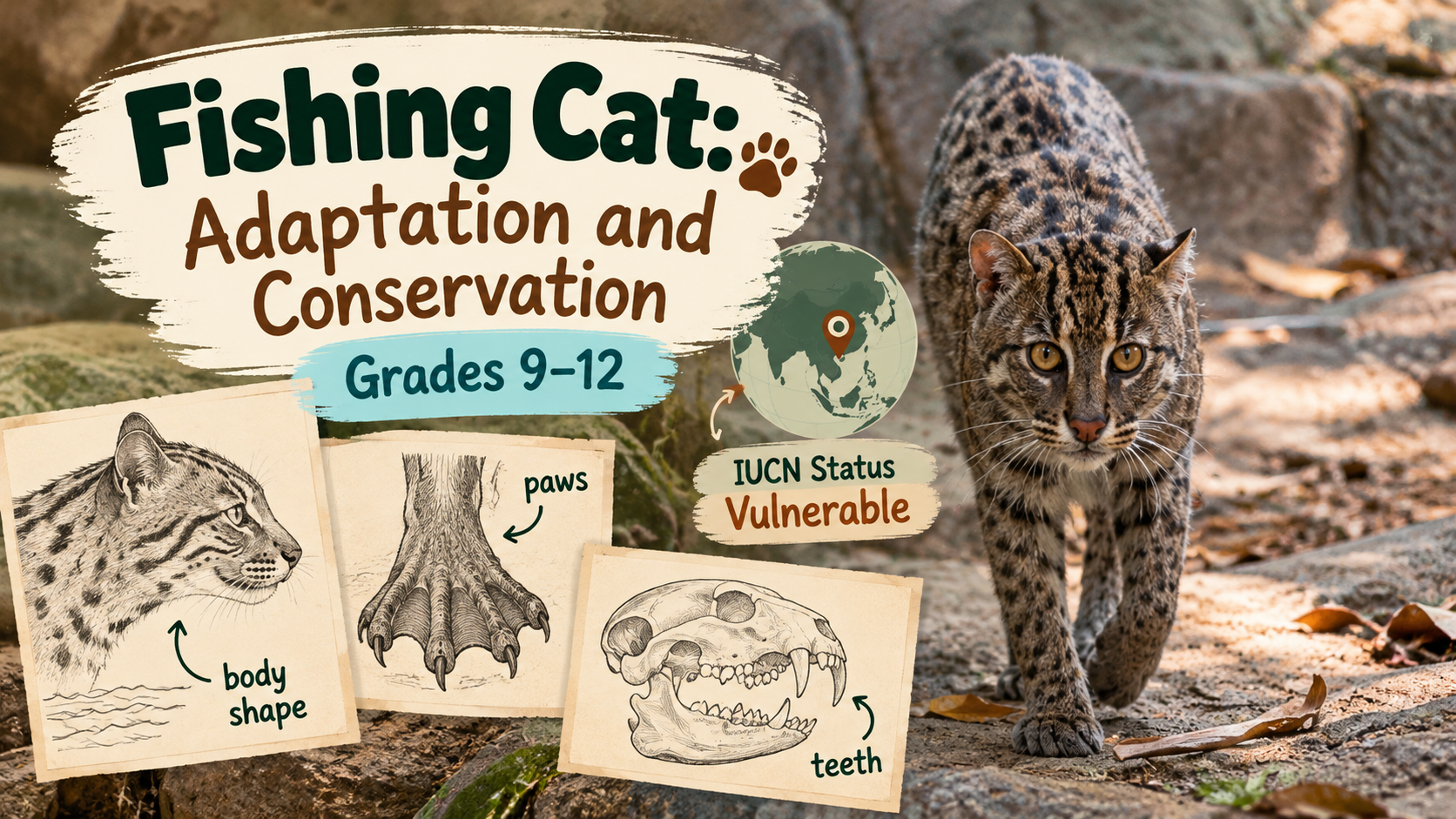
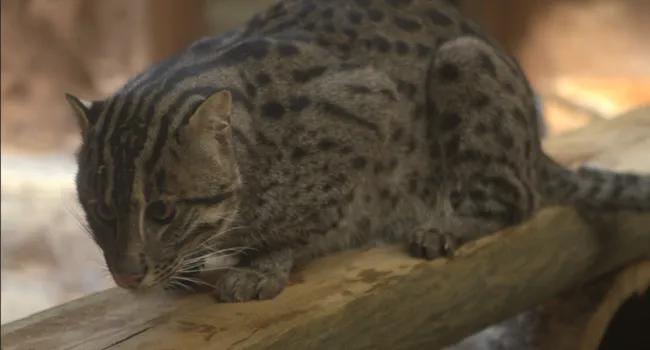
This lesson uses the Fishing Cat: Zoo Minutes video and companion 360 Habitat Tour to help students connect structure-function relationships to natural selection and ecosystem interdependence. Students begin by predicting how a semi-aquatic hunting cat might differ physically from a typical house cat, then watch the video to identify specific structural adaptations (paws, head shape, body) and evidence of learned versus innate hunting behavior. The lesson extends into conservation science, asking students to consider the fishing cat's IUCN status, the threats driving that classification, and the role of coordinated zoo breeding programs in preserving genetic diversity. A research component allows students to go deeper into one of four topics — IUCN threats, studbook management, convergent evolution in semi-aquatic predators, or shared-habitat species — culminating in a Claim-Evidence-Reasoning writeup and/or the Expert-Level Quiz, which applies these concepts beyond what is directly stated in the video.
Essential Question
How do an organism's structural and behavioral adaptations reflect the selective pressures of its ecological niche, and what role do humans play in maintaining genetic diversity and protecting species whose niches — and survival — are increasingly at risk?
Grade(s):
- 9
- 10
- 11
- 12
Subject(s):
Recommended Technology:
Device with internet access and a large display/projector for whole-class video viewing.
Individual devices for the Research Guide and, if used, the Expert-Level Quiz, since students need internet access to reach IUCN Red List, AZA/EAZA program pages, and other sources.
Speakers/audio capable of being heard clearly throughout the room.
Optional: shared digital doc for recording Before Watching predictions as a class.
Other Instructional Materials or Notes:
Printed or digital copies of the Viewing Guide questions so students can take notes while watching.
CER graphic organizer or sentence starters, especially helpful for students who haven't practiced this writing structure before.
Printed or digital copies of the Expert-Level Quiz if using it as a summative assessment.
List of pre-approved/vetted sources for the Research Guide (IUCN Red List, specific AZA/EAZA program pages) if you want to control source quality.
Teacher note: this lesson references a real individual animal (Kayuma) and a real, ongoing conservation transfer to Prague — framing this as a current case rather than a hypothetical can increase engagement with the research questions.
Lesson Progression
| Time | Segment | What Happens |
| 5 min | Before Watching | Students predict how a water-hunting cat might differ from a house cat. Record predictions. |
| 5 min | Vocabulary Preview | Introduce key terms so students recognize them during viewing. |
| 12–15 min | Viewing | Show Fishing Cat: Zoo Minutes. Students complete the Viewing Guide as they watch. |
| 10–12 min | Discussion | In pairs or small groups, students work through the After Watching discussion questions, then share out. |
| 10 min | Assessment | Students independently write their CER response. |
| Remaining time / Day 2 | Research Guide | Students select one prompt, gather sources, and prepare a short response. |
| Day 2 (optional) | Expert-Level Quiz | Administer as a formal summative assessment after the Research Guide. |
| Extension (optional) | 360 Tour / Case Study / Studbook Analysis | Students complete one or more extension activities. |
Teacher Notes
Teacher Notes:
The core loop (Before Watching → viewing → discussion → CER) fits comfortably in one period. The Research Guide and Expert-Level Quiz are best treated as a second period or homework extension.
This lesson assumes prior familiarity with basic natural selection and ecosystem vocabulary; briefly check for this before starting.
Emphasize that Kayuma is a real, individual animal and the Prague transfer is an active, ongoing conservation effort, not a hypothetical scenario — this tends to increase student investment.
Watch for the common misconception that a larger captive population automatically means healthier genetic diversity; the video and Research Guide Prompt 2 both address this directly through the founder-population concept.
If students haven't used the CER format before, model one example response as a class before releasing them to write independently.
Decide in advance whether the Research Guide response is graded for content accuracy, source quality, or both, and communicate this to students before they begin.
Differentiation:
Struggling Students
Provide sentence stems for the CER response (e.g., "I claim that... The video shows... This supports my claim because...").
Provide a curated, shorter list of pre-approved sources for the Research Guide to reduce the burden of source evaluation.
Allow partner work on the Research Guide rather than requiring fully independent research.
English Language Learners
Pre-teach vocabulary with visuals and a bilingual glossary where available.
Allow students to draft the CER response in their home language before translating key claims into English.
Provide closed captions during video viewing if available.
Students with IEPs / 504 Plans
Allow extended time for the CER response and/or the Expert-Level Quiz.
Offer a choice of response format for the CER task: written, verbal (recorded or dictated), or a labeled diagram with short justifications.
Allow the video to be paused at key structural evidence points to support processing time.
Advanced / Honors / AP Biology Students
- Assign the full Expert-Level Quiz as the primary assessment instead of (or in addition to) the CER response.
- Require three sources instead of two for the Research Guide, including at least one peer-reviewed article.
- If your course has covered population genetics, ask students to explicitly connect genetic diversity and founder effects in the Prague breeding program to concepts like allele frequency and Hardy-Weinberg equilibrium.
Extension:
360 Habitat Tour Evaluation
Use the Fishing Cat 360 Habitat Tour to have students evaluate the zoo habitat as a model: which design features address the species' basic survival needs, and which primarily support natural behaviors (enrichment)? Discuss the difference between a habitat meeting survival needs versus one promoting a full behavioral repertoire.
Convergent Evolution Case Study
Have students select a second semi-aquatic predator (river otter, platypus, American mink, or another of their choosing) and write a short comparative case study explaining which traits arose through convergent evolution versus shared ancestry. This extends Research Guide Prompt 3 and Expert Quiz Question 4 into an independent research product.
Studbook Data Analysis
For classes with access to computers, have students research a real AZA or EAZA studbook summary (population size, founder number, mean kinship where available) and write a short analysis of what the data suggests about the population's genetic health and long-term viability.
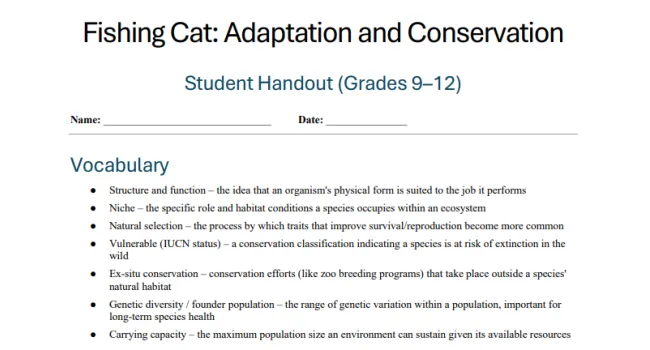
Fishing Cat: Adaptation and Conservation Student Handout (Grades 9–12)
This handout goes along with the lesson "Fishing Cat: Adaptation and Conservation (9-12)".
View AssetStandards
- B-LS1-2 Develop and use a model to illustrate the hierarchical organization of interacting systems that provide specific functions within multicellular organisms.
- B-LS1-3. Plan and conduct an investigation to provide evidence that feedback mechanisms maintain homeostasis.
- B-LS2-6. Evaluate claims, evidence, and reasoning that the complex interactions in ecosystems maintain relatively consistent numbers and types of organisms in stable conditions but changing conditions may result in a new ecosystem.
- B-LS2-8 Evaluate evidence for the role of group behavior on individual and species chances to survive and reproduce.
- B-LS4-4. Construct an explanation based on evidence for how natural selection leads to adaptation of populations
Assessments
Primary Assessment (CER Response): Have students write a Claim-Evidence-Reasoning response to the prompt: "The fishing cat's paws are an adaptation for its hunting niche." Students state a claim, cite specific video evidence, and explain the underlying reasoning connecting structure to function.
Optional Summative Assessment: Use the companion Fishing Cat: Zoo Minutes Expert-Level Quiz (10 questions) as a formal summative assessment. It extends beyond the video to apply structure-function, natural selection, and conservation genetics concepts, and includes an answer key with explanatory rationale for each question.
Scoring Guidance: For the CER response, look for a specific, evidence-based structure-to-function connection and a clear reasoning statement linking the trait to a survival or reproductive advantage, rather than a general or unsupported claim.