Meet the Radiated Tortoise (Grade 2)
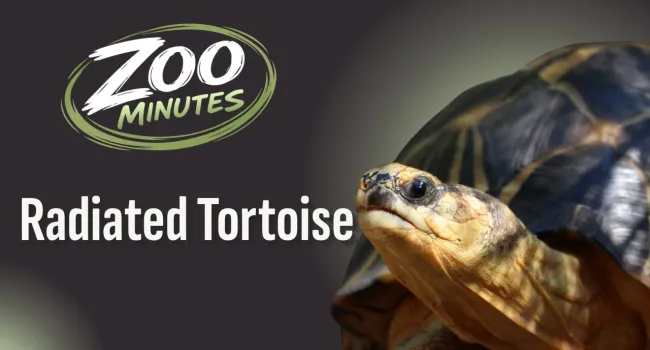
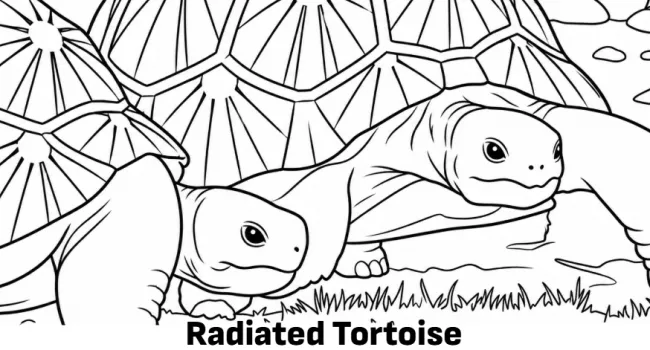
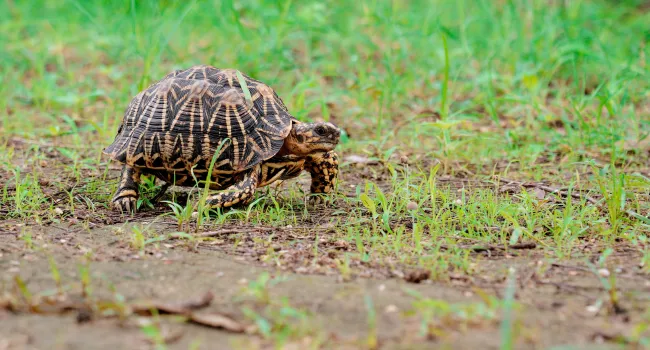
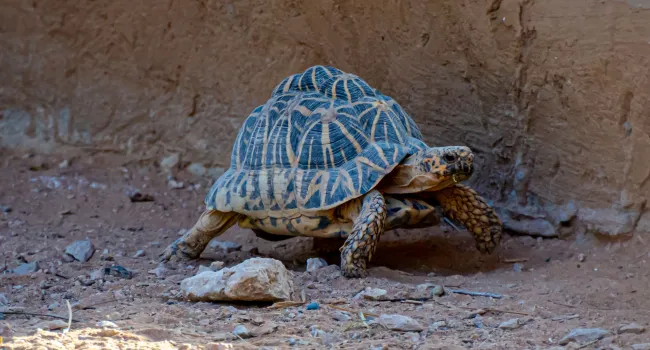
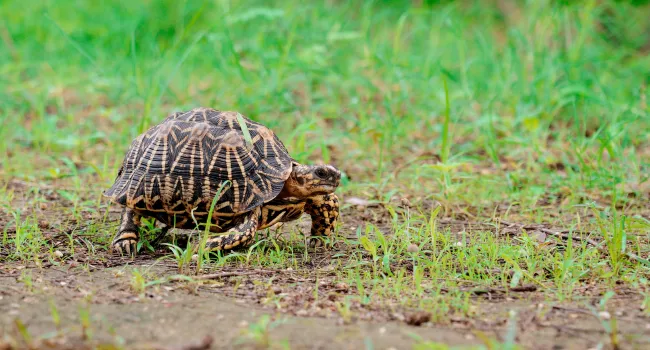
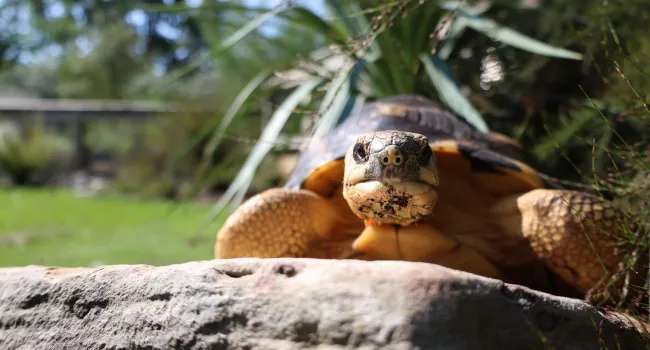
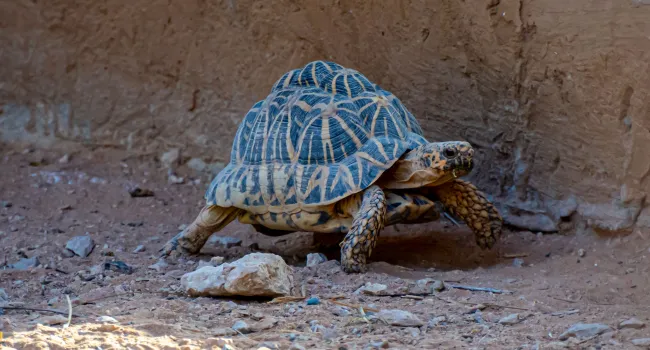
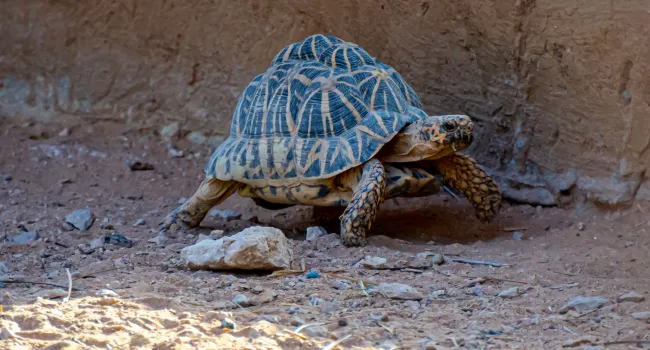
This lesson introduces the youngest students to the idea that an animal's body parts help it survive, using the radiated tortoise's shell and legs as a simple, visual example. Students observe the tortoise's shell pattern, dome shape, and sturdy feet, and connect these features to what the tortoise needs: safety, food, and a place to live. The lesson closes with a simple drawing activity where students label or point to a tortoise body part and its job.
Essential Question
What do animals need to live, and how do their body parts help them get what they need?
Grade(s):
- 2
Recommended Technology:
Device with internet access and a large display for whole-class video viewing, with the ability to pause and replay
Optional: document camera to model the observation chart and Compare Habitats chart
Printed Session 1 and Session 2 student handouts (large print with picture cues), pencils, and crayons or colored pencils
Other Instructional Materials or Notes:
Chart paper for the class "Our South Carolina Habitat" list, revisited during Compare Habitats
One or two teacher-selected photos of Madagascar's spiny forest and of a local South Carolina habitat
Picture cards of tortoise body parts and their jobs for Remediation and English Language Learner support
A real or model tortoise shell, or a close-up photo, for hands-on and visual exploration
Textured surface or raised-line shell template for the Shell Rubbing Craft extension
Teacher note: the standard asks students to observe and compare patterns of diversity across habitats, so keep the focus on comparing (weather, plants, animals, hiding places) rather than memorizing the names of plants and animals in each habitat
Lesson Progression
Lesson Progression
| Time | Segment | What Happens |
| Session 1 (5–7 min) | Before Watching | Habitat warm-up: class lists weather, plants, and animals of a South Carolina habitat, then predicts what a hot, dry habitat animal might be like. |
| Session 1 (3–5 min) | Vocabulary Preview | Introduce habitat, observe, compare, camouflage, reptile, and endangered using photos and gestures. |
| Session 1 (15–18 min) | Viewing | Watch in three chunks; after each chunk, partners fill in their observation chart. |
| Session 1 (3–5 min) | Partner Share | Partners share one observation with the class. |
| Session 2 (8–10 min) | Discussion | Partner and whole-class discussion questions. |
| Session 2 (10 min) | Compare Habitats | Students complete the three-column chart comparing Madagascar and South Carolina habitats. |
| Session 2 (10–12 min) | Assessment | Students complete their Tortoise Fact Page. |
| Optional Session 3 | Extension | Tortoise Number Stories, Shoebox Habitat Model, or Shell Rubbing Craft. |
Vocabulary
- Habitat – the place where an animal lives that has what it needs
- Observe – to look closely and notice details
- Compare – to look at how things are alike and different
- Camouflage – colors or patterns that help an animal blend in with where it lives
- Reptile – an animal with scaly skin that gets its warmth from the sun and its surroundings
- Endangered – there are not many of this animal left, so it needs help to stay safe
Before Watching
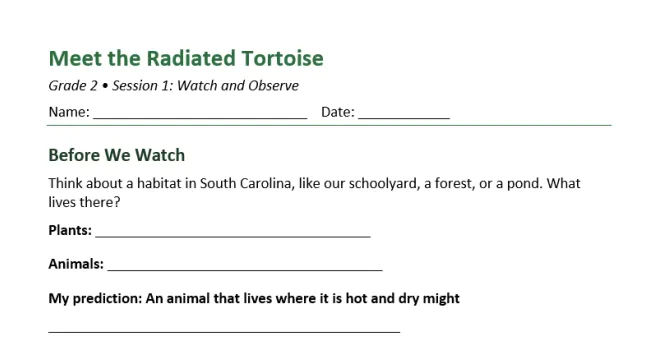
Start with a habitat warm-up. Ask students to think of a habitat they know in South Carolina (the schoolyard, a backyard, a pond, a forest) and make a class list on chart paper titled "Our South Carolina Habitat" with three columns: weather, plants, and animals. Save this chart for the Compare Habitats activity. Then ask: "If an animal lived somewhere very hot and dry, what do you think its body or behavior might be like?" Record two or three predictions to revisit after viewing.
Viewing Guide
The video is about three minutes long and moves quickly, so watch it in three chunks (times are approximate) and pause after each so students can complete their observation chart with a partner.
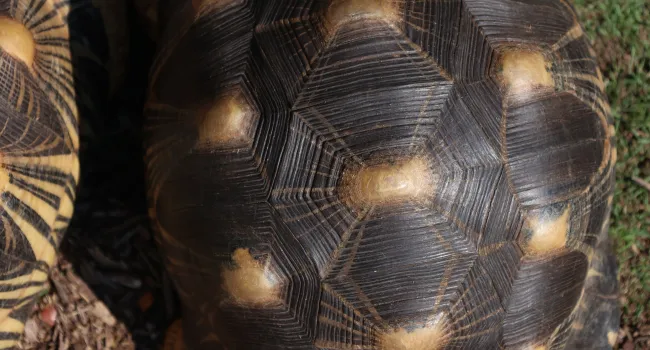
- Chunk 1 (0:00–1:02) — Meet the Tortoise: What do you notice about the lines on the shell? What do the feet and legs look like, and what might they help the tortoise do? Where does the radiated tortoise live?
- Chunk 2 (1:02–1:49) — Weather and Food: What does the tortoise do on a very hot day? What happens when it rains? What does the tortoise eat?
- Chunk 3 (1:49–3:09) — Growing Up and Staying Safe: How many radiated tortoises live at the zoo, and how many hatched there? Why do radiated tortoises need help? Write one "I wonder…" question.
After Watching – Discussion Questions
- What did you notice about the tortoise's shell? How might the pattern help it blend in where it lives?
- How do the tortoise's feet and legs help it move and dig? How are they different from a fish's fins or a duck's webbed feet?
- What did the tortoise do on a very hot day, and why might it do that?
- How is the tortoise's habitat in Madagascar like and different from our South Carolina habitat?
- Why do zoos and people work to protect radiated tortoises? What happens when animals lose their homes or are taken from the wild?
Compare Habitats Activity
Use the class "Our South Carolina Habitat" chart from Before Watching and students' observation charts to complete a three-column Compare Habitats chart: Madagascar (hot, dry spiny forest), Both, and South Carolina habitat. Prompt students to think about weather, plants, animals, and places to hide. Model one row together, then have partners fill in the rest. Show one or two photos of Madagascar's spiny forest and of a local habitat to support students' thinking. Close by asking: "Which habitat would be harder for a radiated tortoise to live in? Why?"
Teacher Notes
Teacher Notes
- This lesson is designed to be taught in two sittings. The video moves quickly for this age, so the chunked viewing with pauses is essential, not optional.
- The Compare Habitats chart is the main evidence of the 2-LS4-1 standard, so make sure every student contributes to it.
- Watch for the misconception that camouflage makes an animal invisible. Reinforce that it makes an animal harder to spot, not impossible to spot.
- Keep language about tortoises and turtles simple: a tortoise is a turtle that lives on land.
- Students will need support writing complete sentences; model the sentence frames aloud before releasing them to write.
Remediation
For students whose Fact Page labels a body part but does not explain its job, or whose habitat comparison describes only one habitat:
- Re-watch the relevant chunk and pause after each key moment, having the student say, "I see ___. It helps the tortoise ___."
- Provide a matching card set (picture of a body part or behavior paired with a picture of its job) for students to sort before they write.
- Offer the sentence frames with a word bank, or let the student dictate the sentences to a teacher or peer scribe.
- Re-do the Compare Habitats chart in a small group using photo cards of each habitat, sorting the cards into "hot and dry" and "green and wet" before filling in the chart.
- Pair the student with a peer who completed the task successfully to explain their thinking aloud.
Differentiation
Struggling Readers / English Language Learners
- Use photo cards and gestures to pre-teach vocabulary (habitat, camouflage, reptile, endangered) before viewing.
- Provide a word bank and sentence frames for the observation chart and Fact Page.
- Encourage partner talk, including in the home language, before writing.
Students with IEPs / 504 Plans
- Pause the video at each chunk break and replay segments as needed for extra processing time.
- Offer a pre-filled observation chart with picture choices to circle, and allow an oral response captured by a teacher or paraprofessional.
- Provide extended time and chunk the Fact Page into one sentence at a time.
Advanced / Gifted Students
- Ask students to add a third body part or behavior with its job, and to write a second habitat comparison.
- Introduce the word "adaptation" (a body part or behavior that helps an animal live in its habitat) and have students find one adaptation on the tortoise.
- Have students write an "I wonder…" research question and find the answer in a book or kid-friendly website.
Extension
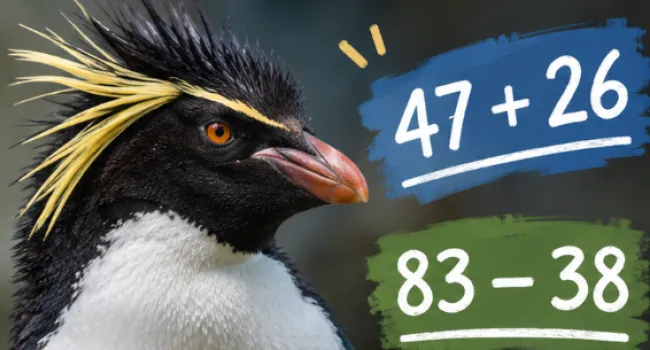
Tortoise Number Stories: Use facts from the video for a math connection. There are 19 radiated tortoises at the zoo, and 14 hatched there. The oldest is about 64 years old and the youngest is 12. Have students write and solve subtraction stories (19 − 14 = 5; 64 − 12 = 52).
Shoebox Habitat Model: Students build a small model of a habitat for a radiated tortoise (shade, plants to eat, a place to hide, a spot to dig) and explain how each part meets the tortoise's needs, practicing modeling.
Shell Rubbing Craft: Using a textured surface or a simple raised-line shell template, have students create a shell "rubbing" with crayons to feel the raised, radiating-line pattern, reinforcing the visual pattern from the video.
Suggested Additional Reading
- Turtles and Tortoises (National Geographic Readers, Level 2) — a photo-rich, early-reader nonfiction book that pairs well with this lesson's focus on body parts and habitat.
- Turtle Splash! Countdown at the Pond by Cathryn Falwell — a read-aloud counting book featuring turtles, good for a lighter follow-up read.
- The Tortoise and the Hare (classic fable, many illustrated editions available) — a familiar story to introduce the tortoise as a character before or after the video.
- Hurry, Little Tortoise, Time for School! by Jean Reidy — a read-aloud picture book featuring a young tortoise.
- Note: preview each title and choose an edition available at your school or local library.
Assessments
Assessment / Check for Understanding
Primary Assessment (Tortoise Fact Page): Students complete a Fact Page with (1) a drawing of a radiated tortoise with at least two labeled body parts, (2) the sentence "The radiated tortoise's ___ helps it ___.", (3) the sentences "Madagascar's habitat has ___." and "A South Carolina habitat has ___.", and (4) the sentence "People can help radiated tortoises by ___."
Scoring Guidance:
| Level | What It Looks Like |
| 3 – Meets | Two accurate body part or behavior pairs with their jobs, one accurate habitat comparison, and one reasonable way people help. |
| 2 – Approaching | One accurate body part or behavior pair OR one accurate habitat comparison; may need a prompt to complete the rest. |
| 1 – Beginning | Labels body parts but does not yet explain what they do or compare the habitats; needs re-teaching with support. |
Formative Check: Use students' observation charts, partner talk during the chunked viewing, and the Compare Habitats chart as ongoing checks for understanding before the Fact Page.