Fishing Cat: Adaptation and Conservation (Grades 6–8)
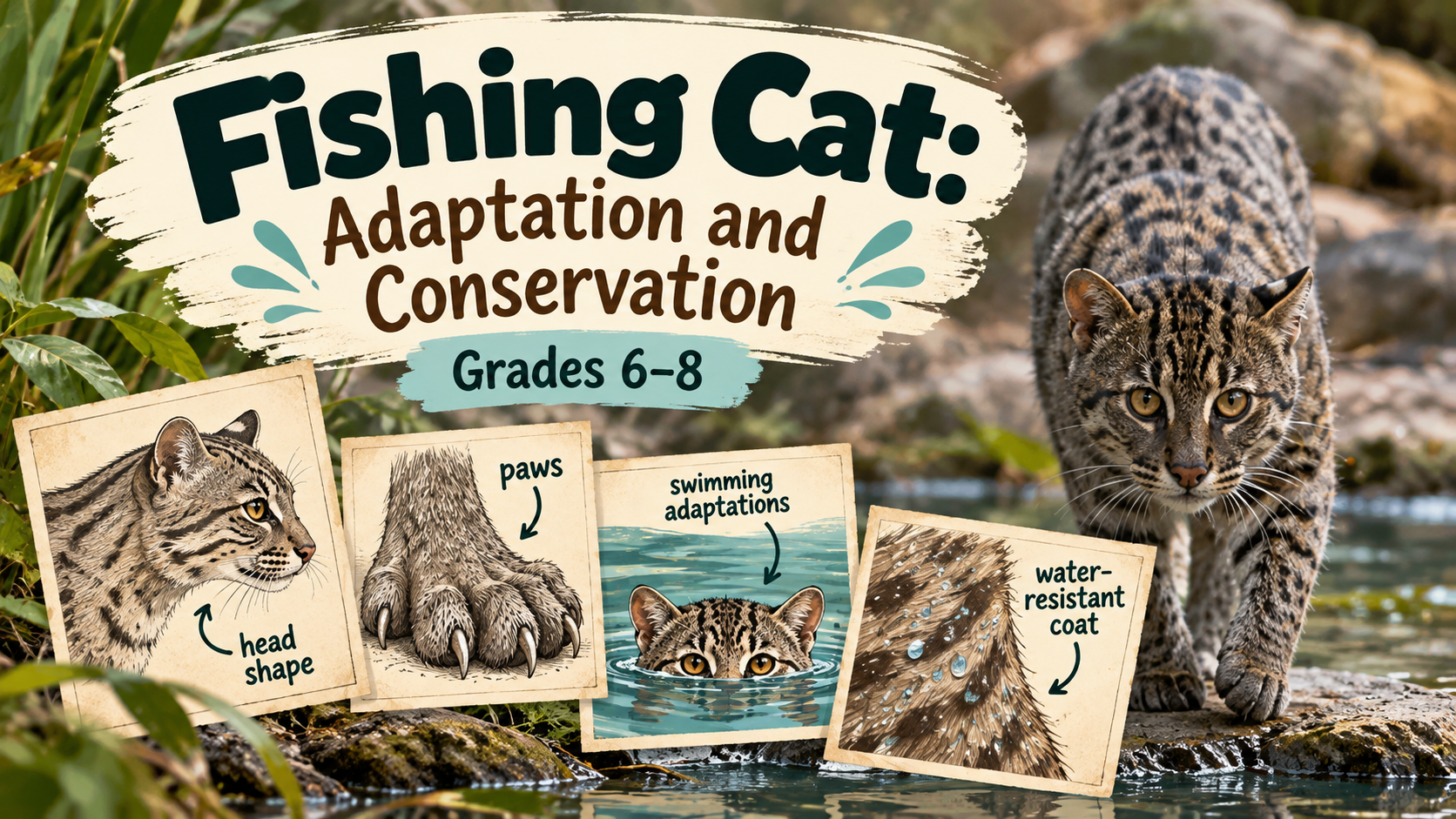
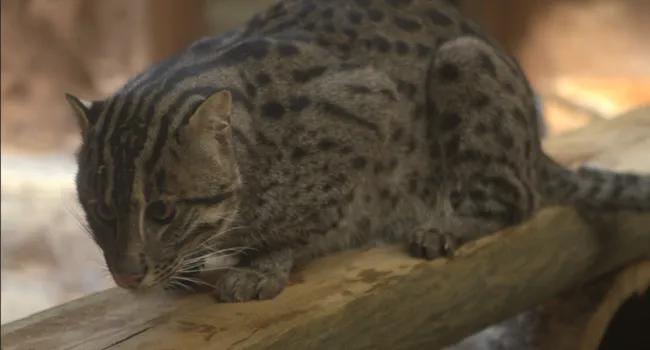
This lesson introduces middle school students to the connection between an organism's physical structures and behaviors and its ability to survive in a specific habitat, using the fishing cat as a case study. Students watch the video to identify structural adaptations (paws, head shape, body), consider whether hunting behavior is learned or instinctive, and learn about the fishing cat's conservation status and the role of zoo breeding programs. Through guided discussion, students connect these observations to core ecosystem concepts such as predator-prey relationships and limiting factors, then apply their understanding in a short Claim-Evidence-Reasoning (CER) writing task. Big Idea: Structural and behavioral adaptations equip the fishing cat for a semi-aquatic niche, and human-managed conservation programs (like the one in Prague) help protect vulnerable species from extinction.
Essential Question
How do an animal's body structures and behaviors help it survive in its specific habitat, and why do some species need extra help from humans to survive?
Grade(s):
- 6
- 7
- 8
Subject(s):
Recommended Technology:
Device with internet access and a large display/projector or SMART board for whole-class video viewing.
Individual or small-group devices (Chromebooks, tablets, laptops) for the Research Guide, since students need internet access to reach the IUCN Red List and zoo conservation program pages.
Speakers/audio capable of being clearly heard throughout the room.
Optional: shared digital doc (Google Doc, Padlet, Jamboard) for recording Before Watching predictions as a class.
Other Instructional Materials or Notes:
Printed or digital copies of the Viewing Guide questions so students can take notes while watching.
CER graphic organizer or sentence starters for students who haven't practiced this writing structure before.
List of pre-approved sources for the Research Guide (IUCN Red List, specific zoo program pages) if you want to control source quality.
Teacher note: this lesson references a real individual animal (Kayuma) and a real, ongoing conservation transfer to Prague — this can be framed as a current, real-world case rather than a hypothetical to increase engagement.
Lesson Progression
| Time | Segment | What Happens |
| 5 min | Before Watching | Students list traits of a house cat, then predict what might differ for a water-hunting cat. Record predictions. |
| 3 min | Vocabulary Preview | Briefly introduce key terms so students recognize them during viewing. |
| 12–15 min | Viewing | Show Fishing Cat: Zoo Minutes. Students complete the Viewing Guide as they watch. |
| 10 min | Discussion | In pairs or small groups, students work through the After Watching discussion questions, then share out briefly. |
| 10 min | Assessment | Students independently write their CER response. |
| Remaining time / Day 2 | Research Guide (if included) | Students select one prompt, gather sources, and prepare a short response. |
| Extension (optional) | 360 Habitat Tour / Design-a-Habitat | Students evaluate the real habitat and/or design their own for a different species. |
Teacher Notes
General Teacher Notes:
The core loop (Before Watching → viewing → discussion → CER) fits comfortably in one period. Treat the Research Guide and Extension as homework or a second-day activity unless working with a longer block schedule.
This lesson assumes some baseline familiarity with "adaptation" and "natural selection" from prior units; briefly check for this before starting.
Emphasize that Kayuma is a real, individual animal and the Prague transfer is an active conservation effort, not a hypothetical — this tends to increase student investment.
Watch for the common misconception that "learned" and "instinctive" behavior are mutually exclusive categories; use the video's specific evidence to show that fishing cat hunting behavior involves both.
If students haven't used the CER format before, model one example response as a class before releasing them to write independently.
Differentiation:
Struggling Readers / English Language Learners
● Pre-teach vocabulary using visuals or short video clips before the lesson begins, rather than relying on definitions alone.
● Provide a graphic organizer for the Viewing Guide (structure → function boxes) instead of open-ended questions.
● Offer sentence starters and a word bank for the CER response (e.g., "I claim that... The video shows... This means that...").
● Pair with a partner for the Research Guide, and allow responses to be given verbally and recorded by the teacher or a peer.
Students with IEPs / 504 Plans
● Allow the video to be paused at key moments (when paws or head shape are shown) to give extra processing time.
● Provide extended time for the CER writing task, or allow a verbal response captured by a paraprofessional.
● Offer a simplified CER sentence frame with blanks for claim, evidence, and reasoning rather than an open-response format.
● Provide preferential seating near the screen and speakers, and consider noise-reducing headphones if needed.
Advanced / Gifted Students
● Require two Research Guide prompts instead of one, with a comparison across sources.
● Push discussion further by asking students to explicitly describe the full natural selection sequence: genetic variation → survival/reproductive advantage → increased trait frequency over generations.
● Offer an independent extension: research a real AZA or EAZA studbook and summarize how genetic management decisions are made.
Extension:
360 Habitat Tour Evaluation
Use the Fishing Cat 360 Habitat Tour to have students identify three features of the zoo habitat that match what fishing cats need in the wild (water access, cover/shade, hunting space).
Design-a-Habitat Challenge
Have students sketch or describe a hypothetical zoo habitat for a different semi-aquatic species of their choice (otter, platypus, beaver, etc.), justifying at least three design features based on that species' structural and behavioral needs. This reinforces the structure-function concept by having students apply it to a new organism rather than just recalling it from the video.
Standards
- 7-LS2-1. Analyze and interpret data to provide evidence for the effects of resource availability on organisms and populations of organisms in an ecosystem
- 7-LS2-2 Construct an explanation that predicts patterns of interactions among organisms across multiple ecosystems.
- 7-LS2-4 Construct an argument supported by empirical evidence that changes to physical or biological components of an ecosystem affect populations.
- 7-LS2-5 Evaluate competing design solutions for maintaining biodiversity and ecosystem services.
- 7-ESS3-3 Apply scientific principles to design a method for monitoring and minimizing a human impact on the environment.
- 8-LS1-4 Use arguments, based on empirical evidence and scientific reasoning, to support an explanation for how characteristic animal behaviors and specialized plant structures affect the probability of successful reproduction of animals and plants respectively.
Assessments
Primary Assessment (CER Response): Have students write a short Claim-Evidence-Reasoning response to the prompt: "The fishing cat's paws are an adaptation for its hunting niche." Students state a claim, cite specific video evidence, and explain the reasoning connecting structure to function.
Scoring Guidance: Look for a specific, accurate structure-to-function connection supported by evidence from the video (e.g., "webbed paws increase surface area against water, giving the cat more control and propulsion while hunting") rather than a general or unsupported statement (e.g., "the paws help it swim").
Formative Check: Use completed Viewing Guides and small-group discussion participation as an informal, ongoing check for understanding before students begin the CER task.