Comparing Two Amazing Penguins (Grades 3 - 5)
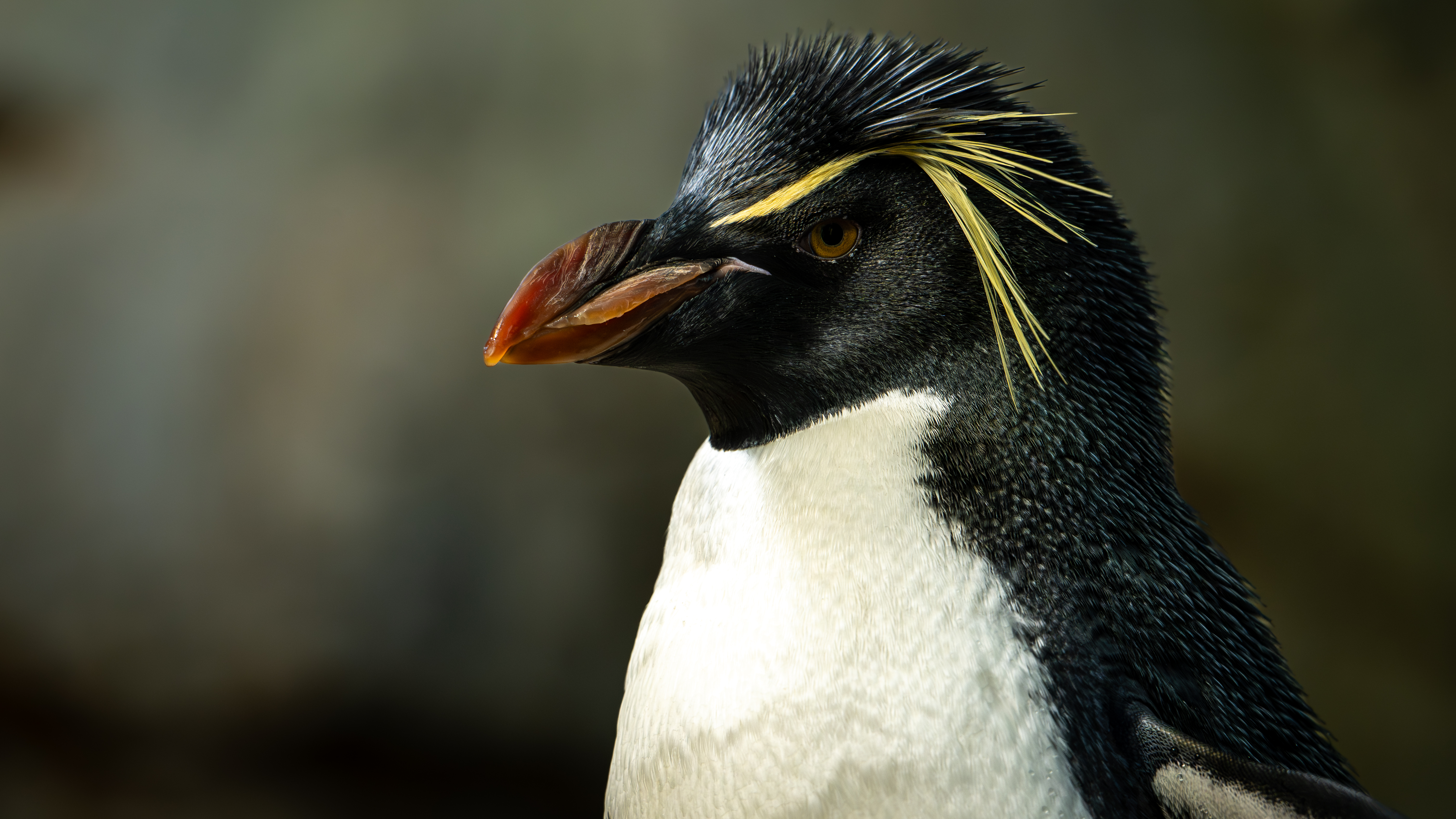
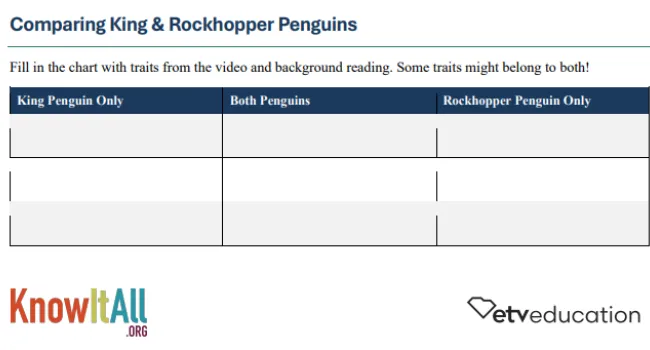
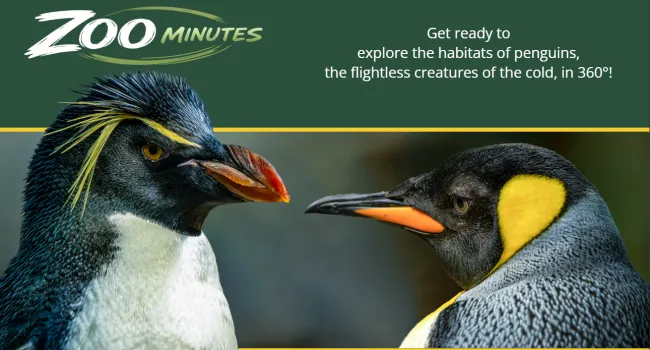
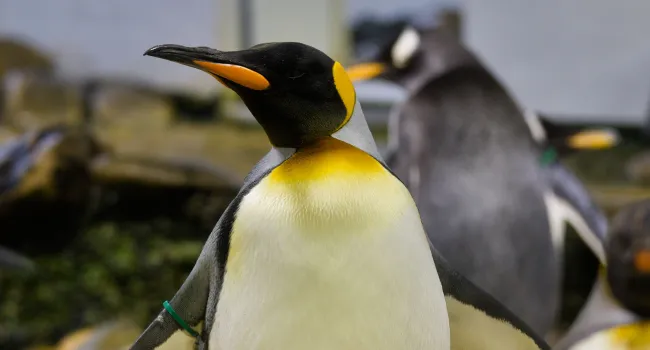
In this lesson, grades 3–5 students investigate how King and Rockhopper penguins' different traits each help them survive in a shared, sub-Antarctic environment. Students begin with a prediction about what makes a cold, rocky, ocean habitat challenging, then watch a short video of both species at Riverbanks Zoo and complete a guided observation log, recording specific behaviors and which species performed them. Working in pairs, students then compare the two species' structural and behavioral traits in a comparison chart or Venn diagram, and use that evidence to answer grade-tiered questions connecting traits to survival, habitat fit, and — for grade 5 — a simple food web. The lesson closes with students explaining which penguin species they would rather be and why, using evidence from the video. The lesson fits a single 40–45 minute class period and requires no materials beyond the video and student packet.
Essential Question
How do a King penguin and a Rockhopper penguin's different traits each help them survive in a shared environment?
Grade(s):
- 3
- 4
- 5
Subject(s):
Recommended Technology:
- A way to play the video with sound for the whole class (interactive whiteboard, projector with speakers, or classroom TV).
- One device per student or pair (Chromebook, tablet, etc.), only needed if distributing the student packet digitally through a platform such as Google Classroom or Seesaw.
- Internet access, only needed if extending the lesson with the optional third-species research project or a digital read-aloud pairing.
Other Instructional Materials or Notes:
- One printed or digital copy of the student packet per student.
- Pencils or pens for written responses; colored pencils if students want to illustrate the Venn diagram.
- Teacher note: preview the video once before class to plan pause points between segments.
- Optional: a nonfiction penguin book at students' reading level, if pairing with the read-aloud extension.
Lesson Progression
Detailed Timeline
| Time | Segment | What Happens |
|---|---|---|
| 5 min | Warm-Up | Turn and talk: "What might be hard about living somewhere very cold, rocky, and close to the ocean?" |
| 10–15 min | Watch & Observe | Play the video. Students complete the video observation log, recording specific behaviors and which species did them. |
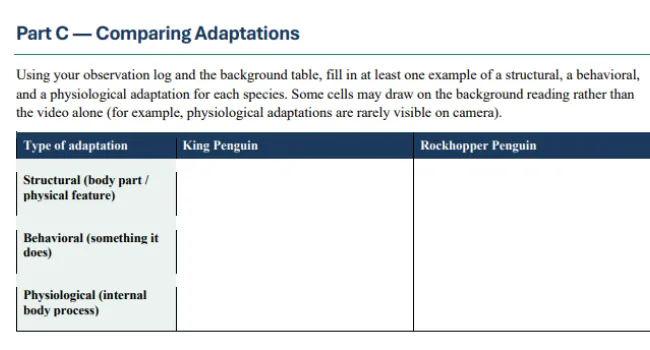
| 10–15 min | Compare | In pairs, students complete a King vs. Rockhopper comparison chart (or Venn diagram), then answer grade-tiered short-response questions. |
| 5 min | Closing | "If you were a penguin, would you rather be a King or a Rockhopper? Explain one reason using evidence from the video." |
Teacher Notes
- Preview the video before class. It's written for a general audience, so when a term above grade level comes up (e.g., osmoregulation, nictitating membrane), pause and restate it in simpler words — students don't need to memorize the exact term.
- The video moves through several distinct segments (species introduction, swimming adaptations, colony communication, behind-the-scenes care, life cycle, conservation). Consider pausing briefly between segments, especially for Grade 3, to check understanding before moving on.
- Model the comparison chart once as a class before students try it independently or in pairs — this is especially helpful for Grade 3.
- The short-answer questions are grade-tiered (3rd/4th/5th). Assign only the tier that matches your class, or let students attempt all three to differentiate by choice.
- This is a formative, discussion-based activity rather than a graded assessment. Circulating during the observation log and comparison chart helps catch misconceptions early.
This lesson can be taught as a standalone unit. It does not require the Grades K–2 version as a prerequisite.
Differentiation
- English Language Learners: Provide a visual vocabulary card set; allow the observation log to be completed in short phrases; pair with a bilingual peer.
- Struggling Students: Provide a partially completed comparison chart as a scaffold; reduce to the grade-level question set most relevant to your class.
- Students with IEPs/504 Plans: Follow all plan accommodations; break the activity into shorter, separately timed segments; offer a graphic organizer version of the comparison chart.
- Advanced Students: Research a third penguin species and add it to the comparison chart; write a short "penguin fact file" paragraph using evidence from the video.
Remediation
For students who need more support meeting the objectives:
- Provide a partially completed comparison chart with 1–2 examples already filled in as a scaffold.
- Reduce the comparison chart to 2–3 traits instead of the full set, and assign only the question tier most relevant to the student's level.
- Provide sentence starters for the short-answer questions (e.g., "This trait helps the penguin ___ because ___.").
- Pre-teach key vocabulary using pictures or short clips before watching the full video.
- Allow verbal or small-group responses instead of independent written responses.
- Re-watch a short clip focused on one behavior before asking the student to complete that part of the chart.
- Pair with a stronger reader/writer for the observation log and comparison chart.
Optional Extensions
- In-person or virtual field trip to Riverbanks Zoo's penguin habitat for extended, live observation.
- Research project: assign a third penguin species and add it to the comparison chart, then present findings to the class.
- Read-aloud pairing: pair the video with a nonfiction penguin book at students' reading level.
- Conservation connection: discuss one challenge named in the video's closing narration (habitat loss, pollution, changing ocean conditions, declining food sources) and brainstorm ways people can help.
Penguin Research Guide K-2
This Penguin Research guide is for K-2 students as they explore Penguins and their habitat.
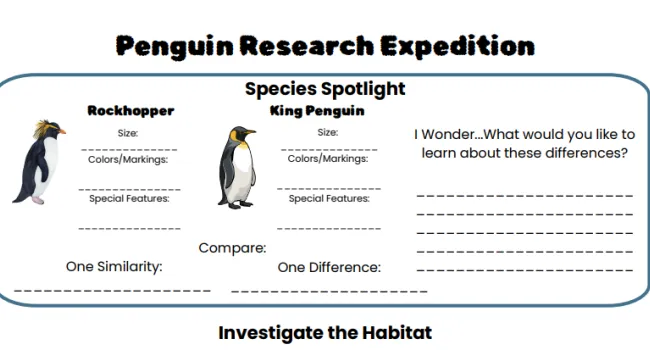
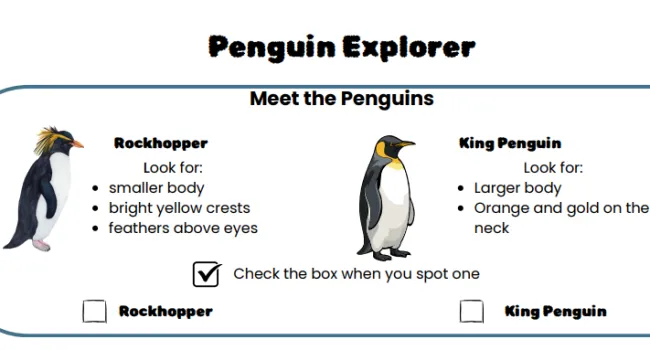
View AssetPenguin Research Guide 3-5
This penguin research guide is intended for grades 3-5 to use while exploring penguins and their habitats.
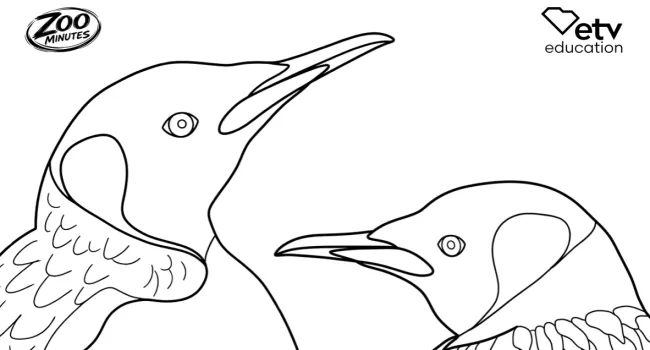
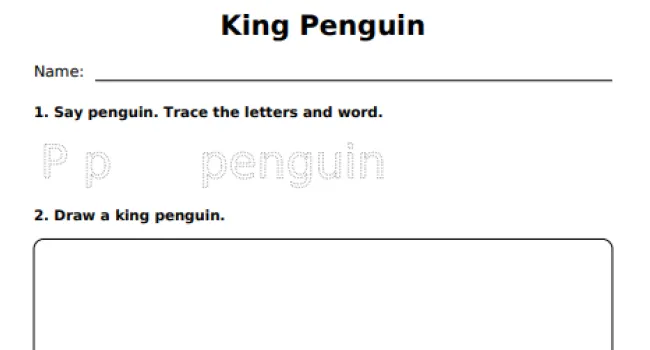
View AssetKing Penguin Coloring Sheet
Color a king penguin and discover a fun fact about one of the world’s largest penguin species, which can stand about 3 feet tall.
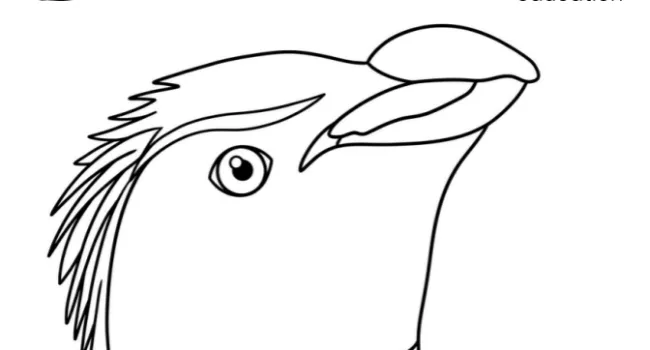
View AssetRockhopper Penguin Coloring Sheet
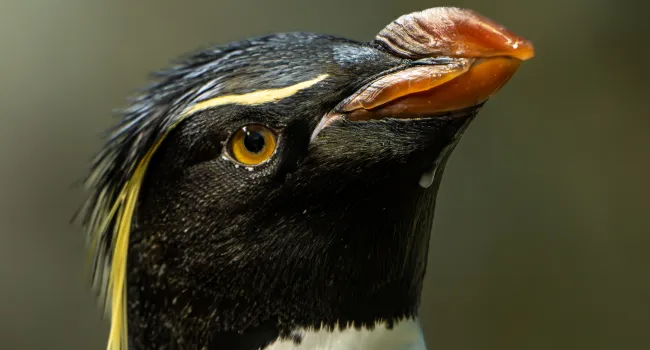
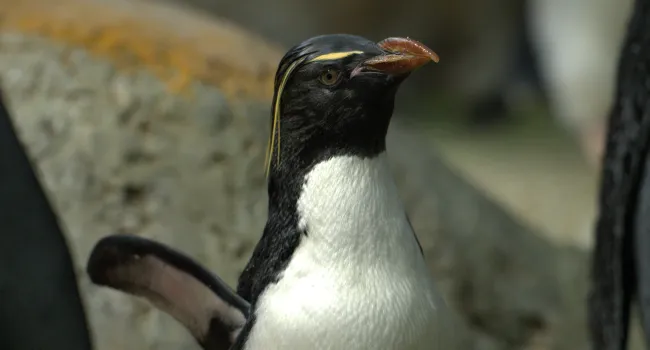
Color a southern rockhopper penguin and learn a fun fact about these energetic birds, including how they hop across rocky terrain with both feet together.
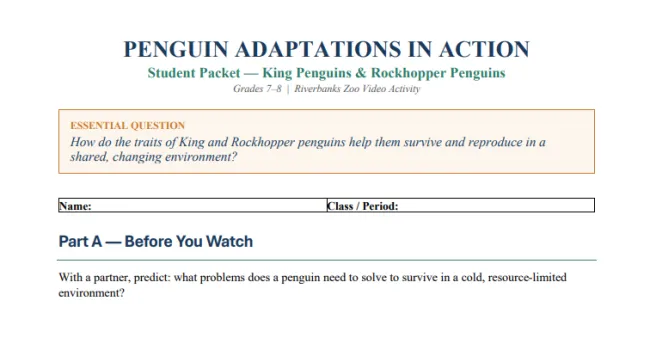
View AssetComparing Two Amazing Penguins Handout (Grades 3-5)
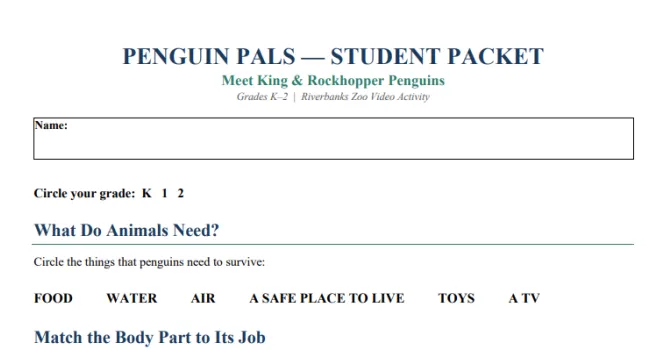
This student handout goes with the "Comparing Two Amazing Penguins (Grades 3-5)" lesson.
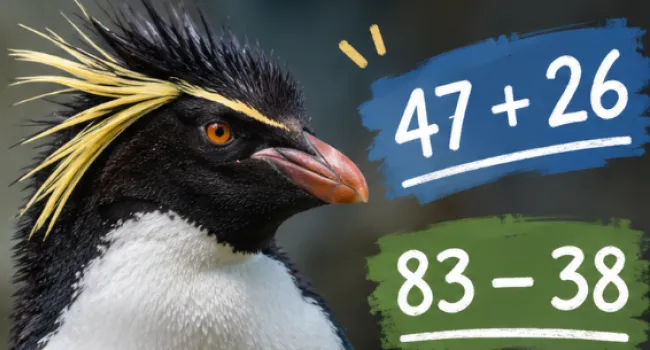
View AssetPenguin Math: Double-Digit Addition & Subtraction
Students take on the role of zookeepers at the Penguin Coast exhibit inside the Birdhouse at Riverbanks Zoo & Garden in Columbia, SC. Using place value strategies and base-ten blocks, students solve...
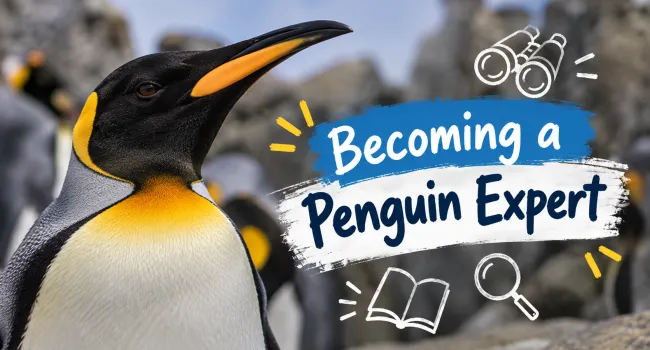
View LessonBecoming a Penguin Expert
Students read informational texts and articles about penguins. While identifying key details and new vocabulary, students gather facts about penguins. Students will share their new learning and...
View LessonPenguin Pals - Meet King & Rockhopper Penguins (K-1)
In this lesson, K–1 students investigate how a penguin's body helps it live in a cold, ocean-side home. Students begin by naming what all animals need to survive, then watch a short video of King and...
View LessonStandards
- 3-LS4-2. Use evidence to construct an explanation for how the variations in traits among individuals of the same species may provide advantages in surviving and producing offspring.
- 3-LS4-3. Construct an argument with evidence that in a particular habitat some organisms can thrive, struggle to survive, or fail to survive.
- 3-LS3-1. Analyze and interpret data to provide evidence that plants and animals have inherited traits that vary within a group of similar organisms.
- 4-LS1-1. Construct an argument that plants and animals have internal and external structures that function together in a system to support survival, growth, behavior, and reproduction.
- 5-LS2 Ecosystems: Interactions, Energy, and Dynamics
Assessments
Assessment
Use the checkpoints below as formative checks throughout the lesson. The grade-tiered questions and closing reflection can also be collected as a light summative check if desired.
- Observation log check: Can students record at least 5 specific behaviors and correctly identify which species did them?
- Comparison chart check: Can students identify at least 2–3 accurate structural or behavioral differences between the two species?
- Grade-tiered question check: Does the student's answer connect a specific trait to a survival benefit, using evidence from the video?
- Closing reflection check: Can students state a preference and support it with at least one piece of evidence from the video?
Simple 3-point look-for scale you can use informally while circulating:
| Level | What You'll See |
|---|---|
| Meets expectations | Records several accurate behaviors, completes the comparison chart correctly, and connects a trait to survival with evidence. |
| Approaching expectations | Participates with some support; comparison chart is partially accurate; needs prompting to connect a trait to survival. |
| Needs support | Requires significant prompting throughout; benefits from the Remediation strategies below. |