Penguin Behavior & Adaptations (Grades 9-12)
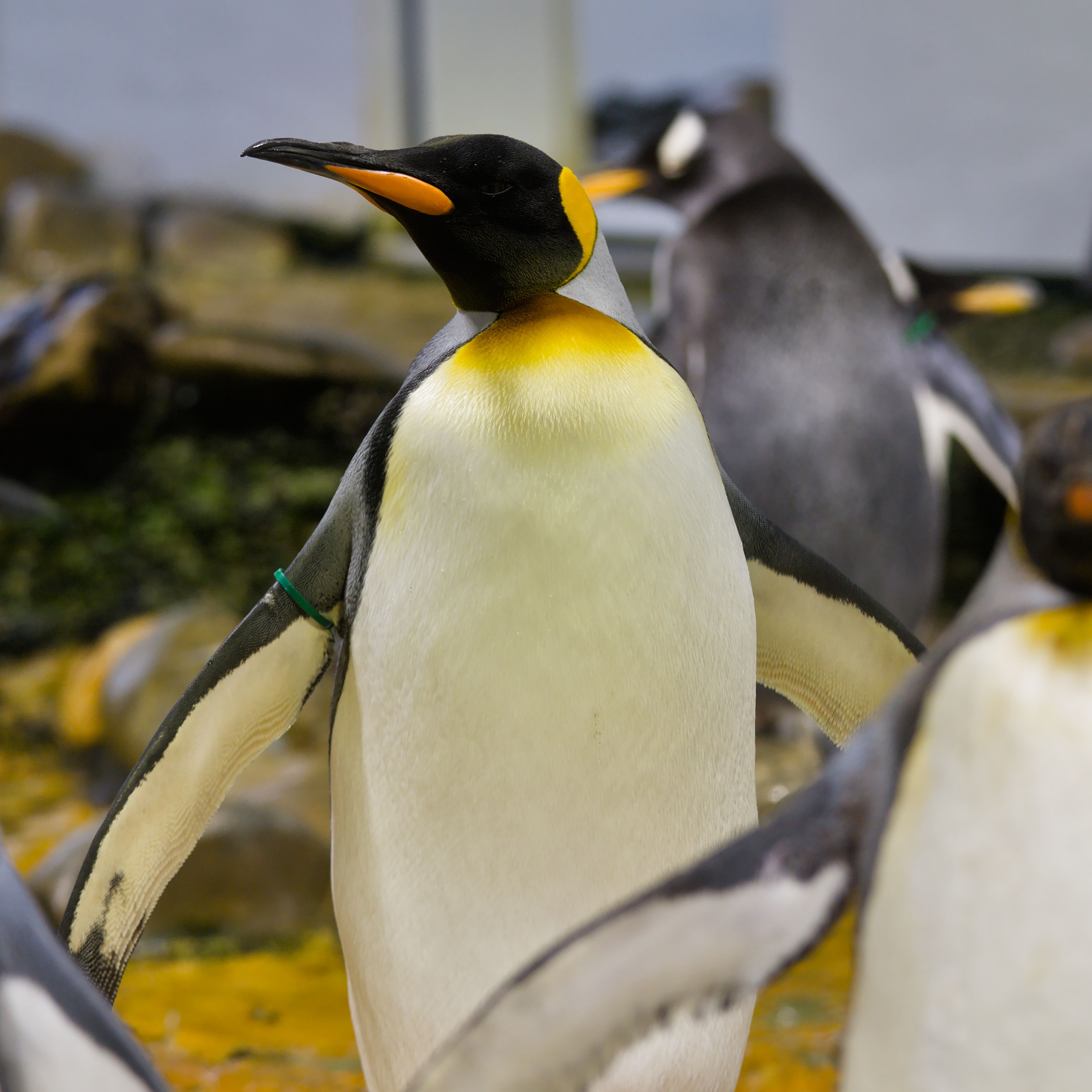
In this lesson, high school Biology students investigate how King and Rockhopper penguins have evolved different strategies for surviving in the same sub-antarctic environment. Students begin by predicting the physical challenges a cold, ocean-facing habitat poses, then watch a short video of both species in their habitat at Riverbanks Zoo, recording specific behaviors — such as diving, entering the water, moving across land, and communicating within the colony — in a guided observation log. Working in pairs, students compare what they observed against background information on each species to identify structural, behavioral, and physiological adaptations, then use that evidence to reason through a set of standards-aligned questions covering natural selection, group behavior, carrying capacity, and human impact on biodiversity. The lesson closes with a short written reflection connecting one observed adaptation to the survival advantage it provides. A Biology 2 extension asks students to reason further with evidence about population trends, proposing and evaluating hypotheses for why two closely related species sharing an environment might be experiencing very different outcomes. The lesson fits a single 50–90 minute class period and requires no materials beyond the video and student packet.
Essential Question
Why do two penguin species living in the same environment move, communicate, and survive in such different ways — and what does that tell us about how adaptations evolve?
Grade(s):
- 9
- 10
- 11
- 12
Subject(s):
Recommended Technology:
- A way to project the video with sound for the whole class (interactive whiteboard, projector with speakers, or classroom TV).
- One device per student or pair (Chromebook, tablet, etc.), only needed if distributing the student packet digitally through a platform such as Google Classroom or Canvas.
- Spreadsheet software (Google Sheets or Excel) or a graphing calculator, only needed if using the optional real-data graphing connection in the Biology 2 extension.
- Internet access, only needed if extending the Biology 2 section with published seabird population datasets or having students research the third species housed at Penguin Coast (African penguin).
Other Instructional Materials or Notes:
- One printed or digital copy of the student packet per student.
- Pencils or pens for written responses.
- Teacher note: preview the video once before class to identify natural pause points (species introduction, adaptations for swimming, colony communication, behind-the-scenes care, life cycle, conservation close) in case you'd like to pause for discussion between segments rather than showing it straight through.
- Teacher note: the Biology 2 extension can be moved to a second class period or assigned as homework if class time is limited.
- Optional: pair this lesson with an in-person or virtual visit to Riverbanks Zoo's penguin habitat for extended, live observation.
Lesson Progression
Learning Objectives
By the end of this lesson, students will be able to:
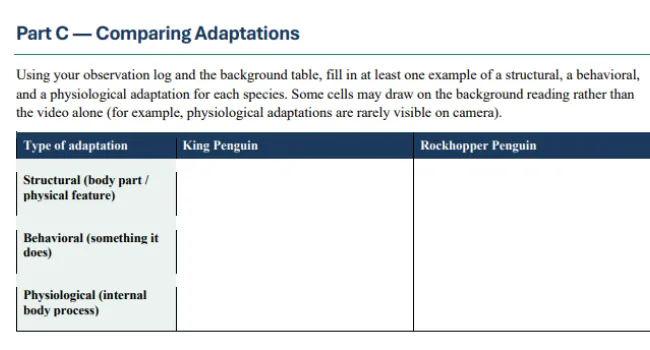
- Describe structural, behavioral, and physiological adaptations of King and Rockhopper penguins observed in the video.
- Explain how specific adaptations increase an individual's chance of survival and reproduction in a cold, marine environment (natural selection).
- Evaluate the evidence for how group behaviors, such as vocal and body-language communication within a colony, affect survival and reproductive success.
- Connect penguin habitat needs to the concept of carrying capacity and discuss how environmental change and human activity can affect polar and sub-antarctic species.
Suggested lesson progression for a single class period. Times are approximate and can be compressed or stretched to fit a 50–90 minute block; the Biology 2 extension (Part D) can be run in class or assigned as homework.
| Time | Segment | What Happens |
|---|---|---|
| 5 min | Warm-Up (Part A) | Students predict, in pairs, what problems a penguin must solve to survive in a cold, ocean-facing environment before watching the video. |
| 15 min | Watch & Observe (Part B) | Play the Riverbanks Penguin Coast video. Students complete the video observation log individually, noting at least 6 specific behaviors. |
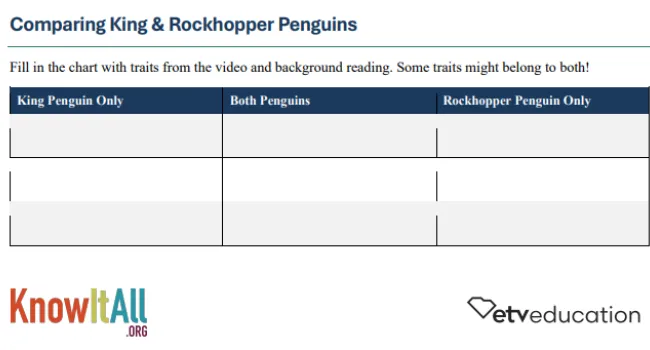
| 15 min | Compare Adaptations (Part C — chart) | In pairs or small groups, students complete the structural / behavioral / physiological adaptations chart for King and Rockhopper penguins. |
| 15 min | Analysis Questions (Part C — Q1–5) | Students answer the five standards-tagged questions individually or in groups; teacher selects 1–2 to discuss as a whole class. |
| 5–10 min | Wrap-Up / Exit Ticket (Part E) | Students respond individually to the exit-ticket prompt and turn it in as a quick formative check. |
| +15–20 min (optional) | Biology 2 Extension (Part D) | Assign in class to Biology 2 sections, or as homework/enrichment for advanced Biology 1 students; includes an optional real-data graphing connection. |
Teacher Notes
King and Rockhopper penguins are both found on sub-antarctic islands, but they have taken very different evolutionary paths to solve the same basic problems: staying warm, avoiding predators, finding food, and raising a chick. The accompanying video follows both species at Riverbanks Zoo & Garden through several segments — introducing the colony, examining physical adaptations for swimming and diving, showing how keepers read penguin communication, going behind the scenes with daily care, covering each species' distinct nesting and molting cycle, and closing with the conservation challenges facing penguins worldwide. The table below can be shared with students as background reading or projected for a quick class discussion before the video; most rows describe what is directly shown or narrated in the video.
| Trait | King Penguin (Aptenodytes patagonicus) | Southern Rockhopper Penguin (Eudyptes chrysocome) |
|---|---|---|
| Size | Second-largest penguin species; stands roughly 3 feet tall | One of the smallest crested penguin species; stands about 18–22 inches tall |
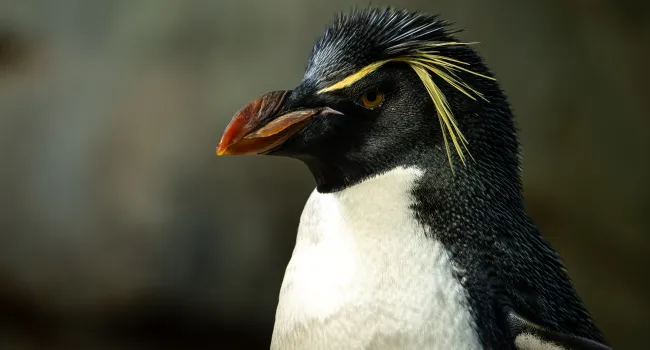
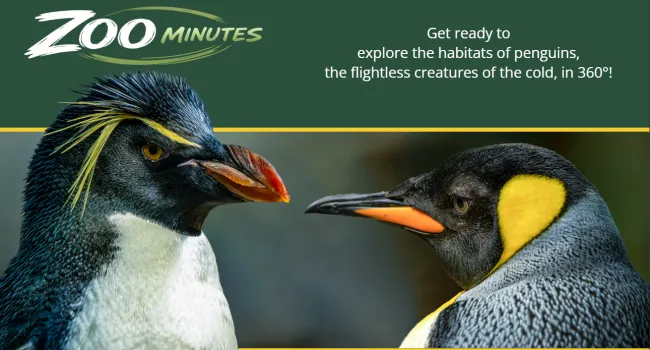
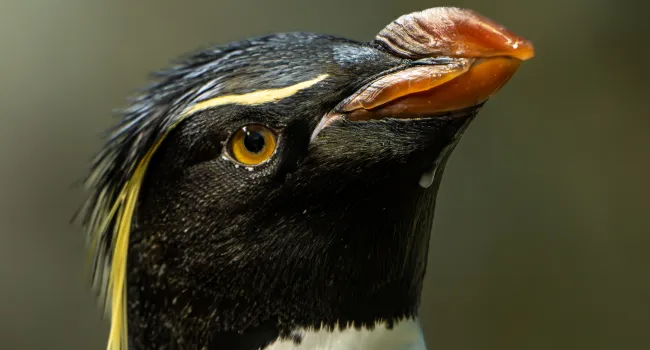
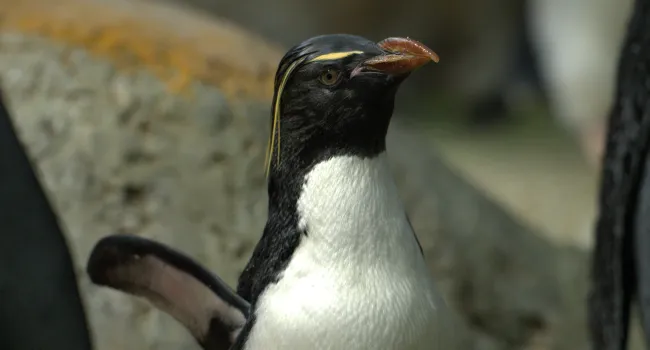
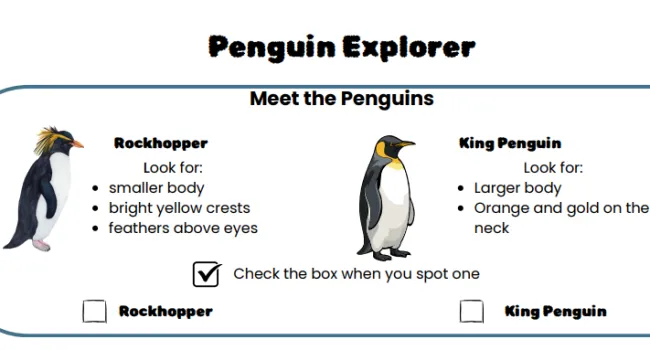
| Key field marks | Bold orange and gold feathers along the neck | Bright yellow feather crests above the eyes |
| Movement on land & water entry | Walks with a slow, dignified waddle (about 2 mph); can toboggan — sliding on its belly across snow and ice; dives to forage using solid, dense bones (rather than the hollow bones of most birds) that help it sink instead of float | Hops from rock to rock with both feet together instead of waddling; the only penguin species known to leap feet-first into the water; can dive more than 100 meters beneath the surface |
| Camouflage coloring | Countershading — a dark back and light belly that help it blend into the water, whether seen from above or below | Shares the same countershading coloring described for the King penguin in the video |
| Nesting strategy | Builds no nest — balances a single egg on top of its feet under a warm fold of skin for nearly two months | Builds a nest from grasses and stones; both parents share the job of incubating the eggs |
| Special senses & body care | Insulated by a layer of fat and tightly packed feathers with trapped air pockets; a nictitating membrane ("third eyelid") protects the eyes underwater; salt glands above the eyes remove excess salt from seawater | Shares the same insulation, third-eyelid, and salt-gland adaptations described for the King penguin in the video |
| Communication | Each bird has its own unique vocal call; body language — posture, walking, and neck stretches — also communicates how a bird is feeling | Same vocal and body-language communication described for the King penguin in the video |
| Molting | Undergoes a yearly "catastrophic molt," replacing nearly all its feathers over about two weeks while remaining on land | Undergoes the same yearly catastrophic molt described for the King penguin in the video |
| Habitat | Sub-antarctic islands surrounding Antarctica (e.g., South Georgia, Crozet, Falklands) | Rocky, wave-battered sub-antarctic and cool-temperate islands (e.g., Falklands, southern South America) |
| At Riverbanks | Housed with Rockhopper penguins in a habitat kept at about 45°F, in nearly 25,000 gallons of fresh water | Housed with King penguins in a habitat kept at about 45°F, in nearly 25,000 gallons of fresh water |
Differentiation
Struggling Students
- Pre-teach the Key Vocabulary list before watching, and pause the video briefly at each new term (e.g., when countershading or the nictitating membrane is shown) to point it out directly.
- Provide a partially completed adaptations chart (Part C) with one example already filled in per category as a scaffold.
- Allow short bullet-point responses instead of full paragraphs for the analysis questions and exit ticket.
- Pair with a stronger reader/writer for Parts B and C, and consider narrowing Part C to 3 of the 5 analysis questions.
English Language Learners
- Preview the Key Vocabulary list with visuals or home-language definitions before the video, and turn on captions/subtitles if available.
- Provide sentence starters for the analysis questions and exit ticket (e.g., "This is a ___ adaptation because ___.").
- Allow the observation log to be completed with short phrases or labeled sketches instead of full sentences.
- Pair with a bilingual peer, or provide access to a translation tool for the background reading table.
Students with IEPs / 504 Plans
- Follow all accommodations specified in the student's plan (extended time, preferential seating, chunked directions, etc.).
- Break Parts B and C into smaller, separately timed segments rather than one continuous block.
- Offer a graphic organizer or checklist version of the adaptations chart in place of the open table.
- Offer a choice of response format — written, typed, or verbal/recorded — for the analysis questions and exit ticket.
- Preview the video's segment titles ahead of time so students know what to expect and when.
Advanced / Honors / AP Biology Students
- Assign the full Biology 2 extension (Part D) as core work rather than optional enrichment.
- Have students look up real IUCN population-status data for King and Rockhopper penguins and cite an actual source in their Question 6 response.
- Ask students to write a full research question and hypothesis — including independent and dependent variables — for the field-monitoring plan in Question 7.
- Extend Question 2 by having students research a third sub-antarctic seabird species and evaluate whether it competes with, or avoids competing with, King and Rockhopper penguins for resources.
Optional Extension(s)
- In-person or virtual field trip: Visit Riverbanks Zoo's penguin habitat (or a livestream, if available) for extended, live observation, and compare real-time behavior to what students saw in the video.
- Cross-species research project: Assign small groups a third penguin species (e.g., African, Emperor, Adélie) to research and add as a new column to the Part C comparison chart, then present findings to the class.
- Data analysis extension: Provide (or have students locate) published seabird population datasets, graph King vs. Rockhopper population trends over the last 20–30 years, and write a claim-evidence-reasoning paragraph explaining the pattern.
- Genetics connection: Research how feather coloration or crest-feather traits are inherited, linking this lesson to a genetics unit.
- Conservation action project: Have students design and pitch a real conservation action — such as a school fundraiser or awareness campaign — addressing one of the four threats named in the video's closing narration.
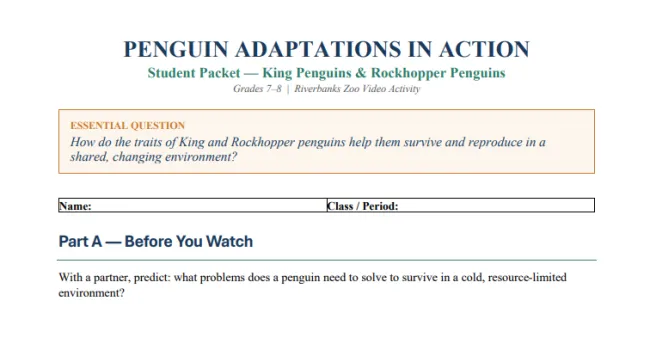
Penguin Behavior & Adaptations (9-12) - Student Packet
A video-companion worksheet for high school Biology students, pairing with a Riverbanks Zoo video of King and Rockhopper penguins. Students complete a guided video observation log, compare structural...
View AssetPenguin | Zoo Minutes
Get to know the king and southern rockhopper penguins at Riverbanks Zoo and Garden. Discover the adaptations, behaviors and animal care that help these remarkable birds thrive on land and in the water...
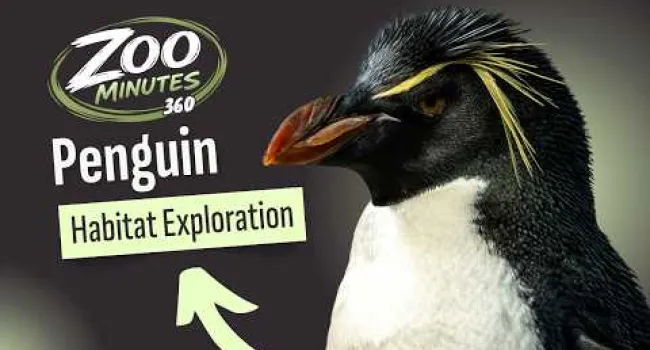
View AssetPenguin 360° | Zoo Minutes 360
Get a new perspective on penguins with a 360-degree look inside their habitat. See king and southern rockhopper penguins up close while exploring the spaces where they swim, rest and receive care...
View AssetStandards
- B-LS4-4. Construct an explanation based on evidence for how natural selection leads to adaptation of populations
- B-LS4-2 Construct an explanation based on evidence that the process of evolution primarily results from four factors: (1) the potential for a species to increase in number, (2) the heritable genetic variation of individuals in a species due to mutation and sexual reproduction, (3) competition for limited resources, and (4) the proliferation of those organisms that are better able to survive and reproduce in the environment.
- B-LS2-1. Use mathematical and/or computational representations to support explanations of biotic and abiotic factors that affect carrying capacity of ecosystems at different scales.
- B-LS2-8 Evaluate evidence for the role of group behavior on individual and species chances to survive and reproduce.
- B-LS2-6. Evaluate claims, evidence, and reasoning that the complex interactions in ecosystems maintain relatively consistent numbers and types of organisms in stable conditions but changing conditions may result in a new ecosystem.
- B-LS2-7 Design, evaluate, and refine a solution for reducing the impacts of human activities on biodiversity and ecosystem health.
Assessments
Please use the "Penguin Behavior & Adaptations (9-12) - Student Packet" linked in the Resources section.