Fishing Cat: Who Eats Whom? Food Chain Lesson Plan (Grades K–2)
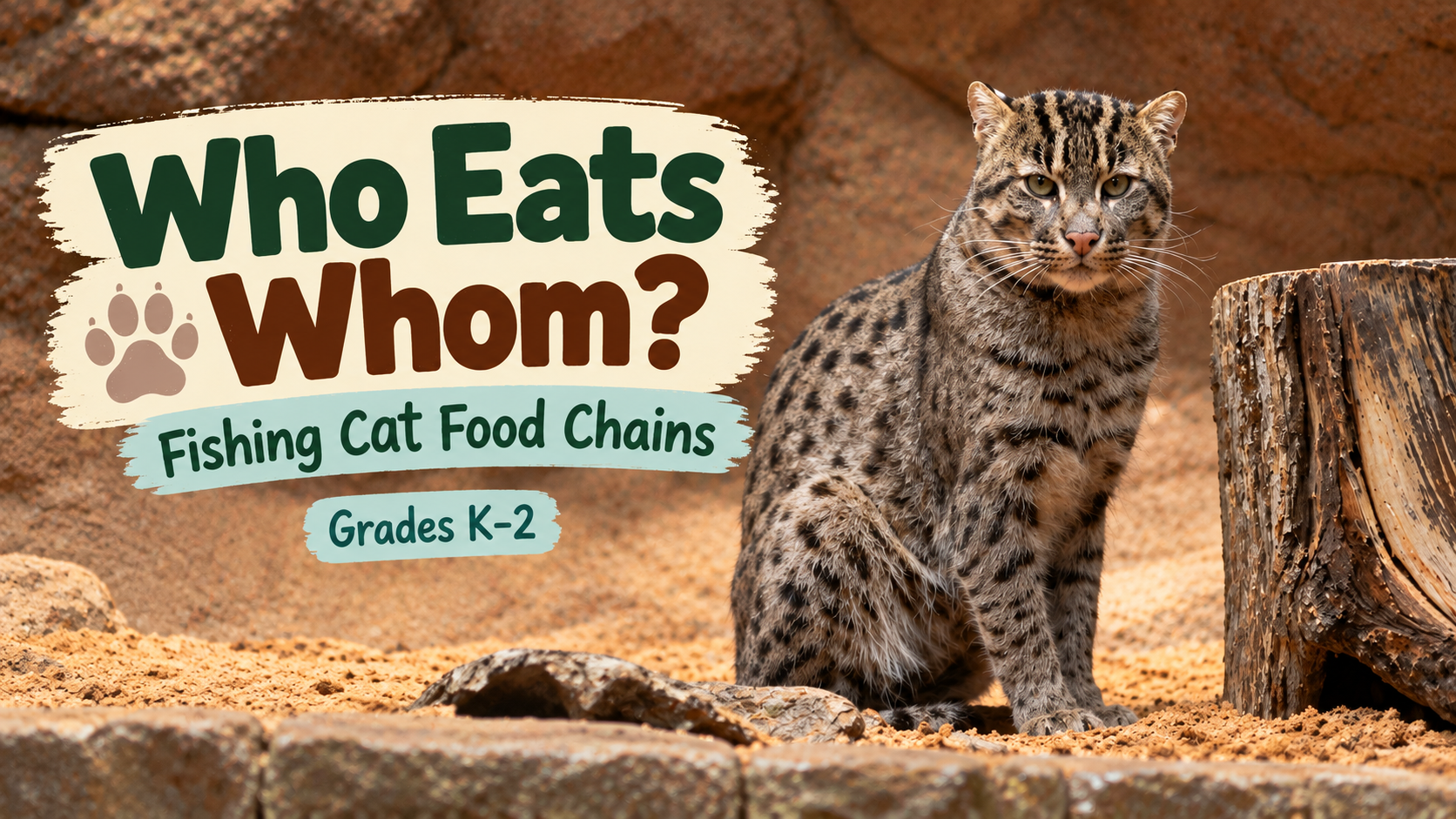
This lesson uses the fishing cat to introduce the idea that living things get what they need from other living things, and that the chain of "who eats whom" starts with the sun and plants. Students begin by thinking about where their own food comes from, then watch the video to find out what the fishing cat eats and how it catches its food. They then become the food chain themselves by passing a piece of yarn from student to student to show energy moving from the sun to the plant to the fish to the cat. In partners, they put picture cards in order and add arrows. The lesson closes with a short exit ticket that can be answered by speaking, pointing, drawing, or completing a sentence.
Essential Question
Who eats whom in the fishing cat's home?
Grade(s):
- Kindergarten
- 1
- 2
Recommended Technology:
- Device with internet access and a large display or SMART board for whole-class viewing.
- Speakers/audio for clear playback.
- Optional: document camera to show the card sequence to the whole class.
- For the 360 Habitat Tour Extension, a display large enough for the whole class to see.
Other Instructional Materials or Notes:
- Printable cards: (picture cards, Be the Chain badges, arrow cards, Predator/Prey cards). Print on cardstock or laminate for reuse.
- Student handout.
- A ball of yarn, scissors, glue sticks, crayons, chart paper.
- Anchor chart: "The arrow points to the one that gets the energy."
- Teacher note: predation is a natural part of the ecosystem. For students who are sensitive about animals being eaten, keep the focus on how plants and animals get what they need.
Lesson Progression
| Time | Segment | What Happens |
| SITTING 1 | ||
| 5 min | Before Watching | Trace lunch back to plants and the sun. Vote on what the fishing cat eats. |
| 3 min | Vocabulary Preview | Teach food chain, sun, plant, predator, prey with pictures and gestures. |
| 8–10 min | Viewing | Show Fishing Cat: Zoo Minutes. Pause when the cat hunts or eats. |
| 5 min | Discussion | What does it eat? What do the fish eat? What do plants need? Where does it all begin? |
| SITTING 2 | ||
| 2 min | Chant | Teach and perform the food chain chant with motions. |
| 8 min | Be the Chain | Four students pass yarn from the sun to the cat while the class describes each link. |
| 8–10 min | Sequence the Chain | Partners order the picture cards, add arrows, and try a challenge chain. |
| 4 min | Exit Ticket | Complete the sentence, point to the cards, or draw. |
Teacher Background
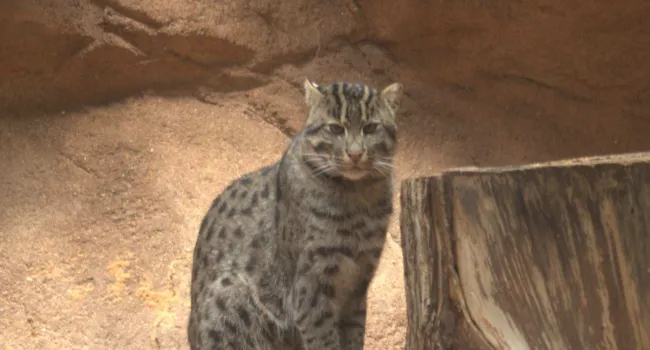
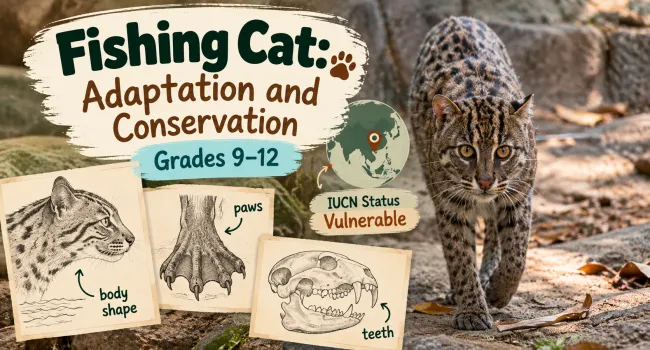
The fishing cat lives in wetlands in South and Southeast Asia and is listed as Vulnerable by the IUCN. Fish are its main food, but it also eats crabs, frogs, snails, snakes, rodents, and birds, and it is mostly active at night. Please confirm which animals the video names so the class chain matches the footage. For this age group, the key idea is simple: the fishing cat eats fish, the fish eat plants, and the plants need the sun.
Before Watching
Ask: "What did you eat for lunch? Where did that food come from?" Follow one example back (an apple came from a tree; the tree needed sun and water). Then ask: "What do you think the fishing cat eats?" Show picture choices (fish, crab, grass, pizza) and let students point or vote. Chart the votes and revisit them after the video.
Viewing Guide
- What does the fishing cat eat?
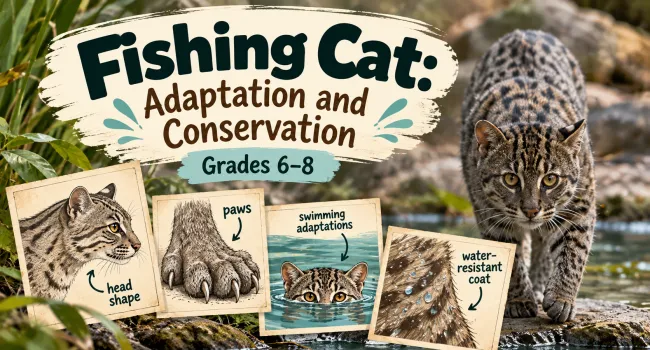
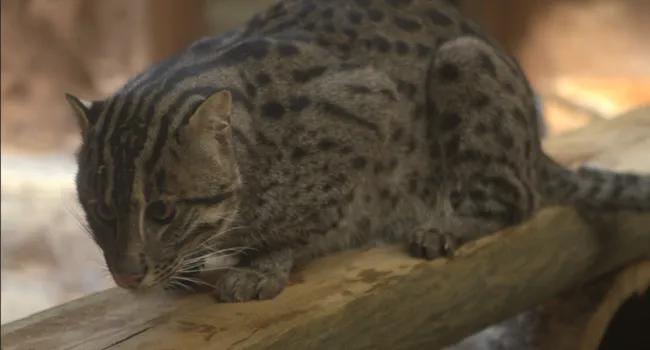
- How does the fishing cat catch its food? (Look at its paws and how it moves in the water.)
- Where does the fishing cat live? What else lives there?
Pause the video when the fishing cat is hunting or eating so students can name what they see.
After Watching – Discussion
- What did the fishing cat eat? Were you surprised?
- What do you think the fish eat? (Plants and tiny things in the water.)
- What do plants need to grow? (Sunlight and water.)
- So where does the fishing cat's food get its energy from, a long, long way back? (The sun!)
Activities
Activity 1: Chant (2 minutes)
Teach this short chant with motions. It previews the chain before students act it out.
- The sun shines down on the water plants. (arms up, wiggle fingers down)
- The plants grow tall in the sun. (crouch, then rise)
- Small fish nibble, nibble, nibble! (pinch fingers)
- Fishing cat pounces — splash, splash, SPLASH! (pounce)
- Energy goes from the sun to the cat. That's a food chain, just like that!
Activity 2: Be the Chain (8 minutes)
- Choose four volunteers to hold or wear the badges from the printable cards (Sun, Water Plants, Small Fish, Fishing Cat). Mix them up and let the class help line them up in order.
- Give the end of a ball of yarn to the Sun. The Sun passes it to the Water Plants and the class says, "The sun gives energy to the plants."
- Water Plants pass it to the Small Fish: "The fish eats the plants." Small Fish passes it to the Fishing Cat: "The fishing cat eats the fish."
- Look at the yarn together: "The energy goes THIS way." Show that an arrow points the same direction as the yarn.
- Swap volunteers and repeat so more students get a turn.
Activity 3: Sequence the Chain (8–10 minutes, partners)
- Partners use the four picture cards and arrow cards to build the chain: Sun → Water Plants → Small Fish → Fishing Cat. They glue or place the cards in order on the student handout.
- Circle the plant (it makes its own food). Underline the predator (the hunter).
- Challenge: build a second chain using the Crab card: Sun → Water Plants → Crab → Fishing Cat.
- Super challenge: build a five-step chain using the Snail and Crab cards: Sun → Water Plants → Snail → Crab → Fishing Cat.
Teacher Notes
- Arrow direction is the biggest stumbling block, even for older students. Use the yarn: the yarn moves from the food to the eater, and the arrow points the same way.
- Keep the language concrete. "Energy" at this age means what food gives you so you can run, grow, and play. You do not need to teach the word "producer."
- Many students will say the fishing cat only eats fish. That is fine for this lesson; if you want to extend, mention it also eats crabs, frogs, and other animals.
- Splitting the lesson into two short sittings works well for kindergarten.
- Repeat the chain with different volunteers so every student has a physical role at least once.
Vocabulary
- Food chain – a line that shows who eats whom
- Sun – the star that gives us light and warmth; plants use its light to grow
- Plant – a living thing that grows in sunlight and makes its own food
- Predator – an animal that hunts other animals
- Prey – an animal that is hunted by other animals
- Wetland – land that is covered with water, like a marsh
- Arrow – in a food chain, it points to the one that gets the energy
Teach each word with a picture or gesture. Core words for assessment: food chain, sun, plant, predator, prey.
Differentiation
Struggling Students
- Pre-teach "sun," "plant," and "eat" with real objects (a potted plant, a flashlight for the sun, a picture of a fish).
- Start with a three-card chain (Sun, Plant, Fish) before adding the Fishing Cat.
- Put numbers 1, 2, 3, 4 on the back of the cards so students can self-check the order.
- Use the anchor phrase every time: "The arrow points to the one that gets the energy."
English Language Learners
- Pair every vocabulary word with a picture and a gesture (sun = arms up, eat = hand to mouth).
- Use sentence frames: "The ___ eats the ___." and "The sun helps the ___ grow."
- Allow students to name cards in their home language first, then repeat in English.
- Pair with a bilingual peer for Sequence the Chain, and accept pointing as a response.
Students with IEPs / 504 Plans
- Allow the video to be paused as often as needed, and show a picture schedule of the lesson steps.
- Offer large, laminated or magnetic cards for students who have trouble gluing or cutting.
- Give a role in Be the Chain that matches the student's comfort level (holding the yarn, holding a card, or being the "energy checker" who points along the yarn).
- Accept pointing, picture selection, or a communication device for the exit ticket. Provide preferential seating and noise-reducing headphones if needed.
Advanced / Gifted Learners
- Build the five-step chain (Sun → Water Plants → Snail → Crab → Fishing Cat) and explain it to a partner.
- Use the "draw your own" card to add another animal the fishing cat might eat and explain where it fits in the chain.
- Ask: "What would happen to the fishing cat if the fish disappeared?" and draw or say an answer.
- Make a food chain from an animal they know (a bird, a squirrel) and compare it with the fishing cat's.
Extension
Plant Needs Mini-Investigation (Grade 2, 2-LS2-1)
Plant grass or bean seeds in two clear cups. Give both the same soil and water, but place one in a sunny window and one in a dark spot (or give one water and one none). Students draw what they see each day for about a week and decide what plants need to grow. Connect back: "If plants cannot grow, what happens to the fish and the fishing cat?"
360 Habitat Tour: I Spy
Watch the Fishing Cat 360 Habitat Tour and have students spy things a fishing cat needs: water, plants, and a place to hide. Chart what they find.
My Lunch Food Chain
Students draw a short food chain for something they ate (for example: sun → wheat → bread → me) with arrows, and share with a partner.
Ask the Zoo
Students dictate one question for a zookeeper about what a fishing cat eats at the zoo.
Fishing Cat: Built for the Water - K-12 Science Standards
This is a list of all applicable South Carolina K-12 science standards that can be applied to the Fishing Cat video and science materials and lessons.
View AssetFishing Cat: Built for the Water (Grades 3-5) Handout
This handout goes along with the "Fishing Cat: Built for the Water (Grades K-5)" lesson.
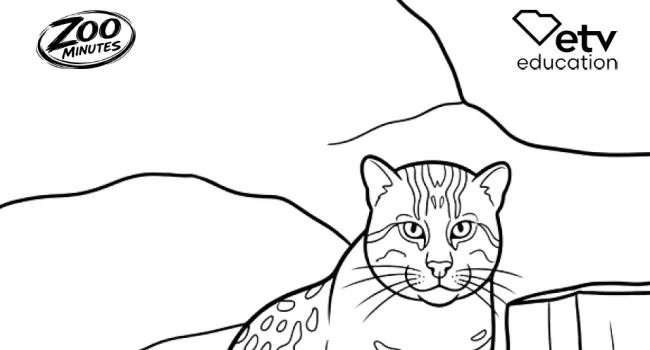
View AssetFishing Cat Coloring Sheet
Color a fishing cat and discover what makes this water-loving feline unique.
View AssetFishing Cat: Who Eats Whom? Food Chain Lesson Plan (Grades 4–5)
Students begin by predicting what the fishing cat eats, then watch the video to gather evidence about its prey and hunting style. Using illustrated organism cards from a wetland habitat, they build a...
View LessonThe Fishing Cat: A Master of Water
Students explain how the fishing cat's adaptations supports its survival and why protecting the species is important.
View LessonStandards
- K-LS1-1. LS1.C: Organization for Matter and Energy Flow in Organisms
- K-ESS3-1 Use a model to represent the relationship between the needs of different plants or animals (including humans) and the places they live.
- 2-LS2-1 Plan and conduct an investigation to determine what plants need to grow.
- 2-LS4-1. Make observations of plants and animals to compare patterns of diversity within different habitats.
Assessments
1. Exit Ticket
Students complete the sentence on the handout, say it aloud, or point to the correct cards:
"The sun helps the ______ grow. The fishing cat eats the ______."
Picture word bank: plants · fish · sun · crab. Accept a spoken, pointed, or drawn response.
2. Simple 3-Point Rubric
| Score | Criteria | Example Response |
| 3 – Clear Understanding | Puts the cards in the correct order with arrows pointing forward, and says or shows that plants need the sun and the cat eats fish | "The sun helps the plants grow. The fishing cat eats the fish." |
| 2 – Partial Understanding | Order mostly correct, but an arrow points the wrong way or one link is missing | "The fishing cat eats the fish." (no plants or sun) |
| 1 – Not Yet | Names the animals but does not show who eats whom | "The fishing cat is orange and has stripes." |
Score the thinking, not the writing. Spoken, pointed, and drawn responses all count.