Using Spanish around the community.
Vocabulary used in this episode:
- school / la escuela (las escuelas)
- restaurant / el restaurante (los restaurantes)
- store / la tienda (las tiendas)
- cinema / el cine (los cines)
- bookstore / la librería (las librerías)
- library / la biblioteca (las bibliotecas)
- hospital / el hospital (los hospitales)
- hotel / el hotel (los hoteles)
- pharmacy / la farmacia (las farmacias)
- church / la iglesia (las iglesias)
- museum / el museo (los museos)
- coffee shop / el café
- supermarket / el supermercado (los supermercados) bank el banco (los bancos)
- post office / el correo
- bakery / la pastelería (las pastelerís)
- letter / la carta
- money / el dinero
- house / la casa (las casas)
- market / el mercado (los mercados)
Lesson 8 - Walking through the Community
Objectives
- To learn words related to towns and buildings in the town
- To learn about the stores and shops in Spanish towns
- To learn about Spanish towns
Culture
Many smaller Spanish towns and villages are built around a square (la plaza). The church is usually on the square as is the town hall and shops. The church is very important in the life of the people, therefore, it has a prominent place on the square. There are shops where the people can buy the things they need. There is usually a supermarket as well as markets where fresh fruits and vegetables are sold. There is a bakery and a pastry shop and sometimes even a meat market.
In Latin America people can buy groceries either at the supermarkets, which are almost identical to American supermarkets or at the outdoor markets which are like farmer’s markets in the United States. Most outdoor markets are run by native people, who are sometimes called Indians. The majority of the people shop at the open air markets in Latin America. Only people with money shop at the supermarkets.
Information for the Teacher
One major difference in language to point out to the students is that la libreria is the Spanish word for bookstore. The Spanish word for library is la biblioteca. This seems opposite to the English words and can cause confusion.
Before Viewing the Video Lesson
- Review previous vocabulary words. In this lesson the words learned relate to food, clothing and counting and they will be used in context.
- Talk about the stores and buildings in your community. Do you live in a large city or a smaller town? Even if you live in a large city there are probably many different stores and service buildings that are located in your neighborhood. Use a smaller area as the “town” you discuss. What types of building are found in your “town”? Why are they located where they are? Are they convenient to where the people live? Can people get all the things they need near their homes?
- Tell the students that in this lesson they will see the types of building in a smaller Spanish town. They will learn the words for these buildings and their purpose. Listen for familiar sounding words and see if they mean what we think they should mean.
- Show some money from a Spanish-speaking country. You can get international money through banks in the United States. You can also buy play money from foreign language educational supply stores. Discuss the differences in the foreign currency and the American currency as to size, color, etc. If you live near a major airport, you may be able to get foreign currency at the money exchange counter.
- Talk about the differences between grocery shopping in Latin America and in the United States.
- Listen to the audio cassette tape of lesson 8 vocabulary words. Explain that some of these are the same words they used in activity #2. You may choose to give the students a copy of this lesson’s vocabulary words found at the back of the teacher’s guide.
Description of the Video Lesson
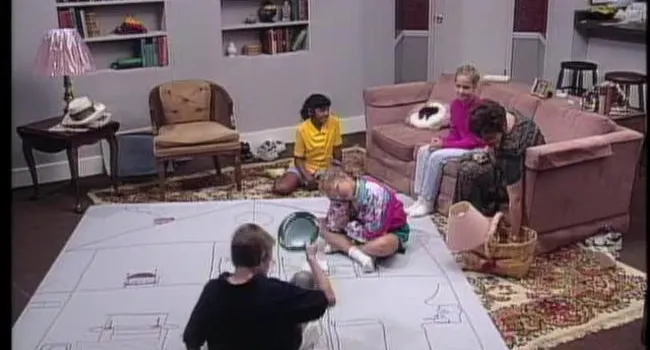
Señora Carnes shows the children a letter from her mother in Ecuador. She has a drawing of her town that she uses to show the children the different buildings in her town. Her mother had to go to the post office (el correo) to mail the letter. The town is built around a town square and the church (la iglesia) is at the center of the square. The church has a large bell rings when there are services in the church. The flag is seen at the school (la escuela). There is a library (la biblioteca) with lots of books, a hospital (el hospital) and a bank (el banco) that has lots of money. One child asks in English the question “what is?” and Señora Carnes corrects her with the Spanish “¿Qué es?”
Count money
uno, dos, tres, cuatro, cinco, seis, siete, ocho, nueve, diez diez, nueve, ocho, siete, seis, cinco, cuatro, tres, dos, uno
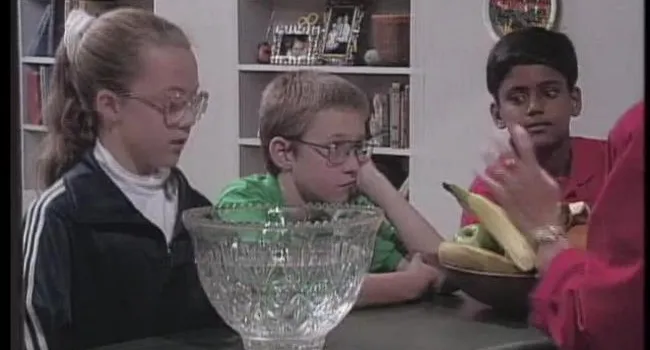
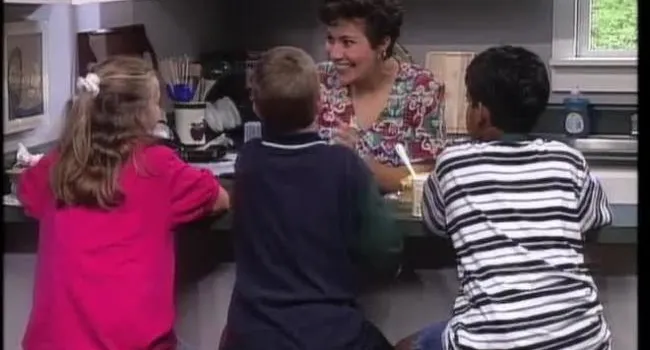
The children have some money. When you are hungry, where do you go? If you want coffee to drink, you would go to the coffee shop (el café); if you want a meal, you would go to a restaurant (el restaurante); but if you want a pastry, you would go to the bakery (la pastelería). Señora Carnes asks the children what they want to buy and then she tells them where they would buy it.
- Where would you go if you wanted to buy clothes (la ropa)?...la tienda
- Where would you go if you wanted to buy books (libros)?...la librería (You borrow books from la biblioteca and you buy books at la librería)
- Where would you go if you wanted a banana?...el supermercado o el mercado (At el supermercado you usually buy all types of food as well as cleansers, packaged foods, etc., you only buy fresh food like fruits and vegetables from el mercado).
Through the community
bakery, shoe shop, florist, restaurant, library, bank, toy store, card shop, hotel, hospital, fire station, police department Señora Carnes asks the children if they would like to go to the cinema (el cine) or to the museum (el museo). Jenny chooses the popcorn to represent the cinema and Emily chooses the pottery to represent the museum. Brian is bending over and grabbing his stomach. Emily goes to get medicine as if from the pharmacy (la farmacia) and gives it to Brian who gets better quickly and wants to go to the bakery (la pastelería).
SONG
Walking through the community: el cine, el café, la farmacia, el banco, la biblioteca, la iglesia, la escuela, el museo.
Spanish and South American dancers are seen at the International Festival and the Latino Festival which are held each year. Men, women and children are seen in traditional costumes.
Review
el pan, los zapatos, el perro, el color rojo el café, el cine, la librería, la farmacia el supermercado , la pastelería
Follow-up Activities
- Use the First Step Español Again video lesson to review the emphasized vocabulary and conversations.
- Review the vocabulary words related to the shops and buildings in a Spanish town. Ask questions about these stores and what is sold at each.
- Draw a map of your community or of a small Spanish town. Label the buildings with the Spanish words. This would be a good opportunity to review map making skills while reviewing the vocabulary.
- Count money as was done in the program. Use Spanish play money that you purchase or draw and copy for students to use. Use this money to purchase objects from imaginary stores.
- After these follow-up activities, let students view the video lesson again so they can respond and practice with the children on the lesson.
Supplemental Activities
- Build a Spanish village using boxes or draw the buildings and tape the papers together to form the village. Several students could work together and be responsible for the different buildings. One group could create the town square and another group could lay out the roads in the towns and get things ready for the buildings. Once this village is completed, let students give tours of the town to each other or to other classes. Let them pretend that they are tour guides for the town hall and are showing tourists around their town.
- The lesson began with Señora Carnes showing a letter from her mother in Ecuador. Let students pretend they are writing a letter telling about a shopping trip which they are planning. Tie this activity into a language arts activity on writing letters.
- Learn Spanish dances. The PE or Music teachers may be able to help with this activity. Spanish music is available at music stores and other stores that sell video tapes.
Remember to use the vocabulary words in context as much as possible in class during the next week. Add words and materials to the First Step Español suitcase folder.
Using Spanish around the community.
Vocabulary used in this episode:
- school / la escuela (las escuelas)
- restaurant / el restaurante (los restaurantes)
- store / la tienda (las tiendas)
- cinema / el cine (los cines)
- bookstore / la librería (las librerías)
- library / la biblioteca (las bibliotecas)
- hospital / el hospital (los hospitales)
- hotel / el hotel (los hoteles)
- pharmacy / la farmacia (las farmacias)
- church / la iglesia (las iglesias)
- museum / el museo (los museos)
- coffee shop / el café
- supermarket / el supermercado (los supermercados) bank el banco (los bancos)
- post office / el correo
- bakery / la pastelería (las pastelerís)
- letter / la carta
- money / el dinero
- house / la casa (las casas)
- market / el mercado (los mercados)
Lesson 8 - Walking through the Community
Objectives
- To learn words related to towns and buildings in the town
- To learn about the stores and shops in Spanish towns
- To learn about Spanish towns
Culture
Many smaller Spanish towns and villages are built around a square (la plaza). The church is usually on the square as is the town hall and shops. The church is very important in the life of the people, therefore, it has a prominent place on the square. There are shops where the people can buy the things they need. There is usually a supermarket as well as markets where fresh fruits and vegetables are sold. There is a bakery and a pastry shop and sometimes even a meat market.
In Latin America people can buy groceries either at the supermarkets, which are almost identical to American supermarkets or at the outdoor markets which are like farmer’s markets in the United States. Most outdoor markets are run by native people, who are sometimes called Indians. The majority of the people shop at the open air markets in Latin America. Only people with money shop at the supermarkets.
Information for the Teacher
One major difference in language to point out to the students is that la libreria is the Spanish word for bookstore. The Spanish word for library is la biblioteca. This seems opposite to the English words and can cause confusion.
Before Viewing the Video Lesson
- Review previous vocabulary words. In this lesson the words learned relate to food, clothing and counting and they will be used in context.
- Talk about the stores and buildings in your community. Do you live in a large city or a smaller town? Even if you live in a large city there are probably many different stores and service buildings that are located in your neighborhood. Use a smaller area as the “town” you discuss. What types of building are found in your “town”? Why are they located where they are? Are they convenient to where the people live? Can people get all the things they need near their homes?
- Tell the students that in this lesson they will see the types of building in a smaller Spanish town. They will learn the words for these buildings and their purpose. Listen for familiar sounding words and see if they mean what we think they should mean.
- Show some money from a Spanish-speaking country. You can get international money through banks in the United States. You can also buy play money from foreign language educational supply stores. Discuss the differences in the foreign currency and the American currency as to size, color, etc. If you live near a major airport, you may be able to get foreign currency at the money exchange counter.
- Talk about the differences between grocery shopping in Latin America and in the United States.
- Listen to the audio cassette tape of lesson 8 vocabulary words. Explain that some of these are the same words they used in activity #2. You may choose to give the students a copy of this lesson’s vocabulary words found at the back of the teacher’s guide.
Description of the Video Lesson
Señora Carnes shows the children a letter from her mother in Ecuador. She has a drawing of her town that she uses to show the children the different buildings in her town. Her mother had to go to the post office (el correo) to mail the letter. The town is built around a town square and the church (la iglesia) is at the center of the square. The church has a large bell rings when there are services in the church. The flag is seen at the school (la escuela). There is a library (la biblioteca) with lots of books, a hospital (el hospital) and a bank (el banco) that has lots of money. One child asks in English the question “what is?” and Señora Carnes corrects her with the Spanish “¿Qué es?”
Count money
uno, dos, tres, cuatro, cinco, seis, siete, ocho, nueve, diez diez, nueve, ocho, siete, seis, cinco, cuatro, tres, dos, uno
The children have some money. When you are hungry, where do you go? If you want coffee to drink, you would go to the coffee shop (el café); if you want a meal, you would go to a restaurant (el restaurante); but if you want a pastry, you would go to the bakery (la pastelería). Señora Carnes asks the children what they want to buy and then she tells them where they would buy it.
- Where would you go if you wanted to buy clothes (la ropa)?...la tienda
- Where would you go if you wanted to buy books (libros)?...la librería (You borrow books from la biblioteca and you buy books at la librería)
- Where would you go if you wanted a banana?...el supermercado o el mercado (At el supermercado you usually buy all types of food as well as cleansers, packaged foods, etc., you only buy fresh food like fruits and vegetables from el mercado).
Through the community
bakery, shoe shop, florist, restaurant, library, bank, toy store, card shop, hotel, hospital, fire station, police department Señora Carnes asks the children if they would like to go to the cinema (el cine) or to the museum (el museo). Jenny chooses the popcorn to represent the cinema and Emily chooses the pottery to represent the museum. Brian is bending over and grabbing his stomach. Emily goes to get medicine as if from the pharmacy (la farmacia) and gives it to Brian who gets better quickly and wants to go to the bakery (la pastelería).
SONG
Walking through the community: el cine, el café, la farmacia, el banco, la biblioteca, la iglesia, la escuela, el museo.
Spanish and South American dancers are seen at the International Festival and the Latino Festival which are held each year. Men, women and children are seen in traditional costumes.
Review
el pan, los zapatos, el perro, el color rojo el café, el cine, la librería, la farmacia el supermercado , la pastelería
Follow-up Activities
- Use the First Step Español Again video lesson to review the emphasized vocabulary and conversations.
- Review the vocabulary words related to the shops and buildings in a Spanish town. Ask questions about these stores and what is sold at each.
- Draw a map of your community or of a small Spanish town. Label the buildings with the Spanish words. This would be a good opportunity to review map making skills while reviewing the vocabulary.
- Count money as was done in the program. Use Spanish play money that you purchase or draw and copy for students to use. Use this money to purchase objects from imaginary stores.
- After these follow-up activities, let students view the video lesson again so they can respond and practice with the children on the lesson.
Supplemental Activities
- Build a Spanish village using boxes or draw the buildings and tape the papers together to form the village. Several students could work together and be responsible for the different buildings. One group could create the town square and another group could lay out the roads in the towns and get things ready for the buildings. Once this village is completed, let students give tours of the town to each other or to other classes. Let them pretend that they are tour guides for the town hall and are showing tourists around their town.
- The lesson began with Señora Carnes showing a letter from her mother in Ecuador. Let students pretend they are writing a letter telling about a shopping trip which they are planning. Tie this activity into a language arts activity on writing letters.
- Learn Spanish dances. The PE or Music teachers may be able to help with this activity. Spanish music is available at music stores and other stores that sell video tapes.
Remember to use the vocabulary words in context as much as possible in class during the next week. Add words and materials to the First Step Español suitcase folder.
Resources
First Step en Español 108: Walking Through the Community
Using Spanish around the community in reference to various buildings and people.
View Lesson