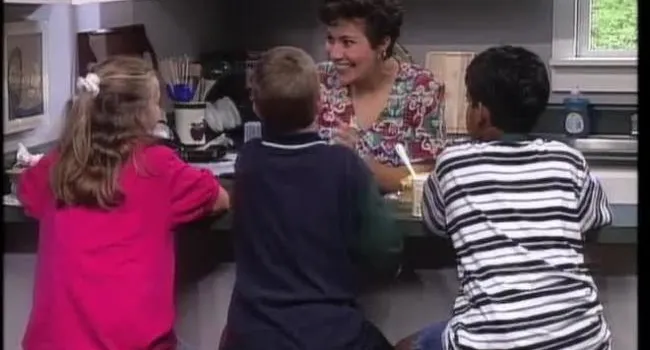
First Step en Español 107: Visiting in the School

Learn to use Spanish in the classroom, including the words for various school supplies and class
subjects.
Grade(s):
- Pre K
- Kindergarten
- 1
- 2
- 3
- 4
- 5
Subject(s):
Recommended Technology:
Other Instructional Materials or Notes:
Vocabulary
| school | la escuela |
| crayon(s) | la crayola (las crayolas) |
| glue | la goma |
| paper(s) | el papel (los papeles) |
| flag(s) | la bandera (las banderas) |
| book(s) | el libro (los libros) |
| scissors | la tijera (las tijeras) |
| pencil(s) | el lápiz (los lápices) |
| ruler(s) | la regla (las reglas) |
| map(s) | el mapa (los mapas) |
| blackboard(s) | la pizarra (las pizarras) |
| student(s) | el estudiante (los estudiantes) la estudiante (las estudiantes) |
| teacher | el maestro (los maestros) la maestra (las maestras) |
| chair(s) | la silla (las sillas) |
| table(s) | la mesa (las mesas) |
| backpack(s) | la mochila (las mochilas) |
Lesson Progression
Before Viewing the Video Lesson
1. Tell your students to watch and listen carefully as you get out a book bag and put ten different school supply items in the book bag. Tell them the name of the item as you put it in the book bag. Use the following items (colors can be changed or not used if this is too much for your students to remember) a yellow pencil, a purple crayon, white paper, a green book, scissors, a brown ruler, a pink eraser, white glue, a flag and a map. Close the book bag and put it on the table. Ask the students to number 1 through 10 on a piece of paper and to write all the items that you put into the book bag. Give them an appropriate amount of time to do so then pull out the items one by one and check the lists.
2. Tell them that in today’s lesson they will be learning words related to school. Do they think the items they used will be seen in the program? Ask them to watch for these items.
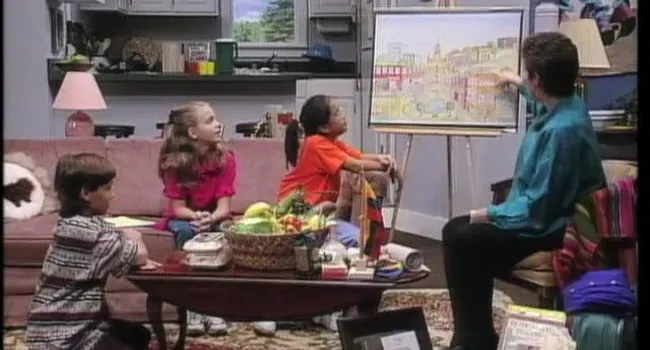
3. What do they think school would be like in a Spanish-speaking country? Tell them that school in Spain is very different from school in some South American countries. Ask them to listen as Señora Carnes tells about school in Ecuador.
4. Discuss uniforms at schools especially if your students do not wear uniforms. Do they think it would be a good idea or not? If this is a controversial issue in your community, you may want to avoid this discussion.
Follow-up Activities
1. Use the First Step Español Again video lesson to review the emphasized vocabulary.
2. Review the vocabulary words related to school and school supplies. Hold up different items and ask ¿Qué es? (What is this?) The students would answer Es _____ (It is ____). If plural, ask ¿Qué son? (What are these?) The students would answer Son ______.
3. Use the book bag and items from introductory activity # 1 again. Pull one item out at a time and ask for the Spanish word. Count the items. Encourage expressions like “I have” or “There is”.
4. Do the activity that Señora Carnes did with the students as to what do you use to erase, measure, write, color, etc. You can just do the activity rather than using the verbs to describe the activity.
5. Play a game with the school supplies from the vocabulary list (like putting them in a bag where students can’t see them). Without looking at the item, the student must identify it just by feeling it and then tell the Spanish word for the item. Practice expressions like “I have a _____.”
6. After these follow-up activities, let students view the video lesson again so they can respond and practice with the children in the lesson.
Supplemental Activities
1. Make a large map of South America drawing only the country outlines. Do the activity that Señora Carnes did in the lesson using the map. Where is the ____ and the students name the country it is in?
2. Play the rock/ scissors/ paper game that was done in the lesson. Piedra, papel tijera, uno, dos, tres.
3. Make flags of the different Spanish-speaking countries. Display them in the classroom with a map of the country.
4. Label all possible items in the classroom with the Spanish word.
5. If your school does not require uniforms, have a uniform day in your class. Ask all students to wear the same or similar clothes. Discuss what this feels like, using expressions “I like…” or “I don’t like.”
Remember to use the vocabulary words in context as much as possible in class during the next week. This should be especially easy since there are words related to school and school supplies. Continue to add to the First Step Español suitcase folder.
Teacher Notes
Culture
In Spain school starts early in the morning and ends around 5 p.m. There is a long break for lunch from 1:00 p.m. to 3:00 p.m. and students go home to eat. They have two or three weeks of vacation at Christmas and one week at Easter. They normally have 2 1/2 months off from school in the summer. In June, the schools shut at lunch time because it is too hot in the afternoon for classes. All children between the ages of 6 and 16 must go to school at either a school that is run by the government or to a private school.
In Ecuador, as in many other countries, students wear uniforms to school at schools run by the government as well as at private schools. Everyone that can afford to goes to a private school.
First Step en Español 107: Visiting in the School
Learn to use Spanish vocabulary when visiting in a school. Vocabulary used in this episode: school / la escuela crayon(s) / la crayola (las crayolas) glue / la goma paper(s) / el papel (los papeles)...
View Asset