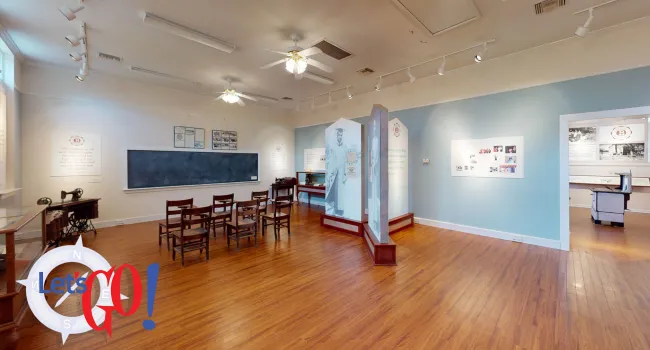
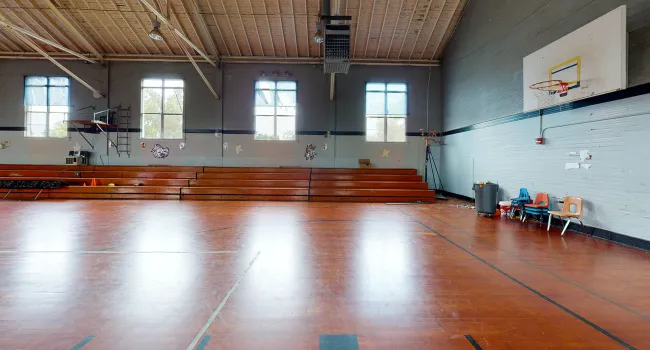
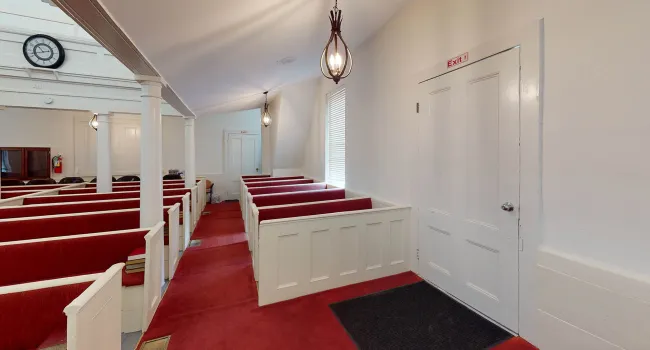
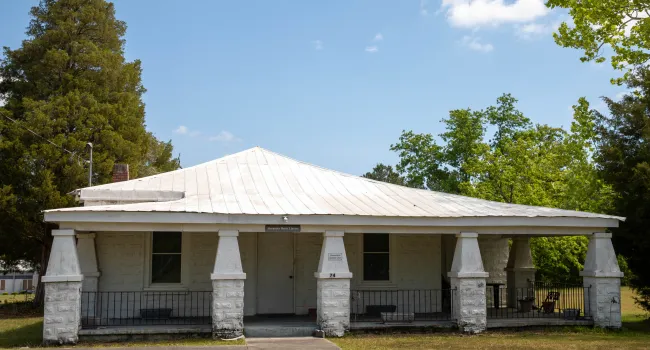
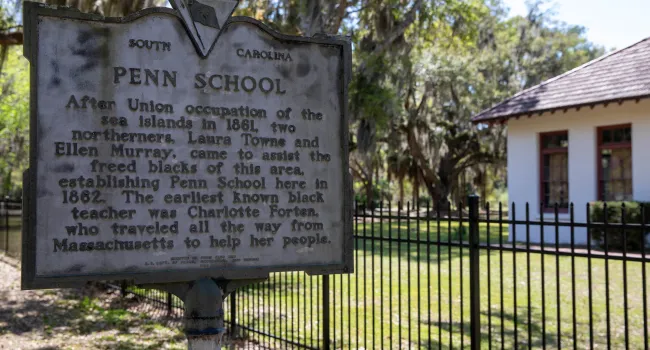
After becoming Penn Community Center in 1953, the institution began to focus on social issues affecting the well-being of the native islanders. This expanded to African Americans as a whole in the 1960s, when Dr. Martin Luther King, Jr., the Southern Christian Leadership Conference (SCLC), and other civil rights organizations began coming to the island to have meetings at the Frissell Community House, one of several buildings that students and community members had built on the campus.
"Penn Center." SC Encyclopedia. Accessed 15 April 2021. https://www.scencyclopedia.org/sce/entries/penn-center/
Click play to view the tour on your device
Standards
- 4.5.CC Identify and evaluate the impact of economic, political, and social events on the African American experience throughout Reconstruction.
- 4.5.E Analyze multiple perspectives of the economic, political, and social effects of Reconstruction on different populations in the South and in other regions of the U.S.
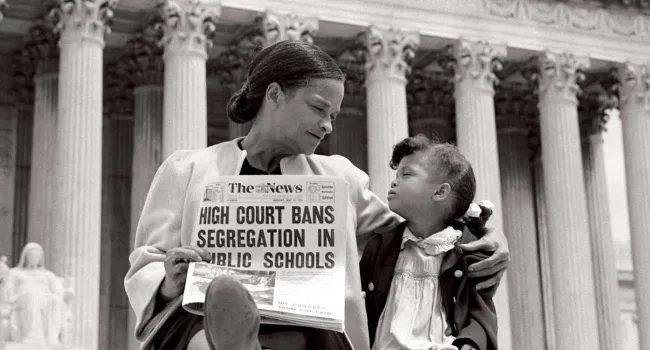
- 5.4.CC Analyze the continuities and changes of race relations in the United States and South Carolina following the Supreme Court decisions of Briggs v. Elliott and Brown v. Board of Education.
- 5.4.E Analyze multiple perspectives on the economic, political, and social effects of the Cold War, Space Race, and Civil Rights Movement using primary and secondary sources.
- 8.4.CX Evaluate South Carolinians’ struggle to create an understanding of their post-Civil War position within the state, the country, and the world.
- This indicator was developed to encourage inquiry into how the former planter class, African Americans, women, and others adjusted to, gained, lost, and/or regained position and status during Reconstruction. This indicator was also written to foster inquiry into how South Carolina worked with a stronger federal government and expanding international markets.
- 8.4.CC Analyze continuities and change in the African American experience in the period of Reconstruction and Jim Crow eras within South Carolina.
- This indicator was developed to encourage inquiry into the successes and failures of Reconstruction, beginning with the Port Royal Experiment, in South Carolina. This indicator was written to explore development of the Constitutions of 1868 and 1895 and to analyze the evolution of restrictions for African Americans from the Black Codes in 1866 through the Plessy decision in 1898.
- 8.5.CX Analyze the correlation between the Modern Civil Rights Movement in South Carolina and the U.S.
- This indicator was designed to foster inquiry into the role of South Carolina in the Modern Civil Rights Movement, to include the influence of court cases such as Briggs v. Elliot and Flemming v. South Carolina Electric and Gas. This indicator was also developed to promote inquiry into the relationship between national leadership, protests, and events and South Carolina leadership, protests and events, such as the Friendship Nine and the Orangeburg Massacre.
- 8.5.E Utilize a variety of primary and secondary sources to analyze multiple perspectives on the cultural changes in South Carolina and the U.S.
- USHC.5.CC Evaluate continuities and changes during the Civil Rights Movement and other subsequent movements for equal rights.
- This indicator was developed to promote inquiry into thematic continuities and changes into how marginalized groups sought and won legal rights. Inquiry into the leadership, methods, and outcomes of modern equal rights movements are supported by this indicator.
Resources
Penn Center Overview | Let's Go!
Penn Center is one of the most significant African American historical and cultural institutions in existence today. The historic campus is located on St. Helena Island, one of the most beautiful and...
View AssetPenn Center Photo Gallery | Let's Go!
The Penn Center, founded officially as the Penn School in 1865, is a campus of buildings dedicated to African American education in St. Helena Island, South Carolina. The original school grew out of...
View AssetPenn Center History | Road Trip
Joseph McDomick, Jr., former Penn Center project supervisor for over thirty years, talks about the history of the Penn Center. A history that began with the Port Royal Experiment in 1862 and the...
View AssetRoad Trip Coastal, Stop 2
The Road Trip Coastal crew visits the historic Penn Center in Beaufort, South Carolina.
View AssetMary Long Talks About Penn Center | Road Trip
Mary Long talks about how far the Penn Center has come in establishing freedom for African Americans. It was at the Penn Center where many African Americans were given a chance to learn. CREDIT: Mary...
View AssetWhy the Penn Center? | Road Trip
Joseph McDomick, Jr, civil rights activist and former Penn Center employee, talks about why Dr. Martin Luther King, Jr. chose to visit the Penn Center on many occasions during the civil rights...
View AssetKing at Penn Center | Road Trip
Joseph McDomick, Jr., former Penn Center project supervisor for over thirty years, talks about Dr. King's many visits to Penn Center and how the visits had to be kept quiet because of the threats on...
View AssetPenn Center: A Legacy | Carolina Stories
Located on St. Helena Island, some may remember it as Penn School, while others know it as Penn Center. St. Helena is one of the few places where you will see a living Gullah community. The history...
View AssetLand
Several generations of the St. Helena community attended the historic Penn School, established as one of the first schools for freed slaves. In the 1950s and 1960s, the site served as a safe retreat...
View AssetBaskets at Penn School | Digital Traditions
Resident of St. Helena Island, SC (Beaufort County). His father, George Brown, taught basketmaking at the Penn School on St. Helena Island in the early 20th Century. The school was founded in the...
View AssetFirst Baskets at Penn School | Digital Traditions
Researcher Dale Rosengarten reads a passage from a Penn School program dating the first year that basketmaking was taught at the school.
View AssetGullah Roots: Penn Center, Education of Free Blacks, African Myths and Beliefs | Carolina Stories
The Penn Center, formerly the Penn School, was founded on Saint Helena Island, South Carolina, by Northern abolitionist missionaries. The school was created to educate freed people, and was one of the...
View AssetPenn Center: A Legacy of Change Learning Activity
This program tells the story of the Penn Center’s inception in 1862 as a school for freed slaves to its involvement in the Gullah community today. Today the center collects, documents, preserves, and...
View AssetThe Annual Baby Fair At The Penn Center | History Of SC Slide Collection
An important event at the Penn School was the annual Baby Fair, sponsored by the school as a way to encourage good nutrition and other health practices for children of St. Helena's Island. This...
View Asset