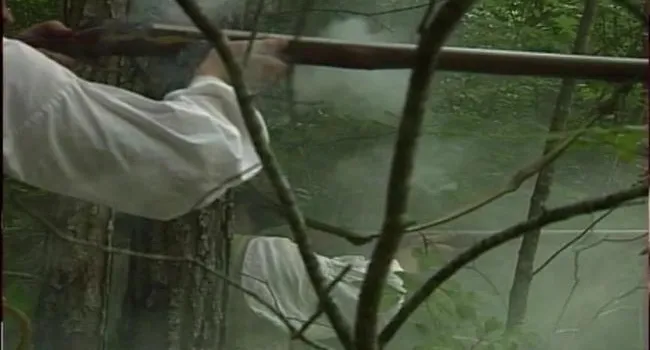
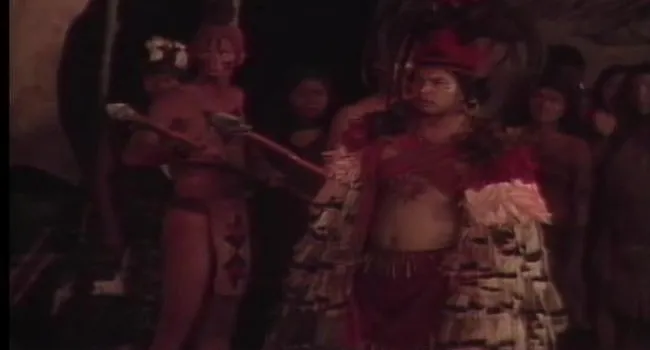
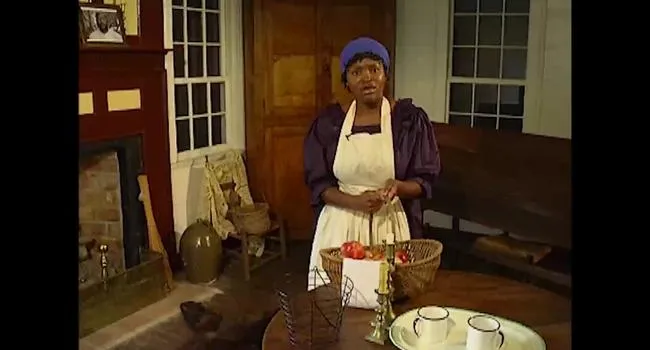
In this story, in the year 1562, Jacques and Rouffi have sailed to the new world on an expedition to establish a colony for French Protestants (Huguenots). The Huguenot colony was settled on what is present day Port Royal in Beaufort County. They named it Charlesfort after Charles IX of France. After a short while, the leader of the expedition, Captain Jean Ribaut goes back to France to obtain more provisions. About 28 Huguenots remain at Charlesfort. Discontent soon arises and Captain Barre assumes command. Barre decides to return to France in a small homemade boat. Rouffi chooses to remain at Port Royal. After a short time, the settlement ends in failure.
In this story, in the year 1562, Jacques and Rouffi have sailed to the new world on an expedition to establish a colony for French Protestants (Huguenots). The Huguenot colony was settled on what is present day Port Royal in Beaufort County. They named it Charlesfort after Charles IX of France. After a short while, the leader of the expedition, Captain Jean Ribaut goes back to France to obtain more provisions. About 28 Huguenots remain at Charlesfort. Discontent soon arises and Captain Barre assumes command. Barre decides to return to France in a small homemade boat. Rouffi chooses to remain at Port Royal. After a short time, the settlement ends in failure.
Standards
- 4.1.CO Compare the interactions among cultural groups as a result of European colonization.
- 4.1.CX Contextualize the experience of Africans, Europeans, and Native Americans in South Carolina.
- 8.1.CO Compare the three British North American colonial regions economically, politically, socially, and in regard to labor development.
- This indicator was developed to encourage inquiry into how the three British colonial regions developed in terms of their culture, economies, geography, and labor. The indicator was also developed to encourage inquiry into the unique story of the development of South Carolina.
- 8.1.P Summarize major events in the development of South Carolina which impacted the economic, political, and social structure of the colony.
- This indicator was designed to encourage inquiry into the development of South Carolina as a result of mercantilist policies, which ranged from the Navigation Acts to trade with Native Americans to the use of enslaved people as labor. This indicator was designed to promote inquiry into agricultural development, using the rice-growing knowledge of the enslaved West Africans.
- 8.1.CC Analyze the changes and continuities of the Native Americans' experiences prior to and as a result of settlement and colonization.
- This indicator was developed to encourage inquiry into Native American civilizations and cultures prior to European contact and their interactions with Europeans during the period of settlement and colonization, including their efforts to preserve their cultures.
- 8.1.E Utilize a variety of primary and secondary sources to examine multiple perspectives and influences of the economic, political, and social effects of South Carolina’s settlement and colonization on the development of various forms of government across the colonies.
Resources
Battle of King's Mountain | Palmetto Heritage
In this program, Lord Cornwallis has ordered Major Patrick Ferguson, a Scotsman, to form the Loyalists into a strong royal militia. In late September 1780, Ferguson took up post near present day...
View AssetBrooks-Sumner Affair | Palmetto Heritage
In 1857 during the heated debate on Kansas in the Senate, Charles Sumner delivered a two-day speech entitled "The Crime Against Kansas," which contained an insulting denunciation of Senator Andrew...
View AssetBurning of Columbia | Palmetto Heritage
This reenactment is based on excerpts from Emma LeConte’s diary. Emma, then seventeen years old, kept a diary for several months in 1865 chronicling the approach, occupation and burning of the city of...
View AssetCharleston Tea Party | Palmetto Heritage
Following the Tea Act of 1773 many colonial citizens refused to pay the duty and boycotted British tea. This video portrays actions taken by some citizens of Charleston in November and December, 1774...
View AssetCherokees | Palmetto Heritage
The story of the Cherokees is told through scenes from "lJnto These Hills" the outdoor drama in Cherokee, North Carolina that depicts the story of the Cherokees. The video centers around an Indian...
View AssetDenmark Vesey | Palmetto Heritage
The program begins with Vesey discussing the condition of slavery with an acquaintance who is a slave. Later, at a meeting, details of a plot are worked out with co-conspirators. Some are concerned...
View AssetJohn C. Calhoun | Palmetto Heritage
It is the summer of 1829 and Vice-President Calhoun is spending the Congressional recess at his home near Pendleton, South Carolina. His youngest daughter, Cornelia is helping her father with his...
View AssetLegend of Isaqueena | Palmetto Heritage
The Legend of Isaqueena blends fact with fantasy. An Indian trade based out of Ninety Six in the early 1750's grew to become the largest business operating outside of Charleston. Alan assisted with...
View AssetPickens, Marion, Sumter, Part 2 | Palmetto Heritage
While the British tangled with Andrew Pickens in South Carolina’s upstate, Francis Marion’s patriots fought the British in the Pee Dee region. Marion was known as “The Swamp Fox” due to his effective...
View AssetPickens, Marion, Sumter, Part 3 | Palmetto Heritage
Thomas Sumter was determined to drive the British out from South Carolina. “The Fighting Gamecock” earned his moniker due to his tenacity in battle. A band of British assassins attempted to sneak into...
View Asset