Voices on Cloth: Quilting for the Classroom, Part 2- PAPER QUILT PROJECTS- Based on Peggie Hartwell/ ABC Lessons

Based on Peggy Hartwell's discussion in the previous lesson, students will follow up with developing a quilt idea of their own, based on an inspirational poem, song, or story. or for younger students, holidays, sports, hobbies, seasons, etc. After sketching it on paper, they will construct a poster board-sized quilt from paper supplies, mostly. Whether you choose paper as a starting place, or want to try a small cloth quilt, it's still a great experience with design...so have fun with your idea, design, and art materials!
Essential Question
An inspirational topic is always helpful to design and make an art project, whether it's a drawing, an oil painting, a sculpture, or a quilt! Look at the samples provided, and then use your inspiration and imagination to make your own quilt, whether it's a meaningful topic, or based on a song, poem, hobby, or one of your other interests!
Grade(s):
- 3
- 4
- 5
- 6
- 7
- 8
- 9
- 10
- 11
- 12
Subject(s):
Recommended Technology:
1. Student chrome book - used to access lesson, but not necessary if teacher displays it on a SMARTBOARD.
2. A cell phone - for accessing song lyrics, poems, writings or images that may inspire the paper quilt
Other Instructional Materials or Notes:
quilt photos/ poetry books/ art history books/ poster board/ scissors/ ruler /pencil for sketching / construction paper /wrapping paper /colored markers/ metallic markers or inks ,if possible/ glue stick or glue/ ribbon or string for possible accents
Lesson Progression
1. Watch VOICES ON CLOTH/ Peggy Hartwell from beginning to end.
2. Class Discussion:
-Who has a relative who sews?
1.Do you have a family member who has made a quilt?
2.Does your family own a quilt? Do you have one made by a grandmother, aunt, family friend, or parent?
3.Quilts can be purchased today in stores, ready made...what's the difference between these "store-bought" quilts and the ones that a relative has made?
4.Did you know that the first quilts were a way of recycling old clothes? The scraps of old clothes, or empty food bags were cut into shapes , and were made from old shirts, dresses, skirts, and flour or cornmeal bags. ( People used to buy food supplies in big cloth bags, not small paper bags or boxes, like we do today. Sometimes these cloth bags had a small print or design on them. )
5.A person sewing a quilt begins by stitching together small SQUARES of a design, & then SEWS ALL THOSE SMALLER SQUARES TOGETHER to make a "larger-sized" quilt. ( A "lap-quilt" is one for a sofa, and then "bed quilts" can be single, double, queen, or king-sized, just like the beds they cover) There were 3 layers for a quilt: *the TOP ( the geometric, eye-catching part that was made of small pieces sewn together) *the MIDDLE ( a layer of cotton rolled into a thin "sheet"... it was called cotton "batting") *the BACKING (much larger pieces sewn onto the bottom of the top & middle)
6. THEN...the person making the quilt would sew through ALL 3 LAYERS to hook them together, making a very warm bed covering of 3 layers. ( the quilt had to be stretch tight in a wooden frame to be able to sew through the 3 layers...this frame was called a "Quilting Frame.") Also, it became a way of expressing a person's artistry to sew beautiful designs and use decorative, "fancy" stitching if they desired.
7. This process could take a long time...sometimes women would get together from their separate homes or farms, and work on a quilt for ONE of their families. Then, the next week, they would work on a different family's quilt. The women would sit and sew for hours, and it was a great time for them to talk, and "compare notes" on all sorts of topics of their lives...growing & canning vegetables, raising chickens and farm animals, etc.
VOCABULARY:
Quilting frame quilt top quilt bottom cotton batting design
geometric shapes a needle & spool of thread thimble quilting bee
6.EXPLAIN HOW "QUILT-MAKING" WAS A VERY EARLY EXAMPLE OF "RECYCLING" MATERIALS?
7. Look at the RESOURCES and discuss the quilts, and information there.
8. What social benefits were offered as ladies attended a "quilting bee" in earlier centuries, or decades? What practical reasons were there for quilting with a GROUP instead of by oneself?
9. Can you write an ACROSTIC POEM about making a quilt? ( It could be about yourself making one or a fictitious person sewing it)
Q
U
I
L
T
Teacher Notes
DISCUSSIONS & ACTIVITIES TO "WARM UP" the CLASS:
-If you have an example of a quilt or quilt square, bring it in to show the students.
-Discuss how quilts are entered into the STATE FAIR for prizes, and also because the quilt makers are very proud of their handiwork/ artwork...which takes months to complete.
-Do you know a relative who has made a quilt, or who owns one? Ask students
-Students, if you could magically sew a quilt depicting any topic, what would it be?
Voices on Cloth: Quilting for the Classroom: Peggie Hartwell | ABC Lessons | Arts Grow SC Resources
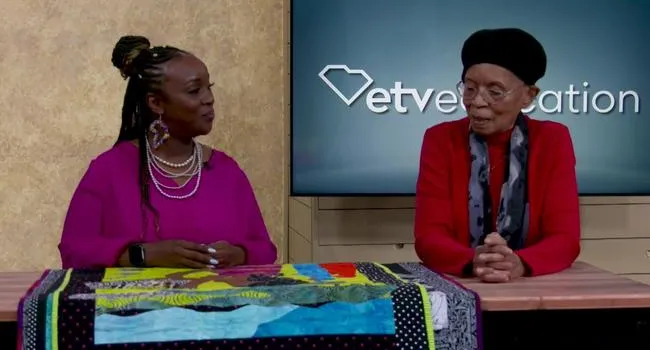
The host of this segment interviews a SC quilter of exceptional talent, Peggie Hartwell. They discuss how quilting can be used in the classrooms to help students synthesize complex ideas, emotions and...
View AssetPaper Quilt by Kathy Stevens Bradley/ middle and high school levels
This quilt is based on a song I like by the Beatles...and I also happen to LOVE crows. I googled the lyrics to this song, and tried to include something in the song from 2 verses in the "quilt blocks." I left out designing for one verse. Please look at the resource with the lyrics to this song, figure out the verse I left out, and draw a design that YOU would put in the "empty" quilt squares.
View ResourceBLACKBIRD lyrics/ The Beatles/ LyricsVideoArtists
Blackbird
Song by The Beatles -Lyrics Video Artists
Blackbird singing in the dead of night
Take these broken wings and learn to fly
All your life
You were only waiting for this moment to arise
Blackbird singing in the dead of night
Take these sunken eyes and learn to see
All your life
You were only waiting for this moment to be free
Blackbird fly, blackbird fly
Into the light of a dark black night
Blackbird fly, blackbird fly
Into the light of a dark black night
Blackbird singing in the dead of night
Take these broken wings and learn to fly
All your life
You were only waiting for this moment to arise
You were only waiting for this moment to arise
You were only waiting for this moment to arise
https://www.homestead.org/frugality-finance/quilting-recycling-made-beautiful/
This is a wonderful site that describes the origins of "quilt-making", which was essentially RECYCLING of old clothing, flour and corn sacks (all food used to come in cloth sacks instead of paper/cardboard/ or plastic) to make warm covers for a family's beds. The creator of the site (and the writer of the opening essay) is MS. BONNIE LAVIGNE.
View ResourceORIGINAL POEM: Grandmas's Glasses, Grandma's Quilt/ Kathy S. Bradley
This is a poem I wrote years ago, inspired by my grandmother's quilt that I inherited, and I also her tiny little wire-rimmed glasses that she wore for years.
Charlotte Outlaw's Quilt
This is the quilt that inspired the poem I wrote above, about my grandmother's quilt, her glasses, and her simple hard-working life.
View Resourcehttps://www.officialkwanzaawebsite.org/
This is an official KWANZAA website, to teach about the SEVEN PRINCIPLES, and the lighting of the 7 candles that are represented by the candles...UNITY, SELF-DETERMINATION, COLLECTIVE WORKS & RESPONSIBILITY, COLLECTIVE ECONOMICS, PURPOSE, CREATIVIY, FAITH.
View Resourcehttps://jewishunpacked.com/how-to-celebrate-hanukkah/
This website gives an overview of the general meaning for HANUKAH, the customs, beliefs, foods, games, etc.
View ResourceHomestead.org/ Essay by Bonny LaVigne
We didn’t invent recycling. Our ancestors did it by necessity. On the original homesteads across North America people re-jigged hard to obtain parts and materials and extended the life of things they needed with creative ingenuity. Nothing was wasted.
Despite our modern culture of planned redundancy, throwaways, and over consumption, recycling is finally becoming important again. However it’s still largely within the venue of the system. Few are we individuals who tinker, sew, and transform things old into things once again useful. Pretty much all reconfigurations are practical and frugal, but some can be beautiful as well.
Nothing marries frugality, practicality, and beauty quite like a quilt. Handmade quilts tell stories of family, friendship, and new beginnings. Quilts were often given to travelers heading out on the long trails west during the time of the American frontier. As people started feeling the effects of the grueling trek, they lightened their loads. Treasured furniture, pianos, and fine china were left behind to litter the trail, but quilts were kept—to protect against the cold, the hard ground, and to wrap those intrepid pioneers and their families in the memories and well wishes of loved ones left behind.
The word “quilt” is derived from the Latin word “culcita”, meaning a mattress or stuffed sack. A quilt is usually considered to be made of an insulating material sandwiched between two layers of fabric. Batting has been made of many things throughout history: wool, cotton, hair, and even crumpled up nylon stockings; anything that gives the finished piece some padding. The outer layers can be multiple pieces stitched together or single cloths of linen, cotton, wool or silk. Stitching can be highly decorative, simple running stitches, or single ties positioned throughout the quilt to keep the filling from shifting.
Official Kwaanza Website.org
This site describes the meanings of kwanzaa symbolism and the principles for healthful, purposeful living.
View ResourceStandards
- V.C Connecting - I can relate artistic ideas and work with personal meaning and external context.
- VA.C Connecting - I can relate artistic ideas and work with personal meaning and external context.
- VA.C Connecting - I can relate artistic ideas and work with personal meaning and external context.
Assessments
1. The student must create: a paper "QUILT-WORK" , with all squares completed according to their "theme".
2. Grades 3-6 : Think of a holiday, season, sport, or arts activity that you really like. This will be the theme for your quilt. On scrap paper, draw ideas for simple ideas to put in your quilt squares. INCLUDE SPECIFICS ABOUT THE HOLIDAY'S SYMBOLISM on a separate sheet of paper... On the art example, I included, I researched why the Kwanzaa candleholder has 7 candles, and what they stand for? You must explain these specifics on a separate sheet of paper with your art project.
3. Grades 6-12: After viewing & completing the LESSON PROGRESSION, think of a song, poem, or artwork that inspires you. Explain something about the "inspirational source" for your PAPER QUILT, written neatly on paper (with the author's name included, if it is a song, story, poem, etc. written by someone other than the student).
-If a POEM is used for inspiration, the poem must be written in its entirety on a separate sheet that is NOT the paper quilt.
-If a SONG is used for inspiration, the writer of the LYRICS, and also the MUSIC, must be notated on the display, for all to see. (If this is NOT DONE, it is considered a COPYRIGHT violation and is similar to "stealing" the author / musician's work... so be respectful and give the artists credit for their song, poem, etc.)
4. Using scrap paper, draw simple designs that might be in geometric squares of your quilt design.
5. Measure, cut, and glue your quilt design onto the poster board in its finished form.
6. Present your finished PAPER QUILT, plus your informational paper about your "inspirational source" (author, musician, artist, teacher, relative, friend, etc.)
SAMPLE: Topic Quilt for Grades 3-6