Philip Simmons | Periscope

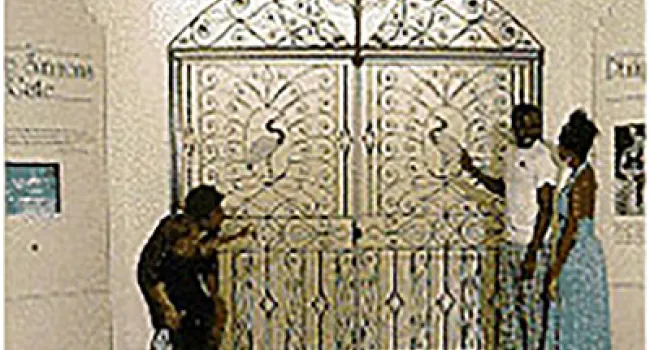
At the age of 12, Philip became an apprentice to a blacksmith. It was a hard job. Apprentices swept floors, shoed horses and worked simple pieces of iron while laboring around a hot forge. Only after years of practice and mastering the basics of ironwork, could apprentices become blacksmiths. Philip was determined and he was known to work harder than his fellow workers. By the time Philip became a blacksmith, the car was beginning to replace the horse and carriage in Charleston. Much of the blacksmith's work was shoeing horses and fixing horse carriages. Philip and his fellow blacksmiths started to worry that there would be fewer and fewer jobs. Fortunately, many people in Charleston had iron gates and fences that needed to be repaired or replaced. Some of the gates and fences were nearly 200 years old. Philip repaired them with extra skill. Many people thought his ironwork had been crafted by the master blacksmiths of long ago. Phillip found his calling and became known as a master blacksmith himself. People from Charleston began buying Philip's original work, as did people from all over the country.


A la edad de 12 años, Philip se convirtió en aprendiz de un herrero. Fue un duro trabajo. Los aprendices barrían suelos, herraban caballos y trabajaban en simple piezas de hierro mientras trabajaban alrededor de una forja caliente. Solo después de años de practica y de dominar los conceptos básicos de la herrería, los aprendices podrían convertirse en herreros. Philip estaba decidido y era conocido por trabajar más duro que sus compañeros de trabajo. Cuando Philip se convirtió en herrero, el automóvil comenzaba a reemplazar al caballo y el carruaje en Charleston. Gran parte del trabajo del herrero consistía en herrar caballos y arreglar carruajes de caballos. Philip y sus compañeros herreros comenzaron a preocuparse de que hubiera cada vez menos trabajos. Afortunadamente, muchas personas en Charleston tenían puertas y vallas de hierro que debían ser reemplazadas. Algunas de las puertas y vallas tenían casi 200 años. Philip los reparo con más habilidad. Mucha gente pensó que su trabajo había sido elaborado por los maestros herreros de antaño. Philip encontró su vocación y se hizo conocido como un maestro herrero. La gente de Charleston comenzó a comprar el trabajo original de philip, al igual que la gente del todo el país.

More in this Series

Periscope / African American History Month | Periscope / D. South Carolina Portraits | Periscope

Robert Smalls | Periscope

Photo

Grades

  • 3
  • 4
  • 5
  • 6
  • 7
  • 8
Robert Smalls | Periscope
Episode 1
In 1839, Robert Smalls was born into slavery in Beaufort, South Carolina. As a slave, he worked in the Charleston shipyards. After learning the local harbor and surrounding waters, 23-year-old Robert...
A Daring Escape: The Planter | Periscope

Photo

Grades

  • 3
  • 4
  • 5
A Daring Escape: The Planter | Periscope
Episode 2
On the evening of May 12, 1862, the captain and officers of the Planter left the ship to spend the night on the shore. Robert and the rest of the slave crew had to stay on board under captain's orders...
Mary McLeod Bethune, Educator | Periscope

Photo

Grades

  • 3
  • 4
  • 5
  • 6
  • 7
  • 8
Mary McLeod Bethune, Educator | Periscope
Episode 3
At a time when there were few educational opportunities for African Americans, Mary McLeod Bethune created schools and a thriving college for them. Mary was born in Mayesville, South Carolina to freed...
Bethune School | Periscope

Photo

Grades

  • 3
  • 4
  • 5
  • 6
  • 7
  • 8
  • 9
  • 10
  • 11
  • 12
Bethune School | Periscope
Episode 4
In 1904, Mary McLeod Bethune began a school for poor African American children in Daytona, Florida. With only $1.50 to start the school, she had to be very creative. The desks were made from packing...
Bethune-Cookman College | Periscope

Photo

Grades

  • 3
  • 4
  • 5
  • 6
  • 7
  • 8
  • 9
  • 10
  • 11
  • 12
Bethune-Cookman College | Periscope
Episode 5
Mary continued to open more schools, created a hospital and promoted voting rights for African Americans. President Franklin D. Roosevelt invited her to become an advisor in 1936. Her job required her...
Modjeska Simkins, Civil Rights Advocate | Periscope

Photo

Grades

  • 6
  • 7
  • 8
Modjeska Simkins, Civil Rights Advocate | Periscope
Episode 6
In the 1950s, Dr. Martin Luther King, Jr. became known as the leader of the civil rights movement. More than 20 years before Dr. King, Modjeska Simkins began her own work for the civil rights of...
Philip Simmons, Master Blacksmith | Periscope

Photo

Grades

  • 3
  • 4
  • 5
  • 6
  • 7
  • 8
  • 9
  • 10
  • 11
  • 12
Philip Simmons, Master Blacksmith | Periscope
Episode 7
When Philip Simmons was a child, he liked to draw the wrought iron gates around Charleston, South Carolina. The spirals and loops he saw in the ironwork inspired his artistic abilities. Philip would...
Philip Simmons | Periscope

Photo

Grades

  • 3
  • 4
  • 5
  • 6
  • 7
  • 8
  • 9
  • 10
  • 11
  • 12
Philip Simmons | Periscope
Episode 9
There are hundreds of Philip Simmons's gates and fences around Charleston. One of his gates hangs in the Smithsonian Institution in Washington, D.C. He has won national awards and was commissioned to...
Dori Sanders, Author | Periscope

Photo

Grades

  • 3
  • 4
  • 5
  • 6
  • 7
  • 8
  • 9
  • 10
  • 11
  • 12
Dori Sanders, Author | Periscope
Episode 11
Dori Sanders' book Clover has been translated into five different languages and made into a Disney film. The story is set in the countryside of South Carolina, and told through the eyes of a 10-year...
Dori Sanders: Clover | Periscope

Photo

Grades

  • 3
  • 4
  • 5
  • 6
  • 7
  • 8
  • 9
  • 10
  • 11
  • 12
Dori Sanders: Clover | Periscope
Episode 12
The setting for her first book, Clover, is a peach farm like the one Dori Sanders grew up on. Clover was published in 1990 and immediately became a best-seller. In the story, Clover is a 10-year-old...