Resource Availability and Gopher Frogs: A Coastal Plain Ecosystem Lesson
• Analyze and interpret data regarding the effects of resource availability on Gopher Frogs within the Coastal Plain ecosystem.
• Understand the relationship between habitat loss and the survival of specific organisms.
• Explore conservation efforts and their impact on ecosystems.
7-LS2-1. Analyze and interpret data to provide evidence for the effects of resource availability on organisms and populations of organisms in an ecosystem.
- 7-LS2-4: Analyze data to determine how the availability of resources impacts individual organisms and the growth of populations.
Grade(s):
- 7
Subject(s):
Recommended Technology:
Access to computers/tablets for research
Smartboard/Board to display video and data map of Gopher frog
Other Instructional Materials or Notes:
Lesson Progression
Engage:
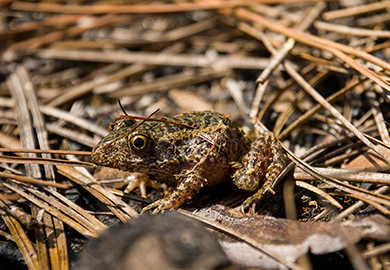
- Begin with What's Wild video introducing the Gopher Frog and its habitat in the Coastal Plain of South Carolina. Ask students what they know about amphibians and their role in ecosystems.
- Pose the question: "What happens to an ecosystem when a species is at risk of extinction?" Facilitate a brief class discussion to gauge student prior knowledge and curiosity.
Explore:
- Divide students into small groups and provide them with data sets showing Gopher Frog population numbers over the years alongside information about wetland availability. https://natural-heritage-program-scdnr.hub.arcgis.com/
- Have students analyze the data to identify trends and patterns. Encourage them to graph the data using chart paper.
- Students will research the Coastal Plain ecosystem, focusing on the unique habitats (longleaf pine forests, cypress swamps) and the Gopher Frog's adaptations to these environments.
Explain:
- Each group will present their findings on the data analysis, highlighting how resource availability impacts Gopher Frog populations.
- Discuss key concepts such as habitat loss, resource scarcity, and their effects on organisms and populations.
- Introduce the conservation efforts currently underway to protect the Gopher Frog, explaining the role of biologists and conservationists.
Elaborate:
- Challenge students to design a conservation plan for Gopher Frogs in the Coastal Plain. This plan should include strategies for habitat restoration, community education, and ways to monitor frog populations.
- Encourage students to consider how their plan addresses the specific needs of Gopher Frogs and the importance of maintaining biodiversity in the ecosystem.
Evaluate:
- Students will create a reflective journal entry discussing what they learned about the importance of resource availability and conservation efforts.
- Assess each group's conservation plan, focusing on creativity, feasibility, and understanding of ecological concepts.
- Use a rubric to evaluate the group presentations based on clarity, data interpretation, and engagement.
Teacher Notes
Use https://natural-heritage-program-scdnr.hub.arcgis.com/
Multiple links to articles regarding conservation efforts in South Carolina regarding Gopher frogs found in instructional materials.
Gopher Frogs | What's Wild
The Coastal Plain of South Carolina is an ecologically rich landscape stretching from the inland sandhills to the coastal marshes along the Atlantic Ocean. This vast expanse, characterized by its flat...
View AssetGopher Frogs Trivia Quiz | What's Wild
Explore South Carolina’s rich Coastal Plain — home to swamps, forests, and the rare Gopher Frog. These unique amphibians are in danger, but scientists are working hard to save them. Think you know...
View AssetArticle about UGA research on Gopher frogs
View ResourceRiverbanks Zoo and SCDNR partnership to conserve gopher frog article
View ResourceResearch at UGA regarding southeast climate and gopher frog
View ResourceSouth Carolina Wildlife Information regarding gopher frog
View ResourceARC protection of gopher frog
View ResourceNorth Carolina Conservation Plan for Gopher Frog
Includes information regarding different environments and land types
View ResourceSCDNR Pond Breeding Report to include Gopher Frogs
View ResourceRiverbanks and DNR Partnership to Conserve Gopher Frogs Additional Article
View ResourceData bank and Resource for South Carolina Wildlife
View ResourceStandards
- 7-LS2-1. Analyze and interpret data to provide evidence for the effects of resource availability on organisms and populations of organisms in an ecosystem
- 7-LS2-4 Construct an argument supported by empirical evidence that changes to physical or biological components of an ecosystem affect populations.