First Step auf Deutsch 101: Guten Tag! Lesson Plan

Grade(s):
- Pre K
- Kindergarten
- 1
- 2
Subject(s):
Recommended Technology:
Other Instructional Materials or Notes:
Vocabulary
| Good Morning | Guten Morgen |
| Hello | Guten Tag |
| Goodbye (formal) | Auf Wiedersehen |
| Goodbye (casual) | Tschüss |
| Mr. | Herr |
| Mrs. | Frau |
| Miss | Fraeulein |
| What is your name? | Wie heisst du? |
| My name is . . . | Ich heisse . . . |
| Yes | ja |
| No | nein |
| Please | bitte |
| Yes, please | ja, bitte |
| Excuse me | Entschuldigung/Verzeihung |
| Thank you | Danke |
| You're welcome | Bitte |
| How are you? | Wie geht's? |
| Very well | sehr gut |
| So so | so so |
| Not well | schlecht |
| Who is that? | Wer ist das? |
| That is . . . | Das ist . . . |
| How do you say . . .? | Wie sagt man . . .? |
| The Family | die Familie |
| Mom/Mother | die Mutti/Mutter |
| Dad/Father | der Vati/Vater |
| Brother | der Bruder |
| Sister | die Schwester |
| Grandpa | der Opa |
| Grandma | die Oma |
| Germany | Deutschland |
| Europe | Europe |
Lesson Progression
Before Video:
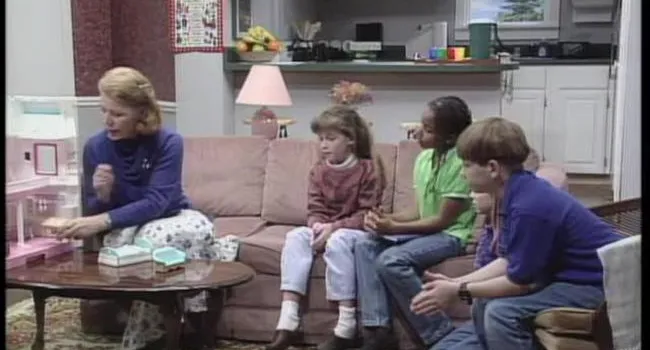
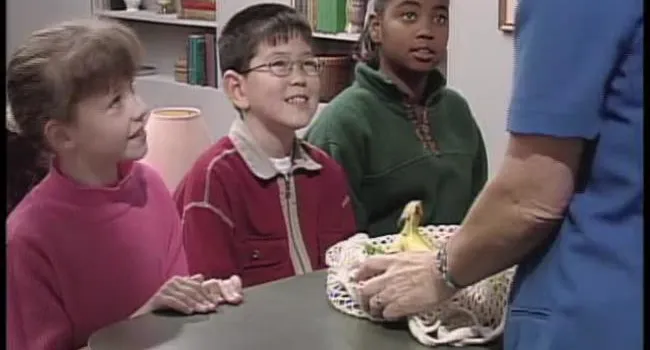
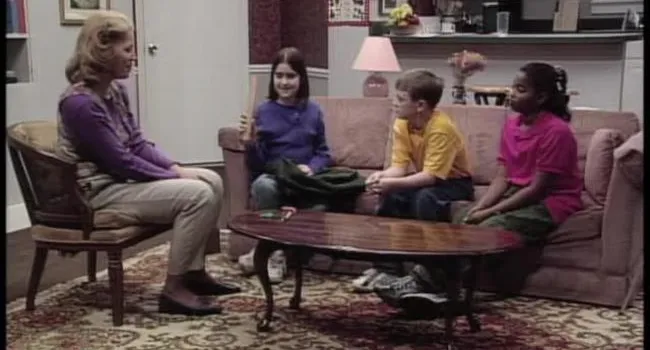
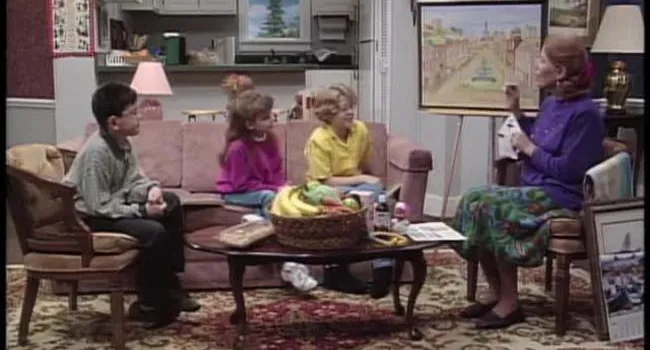
1. Remind the students that they will not understand everything that is said on the video lesson, and their lack of understanding is not important because they are being exposed to the language. Hearing the language spoken is very important, and only certain words and phrases will be learned from the program. Today's program introduces Frau Falcone and the neighborhood children who are learning German.
2. Role-play an introductory situation in English with your students. "Hello, my name is __________. What is your name? My name is __________. Nice to meet you __________. How are you? Very well, thank you. Goodbye." Explain to your students that they will learn introductions, greetings, and family names from today's program. Tell them to watch for these words.
3. Using the world map, point out the German-speaking countries. Has anyone ever visited any of these countries? What do your students know about these countries? Watch for and discuss any stereotypical answers.
Follow-up Activities
1. Use the First Step auf deutsch Again video lesson to review the emphasized vocabulary and conversations.
2. Review vocabulary words related to the family. Ask each student to draw a picture of his/her family and label the family members: die Mutti/Mutter, der Vati/Vater, der Bruder, die Schwester, der Opa, and die Oma.
3. Review Herr, Frau, and Fraulein. Show pictures of each, and let students tell which word is correct.
4. Role-play situations that involve greetings and introductions. This could be done in a round robin/circle type game. Do the same with “How are you?” and use the appropriate responses.
5. Review sehr gut, so so, schlecht, bitte, Entschuldigung, and Danke. Which would be appropriate to use in short role-play situations?
6. After these follow-up activities, let students view the video lesson again. This will allow them to respond and practice with the children on the lesson.
Supplemental Activities
1. Discuss the customs of handshaking and kissing on the cheek. (This is probably more common in Switzerland than in Germany.)
2. Frau Falcone is from Germany. Locate Germany on a map and discuss how to get there from where you live. Also note the location of other German speaking countries in Europe. Find out interesting facts about these countries, such as their contributions and information about their famous people. You may also try to find out if students have ancestors from German-speaking countries. Tell the students that English is a Germanic language, and have an open discussion about this. Find the words that are similar in both languages
*Reminder: use the vocabulary words as much as possible in class during the next week. This should be easy since there are words for greetings, introductions, questions, words for well being, and polite words.
Teacher Notes
Culture:
Culture German is one of the official languages spoken in four European countries -- Germany, Austria, Switzerland, and Liechtenstein. There are also large groups of minorities in the Czech Republic, Northern France and Belgium that speak German.
The standard or "high German" is the German taught in school. However, regional and national dialects vary. Although German is spoken in Switzerland, it is only one of the four national languages recognized in Switzerland. The other three include French (close to the French border), Italian (closer to the Italian border), and Romansch (which is spoken by a small minority in the Alps and is related to Latin).
In German-speaking countries, teenagers and adult friends usually greet each other by shaking hands, or they may kiss each other on the cheek if they are very close friends.
Information for the teacher:
1. The letter J, as in ja and Junge, is pronounced like a Y, as in yes.
2. The names of languages, such as Deutsch, are capitalized when used as nouns, but not when they are used as adjectives.
3. All nouns are capitalized. Masculine nouns are preceded by the definite article der (the). Feminine nouns are preceded by the definite article die (the). Neutral nouns are preceded by the definite article das (the). Nouns can also be preceded by ein (a), with the appropriate ending.
4. All plural nouns -- masculine, feminine, and neutral-- are preceded by die in the nominative and accusative, and they are preceded by der in the dative and genitive cases.
5. There is a formal and familiar expression used with the word "you." The formal "you" is Sie, and it is used as a sign of respect when addressed to older people and people who are in authority. Students should use this with teachers and adults other than their parents.
6. The familiar "you" is du, and it is used to address family members, friends, colleagues (except for bosses and managers), and animals. Students should use this with each other.
7. The German alphabet has four extra sounds represented by four extra letters. They include: Ä = ae sound, Ö = oe sound, Ü = ue sound, and the ß = double s sound. These same sounds are used in English, but letter combinations represent them instead of single letters.
8. In German, when ie is used (i preceding e in any word), then use the e sound. If ei is used (e preceding i in any word), then use the i sound.