First Step auf Deutsch 107: Visiting in the School Lesson Plan

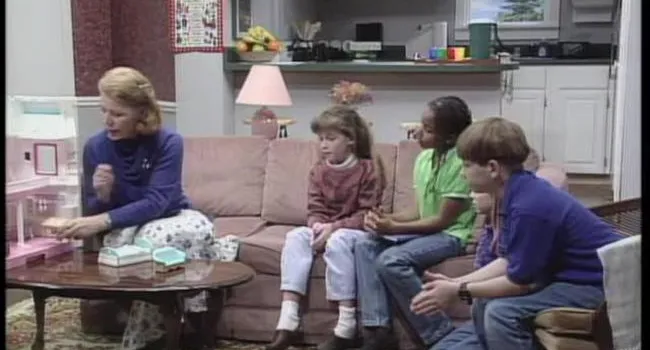
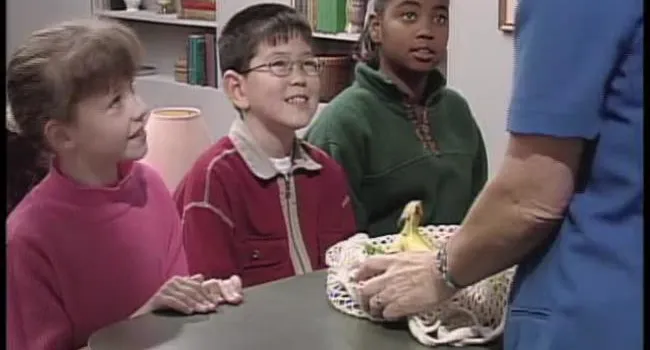
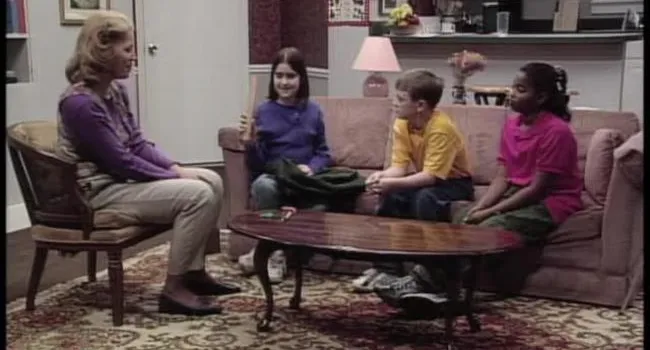
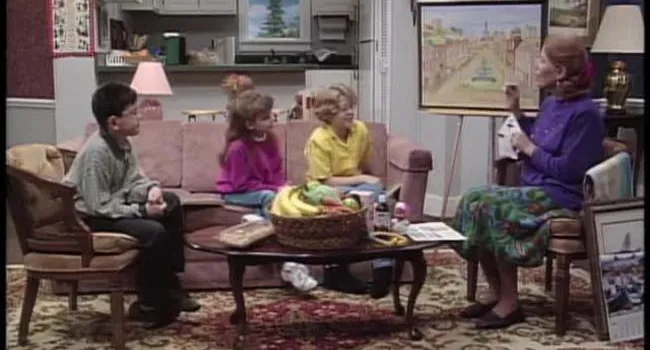
The children return from school with their book bags. They are all tired, so they sit down. They ask how to say the word for school, and they exclaim that they are very tired. Frau Falcone asks to see what is inside the book bag. She comments about its heaviness. Jessica pulls things out of her book bag, and Frau Falcone tells them the name of each item. After Robbie asks for some scissors, Frau Falcone explains how the word is similar to the word “shear,” which is another English word for scissors. Frau Falcone asks Jessica how many books she has, and Jessica replies that she has ten.
Frau Falcone has a large German flag, and they discuss its colors. The students think that the flag is black, red, and yellow. Frau Falcone corrects them, and she says that the yellowish color is referred to as gold. She also gives the students a brief geography lesson about Germany and the surrounding countries. She also includes the major geographic features of the region in her lesson. Frau Falcone uses a blackboard, and she asks the students to draw a cat. She instructs them to first draw a circle, then the ears, the eyes, a nose, and the mouth. After they draw the cat, they pretend that they are in a German classroom. Frau Falcone teaches them the basic classroom commands, such as pay attention, stand up, sit down, raise your right hand, and raise your left hand.
Frau Falcone displays a large map of Germany and the other German-speaking countries, Austria, Switzerland, and Liechtenstein. She asks the students to place the school objects by certain cities and other geographical places. They review where each object is placed.
Grade(s):
- Pre K
- Kindergarten
- 1
- 2
Subject(s):
Recommended Technology:
Other Instructional Materials or Notes:
Vocabulary
| school | die Schule |
| flag/flags | die Flagge/die Flaggen |
| map/maps | die Landkarte/die Landkarten |
| blackboard | die Tafel |
| student (masculine/feminine) | der Schueler/die Schuelerin |
| teacher (masculine/feminine) | der Lehrer/die Lehrerin |
| School Supplies | die Schulsachen |
| backpack | die Schultasche |
| colored pencil | der Buntstift/die Buntstifte |
| glue | der Klebstoff |
| paper | das Papier |
| book/books | das Buch/die Buecher |
| scissors | die Schere |
| pencil | der Bleistift |
| ruler | das Lineal |
Lesson Progression
Before Viewing the Video Lesson
1. Use a colored pencil for this activity instead of a crayon.
2. Ask the students what they think German schools would be like. Ask them if they have met any students from Germany. Some elementary students may even have older siblings who have been on exchange programs, or they may have had exchange students live in their homes at some time.
3. Although they don't usually wear uniforms to school in Germany, it may still be an interesting topic for school children to discuss.
Follow-up Activities
1. Use the First Step auf deutsch Again video lesson to review the emphasized vocabulary.
2. Review the vocabulary words associated with school and school supplies. Hold up different items, and ask, "Was ist das?” The students answer, "Das ist_______ _____,” or if plural, "Was sind sie?” Students answer "Sie sind _____."
3. Reuse the book bag and items from introductory Activity # 1 again. Pull one item out at a time, and ask for its German word. Do the colors also if possible. Count the items.
4. Repeat Frau Falcone’s activity with the students. You can do the activity rather than using the verbs to describe the activity.
5. Count the books and school supplies the same way as the lesson. Ask the color of the school supplies, or ask for a green pencil, a black crayon, etc.
6. Play a game with the school supplies. Hand a student an item from the vocabulary list. Without looking at it, the student must identify the item by touch, and then give the German word for the item.
7. After these follow-up activities, let students view the video lesson again, so they can respond and practice with the children on the video.
Supplemental Activities
1. Play the rock/paper/scissors game from the lesson.
2. Discuss schools in Germany, Austria, Switzerland, Liechtenstein, and other countries. Students may need to do research on this in the media center. If you have access to people from different countries, they can inform students about schooling in their country.
3. Make flags of the different German-speaking countries, and display them in the classroom with a map of the country.
4. Label all possible items in the classroom with its German word.
5. If your school does not require uniforms, then have a uniform day in your class. Ask all students to wear the same or similar clothes. Discuss what this feels like.
Remember to use the vocabulary words as much as possible in class during the next week. This should be easy since the words are related to school and school supplies. Continue to add to the First Step auf deutsch suitcase folder.
Teacher Notes
Culture
In Germany, school starts between 7:30-8:00 am and ends around 12:00-1:00 pm on most days. There is a short morning break for a snack and short recess around 9:30-10:00 am. When students are dismissed, they usually go home to eat or meet their parents for lunch in a restaurant. Most students have one (1) to one-and-a-half (1 1/2) hours for their lunch break. If they are finished for the day, the students stay at home and do their homework or participate in sports or other activities. Some students return to school for a couple of hours for afternoon classes. Students’ afternoon schedules vary. In some areas, students have Saturday morning school.
On the very first day of school, German children are given a large, brightly decorated cardboard cone by their parents. It is called a “Schultuete.” The parents fill the “Schultuete” with small toys, candies, and school supplies. The children take their “Schultuete” to school only for the first day of Kindergarten.
Most German and American children wear the same type of clothing, such as long pants or jeans, shirts, and sweaters. Children are allowed to wear whatever they want, and most do not have to wear uniforms. Children do not wear shorts to school as often as American children, but they do wear shorts in gym class. Shorts are usually worn for weekend hiking, camping trips, and summer vacations.
German schools do not have lunchrooms because the children do not eat lunch at school. However, the schools do provide snack and drink machines. The schools also do not provide bus services because most children walk, ride their bikes, take the local public bus service, or may even take a taxi to school.
In German schools, the teachers move from classroom to classroom instead of the children. For some classes, such as art or music, there may be one specific room where the students go. There is no substitute teacher when the teacher is absent. Students are sent home if their schedules cannot be reorganized.
Schools offer a P.E. class, but this is only a game-type class. This class is not a team-oriented type of Physical Education class. Most schools do not have organized sports teams like those found in the United States. Sometimes there is a football (soccer) team, but teams are usually independent of the school. Local sports clubs and community organizations sponsor afterschool activities for school children.
Students attend school based on a year-round schedule. This schedule includes several 2-3 week breaks throughout the year. These breaks are usually centered around major holidays such as Christmas and Easter, and there is also a month-long summer break. Each school district/region takes the month-long summer break on a staggered schedule. This is done in order to keep large crowds of students from being on vacation at the same time. Most schools have summer holidays during the months of July and August. Holidays may even extend into September.
First Step auf Deutsch 107: Visiting in the School
German vocabulary words to use when visiting a school.
View Asset