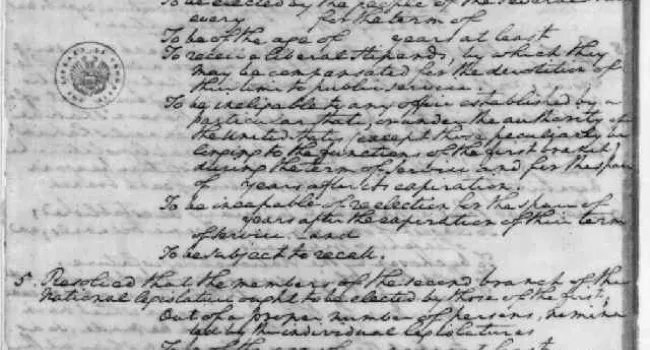
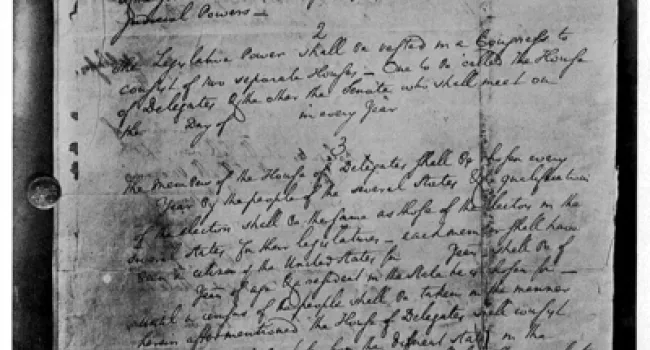
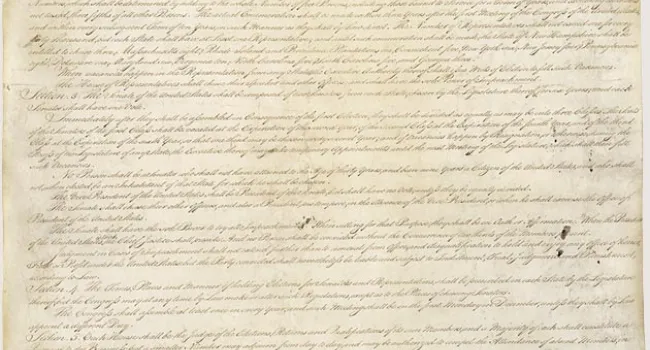
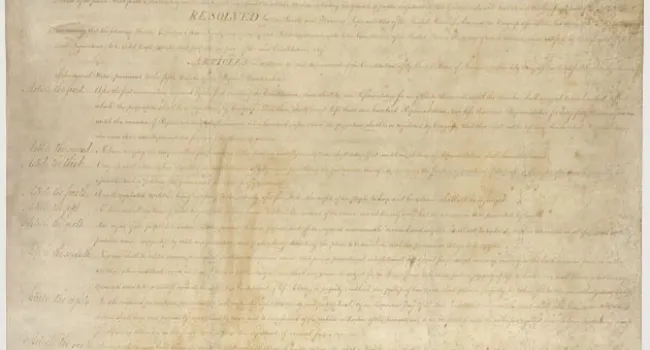
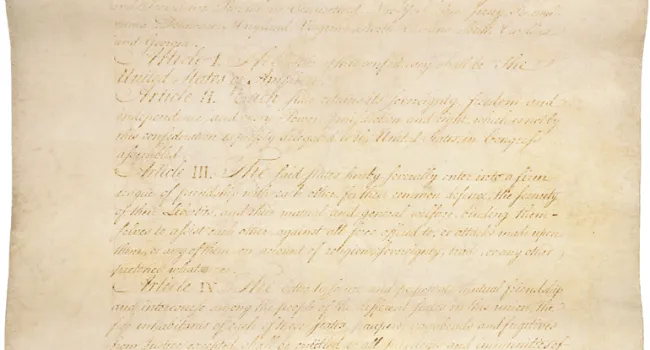
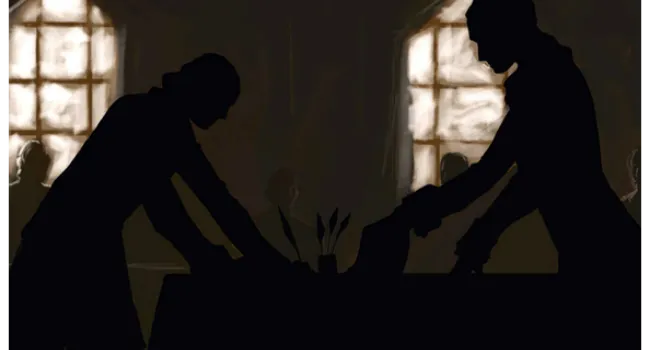
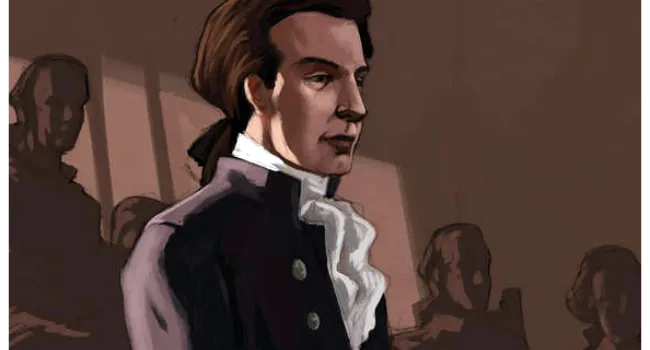
Pinckney's plan consisted of three branches of government--a Legislative Branch, a Judicial Branch, and an Administrative Branch, consisting of a single-member executive. Madison's notes indicate that the Convention came to a stop at that moment. Many of the delegates were startled at this idea because the only single executive they knew was the king. Ben Franklin was able to get the discussion started again. After an enormous amount of discussion, the plan that we know was Pinckney's was accepted.
In Pinckney's plan, the President would be the Commander in Chief and serve for a term of seven years. Each year, the President would report to the Legislature in a State of the Union Address and the President could call the Legislature into session, if need be, and dismiss it, if need be. The Legislature could impeach the President. Representation to both houses of the Legislative Branch was based on a state's population. For the lower house, Pinckney's plan used the 3/5 Clause, allowing every five slaves to be counted as three people. Northerners argued that slaves were not considered to be citizens and couldn't vote, so they were not to be considered part of the population base. This ensured that the South would have greater representation in the Congress than it otherwise would have had. With slavery in the background throughout the Convention, the discussion changed over the summer from one about a perception of large states versus small states, to one about North versus South, which obviously meant slavery. Many of the Founding Fathers, especially those in the South--Madison, Jefferson, Washington, Monroe, for example, lived surrounded by a population that had no rights. That recognition was a powerful force that contributed to the level of dissatisfaction that fueled the American Revolution.
Another reason that Pinckney may have a damaged historical reputation is that he was an insistent defender of the interests of the slave states, a justifier of slavery. When they were out to defend the interests of the folks back home, they wouldn't hold back. His statement, "If slavery be wrong, then it's justified by the history of the world." Being a white Southern man of his time, that was his world view.
Part of Pinckney's plan that was not included originally was a small Bill of Rights--Trial by Jury, the Writ of Habeus Corpus, Freedom of the Press, Freedom of Religion. It was not until later that the Bill of Rights would be added. Pinckney and James Madison worked together on a provision about religion, and it can be seen clearly that the language in his draft and the language in the Constitution are very similar and that is one of the areas where we can see clearly that his draft had a major influence on the Constitution. This comes from his ideas that are developing and evolving about democracy and equality.
Dr. Walter Edgar reminds us that "all of the stories about the Constitutional Convention come from James Madison's pen, so who makes himself the hero of the Constitutional Convention? He does."
Pinckney's plan consisted of three branches of government--a Legislative Branch, a Judicial Branch, and an Administrative Branch, consisting of a single-member executive. Madison's notes indicate that the Convention came to a stop at that moment. Many of the delegates were startled at this idea because the only single executive they knew was the king. Ben Franklin was able to get the discussion started again. After an enormous amount of discussion, the plan that we know was Pinckney's was accepted.
In Pinckney's plan, the President would be the Commander in Chief and serve for a term of seven years. Each year, the President would report to the Legislature in a State of the Union Address and the President could call the Legislature into session, if need be, and dismiss it, if need be. The Legislature could impeach the President. Representation to both houses of the Legislative Branch was based on a state's population. For the lower house, Pinckney's plan used the 3/5 Clause, allowing every five slaves to be counted as three people. Northerners argued that slaves were not considered to be citizens and couldn't vote, so they were not to be considered part of the population base. This ensured that the South would have greater representation in the Congress than it otherwise would have had. With slavery in the background throughout the Convention, the discussion changed over the summer from one about a perception of large states versus small states, to one about North versus South, which obviously meant slavery. Many of the Founding Fathers, especially those in the South--Madison, Jefferson, Washington, Monroe, for example, lived surrounded by a population that had no rights. That recognition was a powerful force that contributed to the level of dissatisfaction that fueled the American Revolution.
Another reason that Pinckney may have a damaged historical reputation is that he was an insistent defender of the interests of the slave states, a justifier of slavery. When they were out to defend the interests of the folks back home, they wouldn't hold back. His statement, "If slavery be wrong, then it's justified by the history of the world." Being a white Southern man of his time, that was his world view.
Part of Pinckney's plan that was not included originally was a small Bill of Rights--Trial by Jury, the Writ of Habeus Corpus, Freedom of the Press, Freedom of Religion. It was not until later that the Bill of Rights would be added. Pinckney and James Madison worked together on a provision about religion, and it can be seen clearly that the language in his draft and the language in the Constitution are very similar and that is one of the areas where we can see clearly that his draft had a major influence on the Constitution. This comes from his ideas that are developing and evolving about democracy and equality.
Dr. Walter Edgar reminds us that "all of the stories about the Constitutional Convention come from James Madison's pen, so who makes himself the hero of the Constitutional Convention? He does."