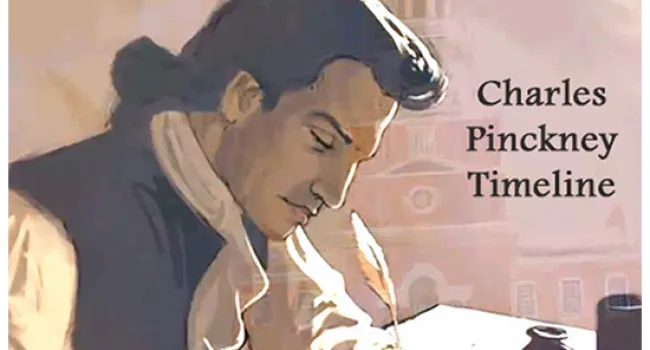
Charles Pinckney is one of the oldest and most historically distinguished names in South Carolina. Having arrived in America in 1692 Thomas Pinckney (Charles Pinckney's great grandfather) was a wealthy English gentleman, who quickly established an enduring base of political power in Charleston. Likewise, his grandson Colonel Charles Pinckney was a prominent plantation owner, lawyer, and a military and political leader. He married Frances Brewton and they had one child, Charles Pinckney, born in Charleston on October 26, 1757. Two other notable Pinckney family members from the era were Charles Pinckney's first cousins; Charles Cotesworth Pinckney and Thomas Pinckney, the sons of famous indigo entrepreneur Eliza Lucas Pinckney. Both became great statesmen in their own right.
Charles Pinckney was born and reared purely as a South Carolinian, receiving his education from a private tutor, followed by a law degree he earned under the personal direction of his father. Charles came of age at the cusp of the American Revolution. After being accepted to the South Carolina Bar and elected to the general assembly in 1779 at the age of 21, Charles had to post-pone his political aspiration to take up arms as the British advanced on the colony. He enlisted in the South Carolina militia as a lieutenant. He fought at the siege of Savannah in an attempt to take over a British garrison where he witnessed heavy patriot casualties. After being forced back to his home city, he was captured during its fall, the single worst defeat of the war. He was originally housed in a British prison ship in Charleston Harbor, until paroled to sit out the rest of the war in Philadelphia. Experiences in the war and associations formed with other patriots during his time in Philadelphia would have a lasting impact on the young Patriot.
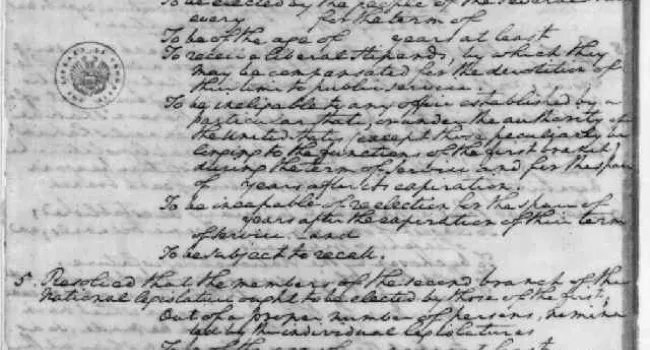
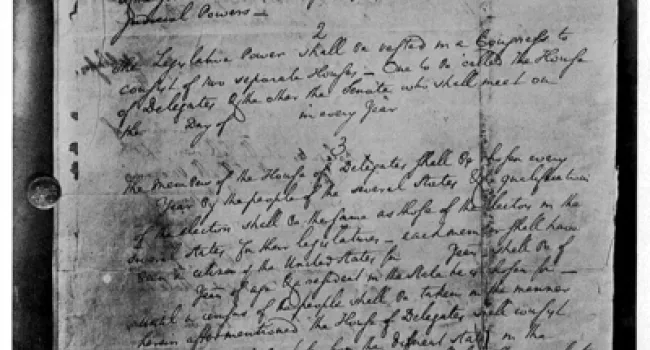
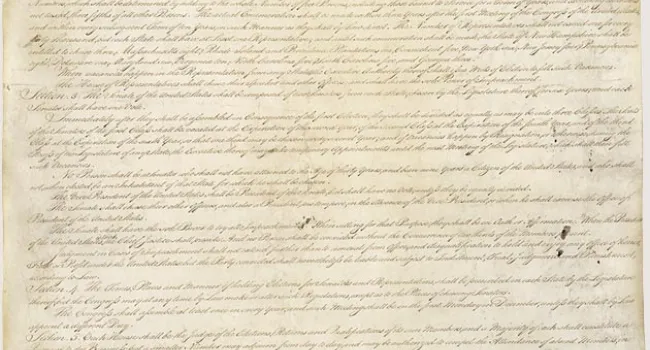
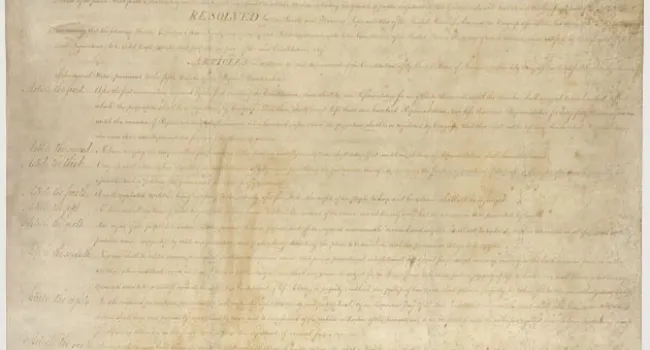
After the war Pinckney resumed his duties in the South Carolina Legislature. In 1784 he was called to represent the state in the Confederation Congress for 3 consecutive years where, as a sub-committee chairman, he forged a plan to amend the Articles of Confederation. Such expressions of dissatisfaction with the Articles by Pinckney and others eventually led to the Constitutional Convention in Philadelphia over the summer of 1787. Although he was one of the youngest in attendance, Pinckney proved to be one of the most active and outspoken of its members. Charles Pinckney presented his plan of government, the so-called Pinckney Draught, at the Constitutional Convention on May 29, 1787, the same day Edmund Randolph presented the Virginia Plan. However, Pinckney's Draft was the only complete plan, drawn up in its entirety by one member. It was this plan from which the delegates drew ideas as they revised the Virginia Plan. With strong views towards a powerful central government, Pinckney is purported to have taken up debate on the floor over 100 times during the convention. Among the more important issues for which Charles fought was the subordination of the military to civil authority. Whereas this provision held the President as Commander in Chief of military forces, it was explicit that Congress retains the power to declare war and that the President could not raise nor support forces by his own authority. He also tried unsuccessfully to include the guarantees of a trial by jury and freedom of the press, which would later be adopted as part of the Bill of Rights.
After returning to South Carolina from the Constitutional Convention, he was wed to Mary Eleanor Laurens on September 24, 1788. The following year he was elected to his first term as Governor of South Carolina, where he presided over a state constitutional convention and helped guarantee a provision for religious freedom.
During his second term as Governor, George Washington visited the farm Charles Pinckney had inherited from his father known as Snee Farm located on what is now Mt. Pleasant. During that visit President Washington also met with Pinckney at his residence in Charleston at 16 Meeting Street.
In 1794, shortly before being elected to yet another term as Governor, his wife Mary gave birth to a son, Henry Laurens Pinckney.
After serving two years of his third term as Governor, Charles was elected to the United States Senate. There his ideas about the role of the central government began to reflect more closely those shared by compatriot Thomas Jefferson, than those of Federalist opponents, which included Pinckneys cousin, Charles Cotesworth. This event sparked a rift within the Pinckney family. When Jefferson defeated Charles Cotesworth Pinckney in the 1800 election, he did so directly as a result of Charles Pinckney, who acted as Jeffersons campaign manager in the state and garnered him South Carolinas eight electoral votes - the exact number needed to put him over the top. After his inauguration, Jefferson appointed his friend and supporter as minister plenipotentiary to Spain. He served in this capacity from 1802 to 1804. Although unfairly accused of neglecting his duties while abroad, Pinckney was actually quite successful in nearly every major assignment that came his way.
During his appointment abroad, the result of being a life-long dedicated public servant evidenced a tragedy of sorts, which caused him to suffer great economic hardships. Despite this financial set back, he was elected for a final term as Governor, taking office in 1806.
In 1808, when the record of the Constitutional Convention was being recorded by John Quincy Adams, he found the Pinckney Draught missing from all records. He wrote to Pinckney, who sent Adams what he thought was a duplicate of the original. It was so similar to the actual ratified constitution that several people, including James Madison, considered it bogus and concluded that Pinckney was dubiously trying to refocus the credit. Hence it would be years before Pinckney received proper credit for his contribution the Constitution. Since then many researchers have concluded that the Virginia Plan included many ideas found in Pinckneys plan.
In 1810, Pinckney was once again elected to the South Carolina House of Representatives, where he served till 1814.
In 1819, he was elected to his final public office. Charles Pinckney served for three years in the United States House of Representatives. During this time he publicly opposed the Missouri Compromise and gave a dramatic and stirring speech, which foreshadowed the ardent state rights rhetoric that would rear its head over the coming years. When he left office he had amassed 42 years of public service.
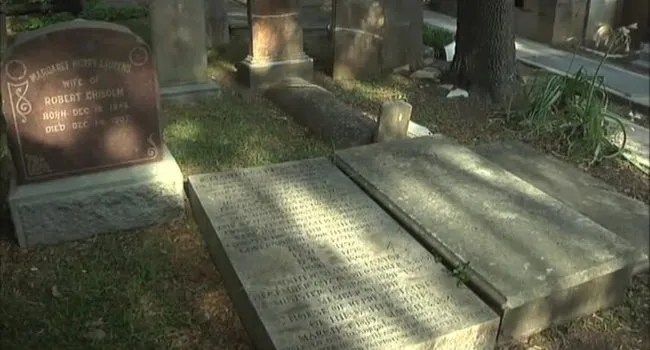
Pinckney died in Charleston, SC on October 29th 1824 and is buried in St. Philips Episcopal Churchyard.