Lesson
Grades
- 3
- 4
- 5
- 6
- 7
- 8
Students will design their own fort and identify its parts using colonial forts from South Carolina as models.
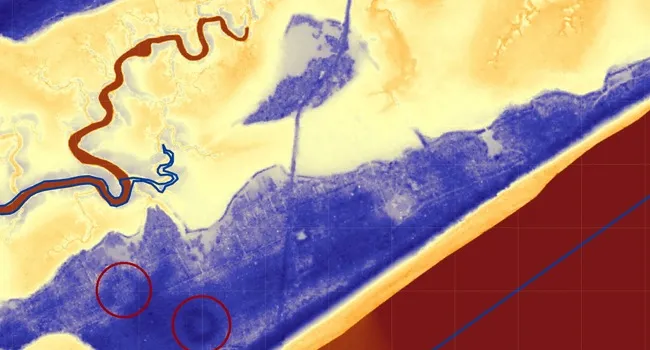
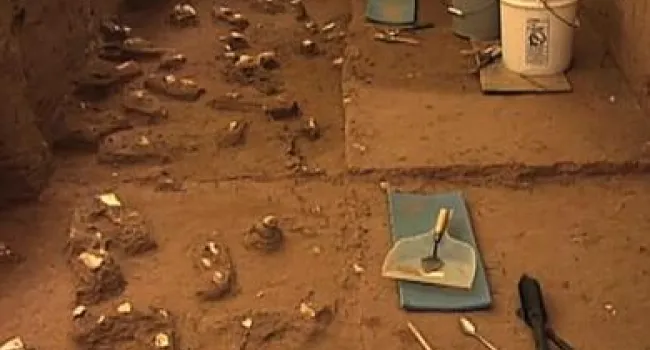
Investigating the Ring People in the coastal zone requires scientists of many disciplines. The technology of archaeology goes far beyond shovels.
Lesson
Grades
Students will design their own fort and identify its parts using colonial forts from South Carolina as models.

Lesson
Grades
Rice is the most consumed grain in the world, feeding more than 3 billion people every day. Students will learn about rice’s diversity and trace its history from its domestication in China 12,000...

Lesson
Grades
This lesson plan covers the topic of Black refugee settlements (otherwise known as contraband camps) in the American Civil War. In this lesson, students will learn how hundreds of thousands of runaway...

Lesson
Grades
Pottery is one of the most common types of artifacts found in the archaeological record. Students will learn how and why archaeologists study pottery and explore how pottery, along with other objects...

Lesson
Grades
This lesson plan explores how archaeologists study and classify projectile points (commonly referred to as arrowheads) into different “types” to learn about past people and cultures. After learning...

Lesson
Grades
This lesson plan is intended to introduce students to critical cartography, a subfield of geography that recognizes maps as inherently political objects subject to bias and hidden meaning. In this...

Lesson
Grades
Students will learn how maps are important primary resources for studying the past and how archaeologists can use historical maps to locate archaeological sites. This lesson plan covers how maps are...

Lesson
Grades
In this lesson plan, students will learn about the unique and complicated threat coastal erosion, sea level rise, and climate change poses to cultural sites. Students will examine how maritime...

Lesson
Grades
This lesson uses tabby, a historical building material local to coastal South Carolina, Georgia, and Florida, to explore chemical reactions, changes in the state of matter during chemical reactions...

Lesson
Grades
Students will explore the unique features and characteristics of South Carolina’s five landform regions: the Coastal Zone, the Coastal Plain (divided between the Inner and Outer Coastal Plain), the...

Lesson
Grades
Students learn about the atlatl, a prehistoric throwing tool that uses leverage, then build and test replicas to measure the increase in throwing distance compared to throwing by hand. They discuss...

Lesson
Grades
Students learn about mollusks, their characteristics and habitats, and how their shells provide clues to the diet of ancient hunter-gatherers who lived on the South Carolina coast thousands of years...

Lesson
Grades
Students brainstorm examples of artifacts archaeologists might find in prehistoric South Carolina and then analyze photos of real artifacts to understand how archaeologists use them to learn about...

Lesson
Grades
Students build model beaches and use waves to simulate coastal erosion, observing how it disturbs and destroys archaeological sites. They then explore engineering solutions to reduce erosion and...

Lesson
Grades
Students design a mock archaeological site and simulate a survey using punch holes to represent shovel test pits. They then discuss the limitations of this method and explore how geophysics offers a...

Lesson
Grades
Students explore the concept of radioactive decay and half-life through a penny-flipping activity, then learn how this principle is used in radiocarbon dating to estimate the age of ancient organic...

Lesson
Grades
Students build a miniature landscape in a sandbox and use tools to measure elevations at various points. By converting these measurements and coloring a graph, they create a 2D elevation model similar...
Lesson
Grades
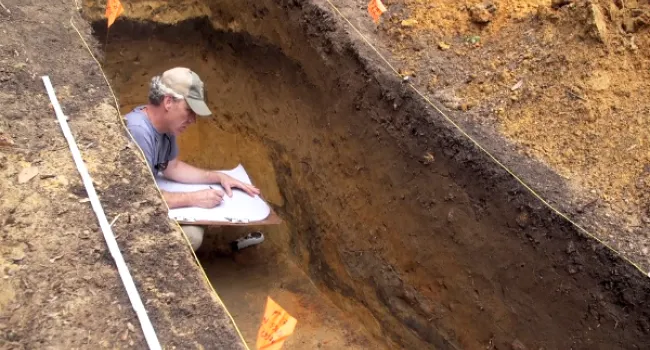
Students become archaeologists for a day, creating scaled drawings of a mock excavation unit to document its features and artifacts. Through this activity, they explore the importance of accurate...
Video
Grades

Video
Grades

Video
Grades

Video
Grades

Video
Grades

Video
Grades
Resources on archaeology on Knowitall.org. October is SC Archaeology Month.

The Science, Technology, Engineering, and Mathematics (STEM) cluster offers careers in engineering, research, and technical services across various industries. Careers in STEM include mechanical engineers, software...