Next Step en Français 209: Looking at Zoo Animals - Episode 209

Kaltura

A variety of French vocabulary words that are used in the context of the zoo.

Vocabulary used in this episode:

Nouns of Animals

  • monkey /  le singe
  • elephant  / l’éléphant
  • polar bear  /  l’ours polaire (m)
  • tiger  /  le tigre
  • wild boar  /  le phacochère
  • giraffe /  la girafe
  • flamingo  /  le flamand rose
  • lion  /  le lion
  • turtle /  la tortue
  • octopus  /  la pieuvre
  • penguin /  le pingouin
  • snake /  le serpent

Verbs

  • to climb  / grimper
  • to walk  / marcher
  • to swim  /  nager
  • to be sleepy  / avoir sommeil

Continents

  • North America  /  l’Amérique du Nord (f)
  • South America  /  l’Amérique du Sud (f)
  • Africa   /  l’Afrique (f)
  • Asia  /  l’Asie (f)
  • Australia  /  l’Australie (f)
  • Antarctica  /  l’Antartique (m)
  • Europe /  l’Europe (f)

Adjectives

  • beautiful  /   beau (belle)
  • tall  /  grand(e)
  • wet  /  mouillé(e)
  • ferocious  /  féroce
  • small  /  petit(e)
  • ugly  /  laid(e)

Lesson 9 - Zoo Animals

Objectives

  1. To learn names of certain animals
  2. To learn verbs of motion regarding those animals
  3. To learn names of some continents
  4. To study and review some descriptive adjectives

Information for the Teacher

In French schools, children learn that there are five continents: America, Europe, Asia, Africa and “Oceanie” which encompasses Australia, the South Pacific Islands and New Zealand.

Description of the Video Lesson

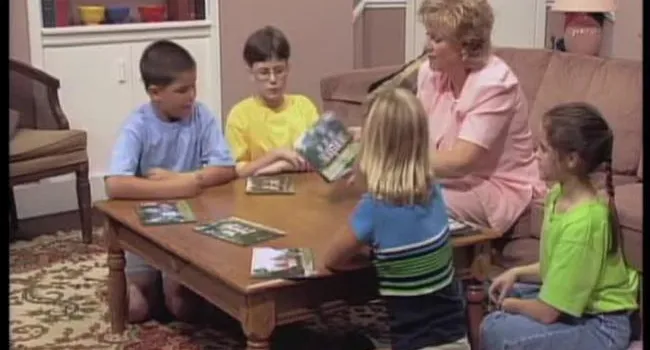
Mme. Dubois is talking to students who have each brought two stuffed animals. She tells them the name of those animals and on what continent they live, placing each animal on its corresponding continent on a world map.

Video Clips
Zoo animals in action, Descriptions of zoo animals

Mme. Dubois and students talk about the physical characteristics of certain animals. The giraffe and the flamingo have a long neck. The monkeys have long legs, arms and tail. The zebra, the tiger, the elephant, the giraffe and the lion have long tails. The lion also has a mane. The elephant has large ears and a trunk. The tiger has strips, and so does the tiger.

Also they go over how some animals move around: flamingos fly, elephants, monkeys, giraffes, tigers, zebras and lions run.

Video Clips 
Zoo animals in action, Descriptions of zoo animals

Game: Each student grabs an animal from a bag, says what it is, what it looks like and where it lives.

Song                  
Nous allons au zoo

le singe            l’éléphant        le tigre             le lion grimpe            nage    féroce

Follow-up Activities

  1. Use the Next Step French Again video lesson to review the emphasized vocabulary.
  2. Have pictures of zoo animals. Group them by physical characteristics. You could write “quatre pattes” (four legs) “deux pattes” (two legs), “a rayures” (has stripes), “cou long” (long neck).
  3. Using the same pictures as activity two. group animals by the way they move.
  4. Create a graph of animal locomotion. Put the actions on the top “courent, marchent, sautent, rampent, nagent” (run, walk, jump, crawl and swim). Put pictures of the animals in the appropriate graph square.
  5. Have students draw 1-2 animals. Have them label animal body parts and colors. An alternative: students draw “Crazy Animals” with parts from various species put together and labeled.
  1. After these follow-up activities, let students view the video lesson again so they can respond and practice with the children on the lesson.

Supplemental Activities

  1. Have a global map. Have cut-outs of pictures of animals. Show animal. Student names it in French and puts it on right continent on the board.
  2. Using a large “Twister”-type game mat, place drawings of various animal parts on the circles. Students close their eyes and toss a beanbag onto the mat, opening their eyes and naming the animal part the beanbag lands upon and an animal possessing that part.

Remember to use the vocabulary words as much as possible in class during the next week. This should be especially easy since the words relate to the days of the week. Every morning ask the students in French what day is today (Quel jour sommes-nous?) and they should answer with “Aujourd’hui c’est                     .

More in this Series

Foreign Language: French / 201-210 Next Step en Français

Next Step en Français 207: Learning at My School
   - Episode 207 Next Step en Français 201: Meeting Again 201

Video

Grades

  • 3
  • 4
  • 5
  • 6
  • 7
  • 8
  • 9
  • 10
  • 11
  • 12
Next Step en Français 201: Meeting Again
Episode 201
This lesson covers the vocabulary words that are used in French when you meet someone for the second time. Vocabulary used in this episode: Family / Members father / le père mother / la mère son / le...
 Next Step en Français 202: Visiting My Home 202

Video

Grades

  • 3
  • 4
  • 5
  • 6
  • 7
  • 8
  • 9
  • 10
  • 11
  • 12
Next Step en Français 202: Visiting My Home
Episode 202
A variety of French vocabulary words that are used around the house. Vocabulary used in this episode: Prepositions inside / dedans outside / dehors on (top of) / sur under / sous next to / à côté de...
Next Step en Français 207: Learning at My School
   - Episode 207 Next Step en Français 203:  Buying Groceries 203

Video

Grades

  • 3
  • 4
  • 5
  • 6
  • 7
  • 8
  • 9
  • 10
  • 11
  • 12
Next Step en Français 203: Buying Groceries
Episode 203
A trip to the grocery store teaches students a variety of food-related vocabulary words. Vocabulary used in this episode: I’m hungry / j’ai faim I’m thirsty / j’ai soif It was good / c’était bon It...
Next Step en Français 207: Learning at My School
   - Episode 207 Next Step en Français 204: Growing Up Healthy 204

Video

Grades

  • 3
  • 4
  • 5
  • 6
  • 7
  • 8
  • 9
  • 10
  • 11
  • 12
Next Step en Français 204: Growing Up Healthy
Episode 204
Tips on how to grow up healthy -- in French. Vocabulary used in this episode: Verbs to walk / marcher to march / marcher au pas to run / courir to dance / danser to throw / lancer to kick (a ball) /...
Next Step en Français 207: Learning at My School
   - Episode 207 Next Step en Français 205: Choosing a Present 205

Video

Grades

  • 3
  • 4
  • 5
  • 6
  • 7
  • 8
  • 9
  • 10
  • 11
  • 12
Next Step en Français 205: Choosing a Present
Episode 205
This video teaches French vocabulary words that are used when choosing a present for a friend. Vocabulary used in this episode: Shapes triangle / le triangle circle / le cercle square / le carré...
Next Step en Français 207: Learning at My School
   - Episode 207 Next Step en Français 206: Playing with Animals 206

Video

Grades

  • 3
  • 4
  • 5
  • 6
  • 7
  • 8
  • 9
  • 10
  • 11
  • 12
Next Step en Français 206: Playing with Animals
Episode 206
Improve your French vocabulary with words related to pets and other animals. Vocabulary used in this episode: Animals cat / le chat dog / le chien turtle / la tortue bird / l’oiseau (m) fish / le...
Next Step en Français 206: Playing with Animals
   - Episode 206 Next Step en Français 207: Learning at My School 207

Video

Grades

  • 3
  • 4
  • 5
  • 6
  • 7
  • 8
  • 9
  • 10
  • 11
  • 12
Next Step en Français 207: Learning at My School
Episode 207
This lesson teaches French words that are used in the classroom and around the school. Vocabulary used in this episode: Nouns pencil / le crayon book / le livre paper / le papier scissors / les...
Next Step en Français 207: Learning at My School
   - Episode 207 Next Step en Français 208: Finding Places in My Town 208

Video

Grades

  • 3
  • 4
  • 5
  • 6
  • 7
  • 8
  • 9
  • 10
  • 11
  • 12
Next Step en Français 208: Finding Places in My Town
Episode 208
This lesson teaches the French words used for directions and landmarks, and other French words that are needed to find your way around town. Vocabulary used in this episode: Nouns fireman / le pompier...
Next Step en Français 207: Learning at My School
   - Episode 207 Next Step en Français 210: Celebrating with Friends 210

Video

Grades

  • 3
  • 4
  • 5
  • 6
  • 7
  • 8
  • 9
  • 10
  • 11
  • 12
Next Step en Français 210: Celebrating with Friends
Episode 210
This lesson teaches you how to use French vocabulary words when visiting with friends at an event or a party. Vocabulary used in this episode: I’m ________ years old. / J’ai ________ ans. I’m from ___...