A variety of French vocabulary words that are used around the house.
Vocabulary used in this episode:
Prepositions
- inside / dedans
- outside / dehors
- on (top of) / sur
- under / sous
- next to / à côté de
- between / entre
- inside / dans
- behind / derrière
Nouns
- house / la maison
- car / la voiture
- train / le train
- boat / le bateau
- den/ le salon
- kitchen / la cuisine
- dining room / la salle à manger
- garage / le garage
- yard / le jardin
- chair / la chaise
- table / la table
- armchair / le fauteuil
- plate / l’assiette
- bed/ le lit
Verbs
- sit down! / asseyez-vous!
- get up! / levez-vous!
Adjectives
- big/tall / grand(e)
- small/short / petit(e)
- new / neuf (neuve)*
- old / vieux (vieille)*
Lesson 2 - Visiting My House
Objectives
- To learn the names of different rooms in a house
- To learn some descriptive adjectives
- To study prepositions of location
Culture French houses
- Due to the fact that land is sparse and very expensive, most French houses are two stories and have much smaller yards than American houses.
- Most French front and backyards are surrounded by fences. French people are very territorial.
- French houses have shutters that people close in the evening and open every morning. It gives them privacy. Shutters also protect from the heat and the cold.
Information for the Teacher
Some adjectives have irregular feminine forms:
*neuf (masculine)  neuve (feminine)
*vieux (masculine)  vieille (feminine)
Before Viewing the Video Lesson
- Review the vocabulary words from lesson 1.
- Ask students previously to bring pictures of their houses or apartments and talk about them (English is appropriate here). Discuss how many floors the house has or which floor in a building they live in. How many people live in their house? What color is their house? What size is their house?
Description of the Video Lesson
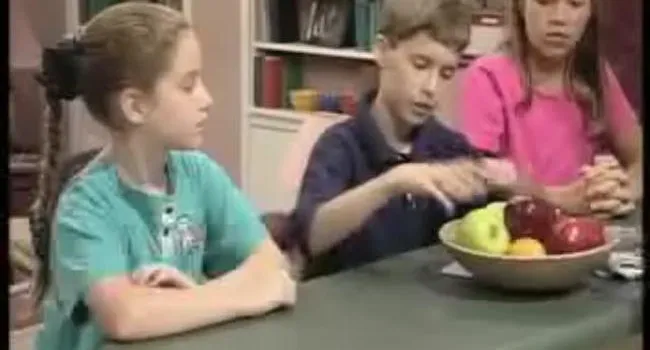
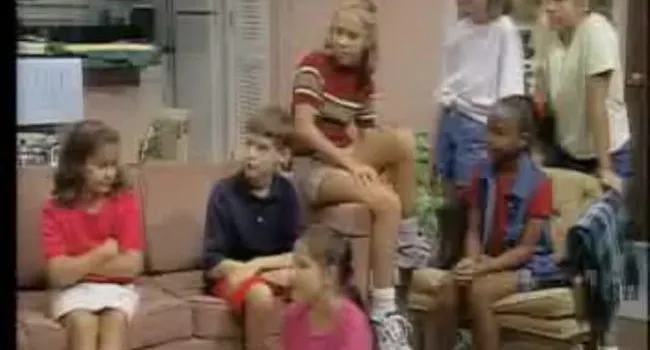
The students are again at the teacher’s house. They have brought along pictures of their houses. They are describing them, telling about their size, colors, etc. Patrick is embarrassed because his house is pink.
Video clips
Little bird introduces, prepositions, descriptive adjectives
The teacher and students play “Simon Says” (Jacques a dit.) She tells the students to do certain things using prepositions of location (on, behind, between, in front of, under).
Video clips
Looking for my shoe, Little bird - prepositions
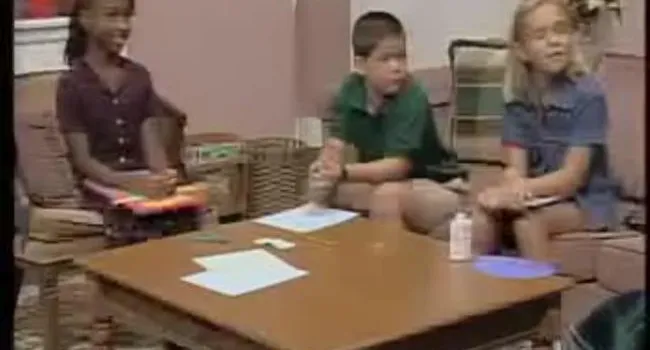
Mme. Dubois and children are sitting around the coffee table. She shows them a house floor plan. She introduces the rooms of the house by saying where each family member is: the baby is in his room, on the bed; the sister, in the den, on a chair; the father, in the garage, behind a car; the mother, in the kitchen, between the table and the chair; the brother, outside, but he rushes inside to go to the bathroom.
Song
My House (Ma Maison)
Video clips
Houses (Inside and Outside) sur sous petit(e) grand(e) la maison
Follow-up Activities
- Use the Next Step French Again video lesson to review the emphasized vocabulary.
- Play a “hide the shoes” game. Take a few shoes and put them under a chair (sous la chaise), on top of a table or desk (sur la table), next to someone (à coté de), in between two chairs (entre les chaises). Have students help you find them and tell you the place in French.
- Draw your house, apartment, mobile home, etc. Label each room in French. Child can then say "My house has bedrooms." Ma maison a chambres (bedrooms) Ma maison a un (one) garage. Ma maison a une (one) cuisine (kitchen). Ma maison a un salon (living room). Ma maison a une salle à manger (dining room).
- Watch the second scene again. Then if teacher feels comfortable she could ask the children "Où est (child's name)?” Write the prepositions of place on board or on sentence strips. Also put pictures or draw some objects such as table and chairs. We strongly recommend not using English translation. Instead, watch the video activities involving prepositions of place until all feel relatively comfortable with their meanings. Then have a few children stand in a specific place, ‘behind a chair’, ‘next to ’, ‘in front of ’. Teacher asks "Où est ?”. Kids respond with preposition of place and object.
- After these follow-up activities, let students view the video lesson again so they can respond and practice with the children on the lesson.
Supplemental Activities
- Play “What is it” games with rooms and furniture? Qu’est-ce que c’est? (What is this?) The students would answer C’est (It is ) or Ce sont (They are). Use pictures of rooms and furniture, or use a dollhouse and furniture.
- Play similar games as those in the lesson where a student pretends to do an activity that would take place in a particular room and let other students guess which room he is ‘in’.
- Play with the magic box. Take any object kids know in French and ask "Où est?" Let kids answer you with on (sur), below (sous), inside (dedans), outside (dehors) followed by "la boîte" (the box).
Remember to use the vocabulary words as much as possible in class during the next week. This should be especially easy with the number and color words. Add work to the suitcase folders.