Tips on how to grow up healthy -- in French.
Vocabulary used in this episode:
Verbs
- to walk / marcher
- to march / marcher au pas
- to run / courir
- to dance / danser
- to throw / lancer
- to kick (a ball) / shooter
- to jump / sauter
- to ride a bike / faire du vélo
- to turn / tourner
- to smell / sentir
- to listen to / écouter
- to see / voir
- to taste / goûter
- to touch / toucher
- to open / ouvrir
- to close / fermer
Body Parts
- ears / les oreilles (F)*
- eyes / les yeux (M)
- nose / le nez
- mouth / la bouche
- hands / les mains (F)
- arms / les bras
- legs / les jambes
- feet / les pieds
Months
- January / janvier
- February / février
- March / mars
- April / avril
- May / mai
- to the left / à gauche
- to the right / à droite
- drawer / le tiroir
- window / la fenêtre
- door / la porte
Lesson 4 - Growing Up Healthy
Objectives
- To learn action verbs
- To learn body parts
- To learn verbs related to body parts (to hear...)
- To review months (January through May)
Culture
In French, when abbreviating a date, you start with the day, then the month and year. For example, 12-1-68 is January 12th, 1968.
In France, soccer is the number one sport, then come tennis and cycling. French schools don’t have sports teams. They just offer P.E. Anyone who wants to play a team sport can join a local league.
Information for the Teacher
*(F) and (M) indicate the gender, feminine or masculine, of a noun, since in the plural form the article “les” is the same for both masculine and feminine nouns.
Description of the Video Lesson
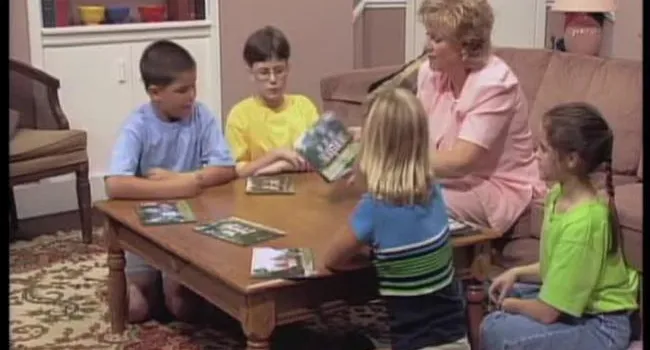
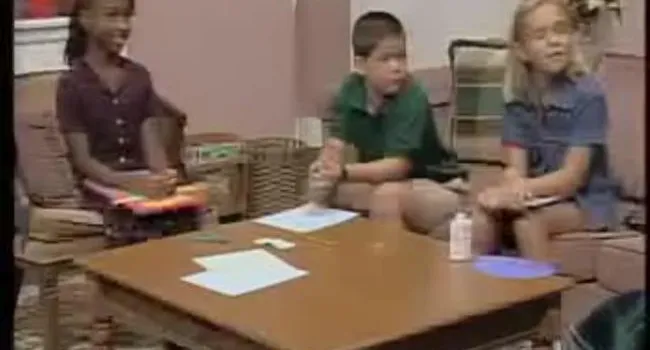
Two students are at Mme. Dubois’ house. A third one, Taylor comes in. She just finished a dance lesson. Mme. Dubois suggests to play a game. She tells the students to do certain things, a certain way. The students have to figure out what it is and do it (dance, slow, fast; march; jump; turn.)
Video Clips
At a dance studio, In the yard
Each student was given a different ball. They each have to describe it. Then, they say where they can put it: on head, nose, under feet. Then, they all sing the French song “Alouette” introducing different body parts such as: head, nose, hands and feet.
Video Clips
Open/close doors, Drawers/windows, Car turning left/right
Mme. Dubois and the children are gathered round the coffee table, looking at a grid. On one side are body parts, on the other, balls. The students have to tell her what body part you can use to play different ballgames (basketball, baseball, soccer, and football.)
Video Clip
At the doctor’s
Song
En haut, en bas (up, down)
Video Clips
Little bird introduces more prepositions
Months
| les oreilles | les yeux | le nez | la bouche |
| les bras | les jambs | les pieds | en haut |
| en bas | lance | tourne | vole |
| cours | marche | à gauche | à droite |
Follow-up Activities
- Use the Next Step French Again video lesson to review the emphasized vocabulary.
- Have children draw themselves and label the body parts that they have learned.
- Teacher could play "Simon Says" by using the vocabulary words. She would say "Jacques a dit marchez (walk), tournez (turn), dansez (dance), écoutez (listen), touchez … (touch…) le nez (the nose), les yeux (the eyes), etc…
- Pick 4 action phrases from the following list. Je marche (I’m walking), Je cours (I’m running), Je marche au pas (I’m marching), Je danse (I’m dancing), Je lance le ballon (I throw the ball), Je shoote le ballon (I kick the ball), Je saute (I’m jumping), Je fais du vélo (I ride a bike). Fold paper in grids of 4-6 boxes. Write one sentence on each grid. (Note: 4th and 5th grade students should be able to copy the phrases themselves) Run copies for kids. Have them draw themselves in each box drawing the appropriate action. Again we recommend no English translations. Watch show until you're comfortable with the phrases.
- After these follow-up activities, let students view the video lesson again so they can respond and practice with the children on the lesson.
Supplemental Activities
- Draw picture of ‘person’ divided into body parts. This ‘person’ can be related to the most recent holiday (i.e. la skelette (skeleton); le Père Nöel (Santa Claus); le lapin (rabbit), etc.) Make a copy for each student. Ask students to cut out the parts, glue them in their proper placement on construction paper, and to label each part in French. These words can then be read to the teacher or another student for oral practice.
- Class vs. Teacher Game. Cut out pictures of (or draw) people performing the actions in the Verb Vocabulary (walking, jumping, running, opening, etc.). Point to a card, say the French word for the action, with the students repeating. Do this several times with different pictures, and then make a mistake! (Ex.: Call “marcher” (to walk) “sauter” (to jump).) If the class repeats the wrong word, the TEACHER gets a point. If they are SILENT, they get a point.
Remember to use the vocabulary words as much as possible in class during the next week. Use other vocabulary words from previous lessons. When you remind students to raise their hand, say “Lève la main”, etc. Continue to add to the Next Step French suitcase folder.