This lesson covers the vocabulary words that are used in French when you meet someone for the second time.
Vocabulary used in this episode:
Family / Members
- father / le père
- mother / la mère
- son / le fils
- daughter / la fille
- grandfather / le grand-père
- grandmother / la grand-mère
- brother / le frère
- sister / la soeur
- uncle / l’oncle
- aunt / la tante
- nephew le neveu
Numbers
- one (1) / un
- two (2) / deux
- three (3) / trois
- four (4) / quatre
- five (5) / cinq
- six (6) / six
- seven (7) / sept
- eight (8) / huit
- nine (9) / neuf
- ten (10) / dix
Days of the Week
- Monday / lundi
- Tuesday / mardi
- Wednesday / mercredi
- Thursday / jeudi
- Friday / vendredi
- Saturday / samedi
- Sunday / dimanche
Colors
- purple / violet (masculine), violette (feminine)
- orange / orange
- yellow / jaune
- red / rouge
Lesson 1 - Meeting Again
Objectives
- To learn names of family members
- To study numbers one through ten
- To learn the days of the week
- To study certain colors
Culture
When French people, who know each other, meet they shake hands or kiss. Men tend to shake hands whereas women and men and women kiss on the cheeks.
On a French calendar or agenda book, you’ll find that Monday is the first day of the week and not Sunday.
When counting on their fingers, the French begin with the thumb.
Information for the Teacher
- In French, the first day of the week is Monday.
- In French, you have to make adjectives agree in gender and number with the nouns they modify. To make an adjective feminine, you usually add an “e” to the masculine one, unless it already has an “e” in the masculine form. To make an adjective plural, you add an “s” to the singular form unless it already ends with an “s” in the singular form.
Before Viewing the Video Lesson
- Do the general introductory activities for the series if you have not already done so.
- Remind the students that they will not understand everything that is said on the video lesson and that this is not important because they are being immersed in the language. Hearing the language being used is very important and that only certain words and phrases will be learned from the program.
Description of the Video Lesson
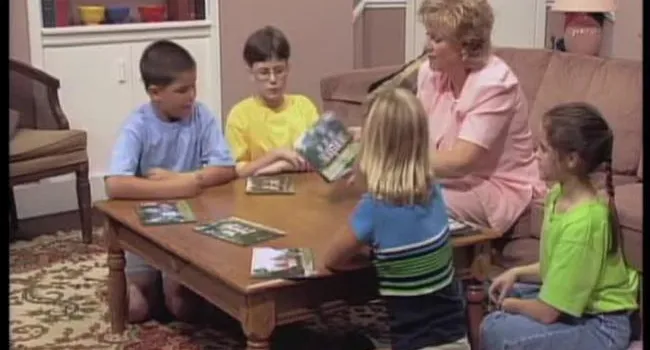
Madame Dubois welcomes children in her house. They brought along pictures of their families. They all sit down on the sofa and talk about each family member. The teacher introduces her own family too.
Video Clip
family members
Three other students stop by Mme. Dubois’ house. They introduce themselves to her. They tell her where they live. Then the teacher reminds Jay he has to leave to go to a birthday party.
Video Clip
birthday party, family members, counting apples (1-10)
Back at Mme. Dubois’ house, she shows the students a puzzle of the days of the week. They go over them together. Then, they play a game, “What day is it?” Each student has to guess what day Mme. Dubois is talking about.
Song
days of the week
Video Clip
flowers in garden, greetings
la mère le père la tante l’oncle la grand-mère le grand-père
Follow-up Activities
- Use the Next Step French Again to review the emphasized vocabulary.
- Make a week-long calendar on the blackboard. Ask students to name activities typically performed on each day, naming that day in French.
- Make large cards with the numbers 1 – 10 written upon them. Ask students to draw out the cards, naming the number in French.
- Show students pictures of various people. Let the children guess their likely relationships in a family.
Supplemental Activities
- Make a suitcase type folder from construction paper or a center cut manila file folder. Write Next Step French on the suitcase like that on the series opening logo. Do luggage type name tags for student names. Keep copies of students’ work in this suitcase.
- Create a French family tree. Include grandparents, aunts, uncles, and cousins.
- Re-create or talk about French birthday parties. They include all age groups from infants to grandparents. There is food, music, games, dancing, gifts, and surprises. Children dance with each other, their parents and grandparents. In the evening when the children go to sleep or to their rooms, the adults stay late dancing and partying. Foods at birthday parties include many of the same things as here: cake, soft drinks, ice cream, and candy.
- Let the children draw, and name in French, one of their family members. Have them color the picture and tell you which colors they are using.
- Teach the children "Joyeux Anniversaire" (same tune as Happy Birthday). Joyeux Anniversaire Joyeux Anniversaire Joyeux Anniversaire, (child’s name) Joyeux Anniversaire! Have them sing it to their classmates who are having a birthday.
- Telephone Game: Copy the international dialing page from your local telephone book. Make a copy for each student. Instruct students in dialing internationally: (011 or zero, un, un) must be dialed first. Show students how country codes, and sometimes city codes, must be dialed before the regular phone number. After practice, have students write 5 international numbers (inventing the regular phone numbers) in 5 minutes. Students trade their work with a partner. The first student to ‘translate’ the numbers into written French form and determine the country called, wins. I.e. 011 331 649-2315 will look like, “zero, un, un, trois, trois, un, six, quatre, neuf, deux, trois, un, cinq: France, Paris”
Remember to use the vocabulary words as much as possible in class during the next week. This should be especially easy since there are words of greetings and introductions, questions and answers about how are you, and polite words.