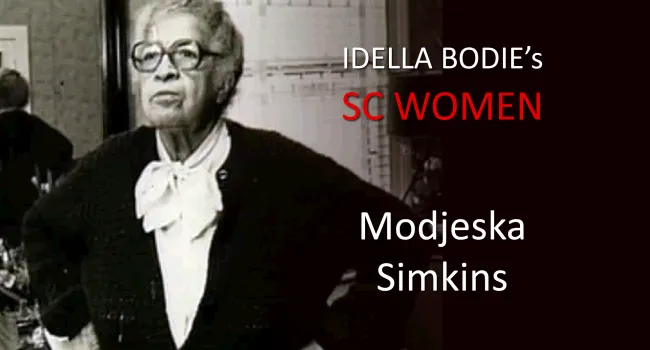
This is the story of an African American girl born to a half-white, half-black brick mason who came from relative wealth and married into wealth, but she dedicated her life to helping the disadvantaged to be treated equally. She was one of the organizers of the Supreme Court Case Briggs Vs. Elliott, which was the first filed of the four cases that later became combined Brown vs. Board of Education.
Classroom Activities
Research: Individual or small groups. Students utilize a variety of research materials to create a short presentation about different stages of Modjeska Simkin’s life: as a child living in Arkansas and South Carolina, as a young lady going to college, as an important figure in the process of equality for all, and as the leader in the lawsuit against Clarendon County. Explain why Modjeska was important to the state and nation. Reports should be presented to the class or larger group.
Character Education: Class Discussion. After researching Modjeska Simkins, the students should list the qualities that enabled her to achieve her goal as a leader in the fight for equality for all. List the many obstacles that Modjeska Simkins had to overcome to pursue her goal.
Compare and Contrast: Individual or small groups. Through Internet Websites and Media Center resources, students research and document information on the Clarendon County lawsuit that was spearheaded by Modjeska Monteith Simkins and others for equality in education. Compare information obtained on the Clarendon County lawsuit to the Brown vs. Board of Education lawsuit.
Analysis: What risks did Modjeska Monteith Simkins face by fighting for equal rights for all? What consequences might have occurred in this process?
Interview: Interview community members that attended different types of schools in the area during the 1950’s and 60’s to find out what impact the phrase “separate but equal” had on the school system. What differences were found in the physical plant of schools, materials and equipment as well as instructional qualifications of staff? Compare and contrast the differences.
Field Trip: Take a field trip to the Modjeska Monteith Simkins House located at 2025 Marion Street, Columbia, South Carolina. Historic Columbia Foundation manages the Modjeska Simkins House and also manages four historic house museums and their associated artifacts, and tells the stories of people, places and progress in Columbia and Richland County. For more information call 803-252-7742 or visit Historic Columbia Foundation’s website at http://www.historiccolumbia.org.
This is the story of an African American girl born to a half-white, half-black brick mason who came from relative wealth and married into wealth, but she dedicated her life to helping the disadvantaged to be treated equally. She was one of the organizers of the Supreme Court Case Briggs Vs. Elliott, which was the first filed of the four cases that later became combined Brown vs. Board of Education.
Classroom Activities
Research: Individual or small groups. Students utilize a variety of research materials to create a short presentation about different stages of Modjeska Simkin’s life: as a child living in Arkansas and South Carolina, as a young lady going to college, as an important figure in the process of equality for all, and as the leader in the lawsuit against Clarendon County. Explain why Modjeska was important to the state and nation. Reports should be presented to the class or larger group.
Character Education: Class Discussion. After researching Modjeska Simkins, the students should list the qualities that enabled her to achieve her goal as a leader in the fight for equality for all. List the many obstacles that Modjeska Simkins had to overcome to pursue her goal.
Compare and Contrast: Individual or small groups. Through Internet Websites and Media Center resources, students research and document information on the Clarendon County lawsuit that was spearheaded by Modjeska Monteith Simkins and others for equality in education. Compare information obtained on the Clarendon County lawsuit to the Brown vs. Board of Education lawsuit.
Analysis: What risks did Modjeska Monteith Simkins face by fighting for equal rights for all? What consequences might have occurred in this process?
Interview: Interview community members that attended different types of schools in the area during the 1950’s and 60’s to find out what impact the phrase “separate but equal” had on the school system. What differences were found in the physical plant of schools, materials and equipment as well as instructional qualifications of staff? Compare and contrast the differences.
Field Trip: Take a field trip to the Modjeska Monteith Simkins House located at 2025 Marion Street, Columbia, South Carolina. Historic Columbia Foundation manages the Modjeska Simkins House and also manages four historic house museums and their associated artifacts, and tells the stories of people, places and progress in Columbia and Richland County. For more information call 803-252-7742 or visit Historic Columbia Foundation’s website at http://www.historiccolumbia.org.
Standards
- 5.4.CC Analyze the continuities and changes of race relations in the United States and South Carolina following the Supreme Court decisions of Briggs v. Elliott and Brown v. Board of Education.
- 8.4.CC Analyze continuities and change in the African American experience in the period of Reconstruction and Jim Crow eras within South Carolina.
- This indicator was developed to encourage inquiry into the successes and failures of Reconstruction, beginning with the Port Royal Experiment, in South Carolina. This indicator was written to explore development of the Constitutions of 1868 and 1895 and to analyze the evolution of restrictions for African Americans from the Black Codes in 1866 through the Plessy decision in 1898.
- 8.5.CX Analyze the correlation between the Modern Civil Rights Movement in South Carolina and the U.S.
- This indicator was designed to foster inquiry into the role of South Carolina in the Modern Civil Rights Movement, to include the influence of court cases such as Briggs v. Elliot and Flemming v. South Carolina Electric and Gas. This indicator was also developed to promote inquiry into the relationship between national leadership, protests, and events and South Carolina leadership, protests and events, such as the Friendship Nine and the Orangeburg Massacre.
Resources
Modjeska Simkins (1899-1992) | Road Trip
Best known for her fierce stance on behalf of civil rights in South Carolina, the successful businesswoman served as NAACP State Secretary during the 1950s. The Columbia native Mrs. Simkins was...
View AssetModjeska Monteith Simkins | History of SC Slide Collection
Modjeska Monteith Simkins (1899-1992) is one of the outstanding civil rights leaders in South Carolina. The oldest of eight children of a bricklayer, she sought education not only for herself, but for...
View AssetModjeska Monteith Simkins House | Road Trip
Catherine Fleming Bruce, the Curator for the Modjeska Simkins House, gives a brief history of the Visanska-Starks Carriage House in the Waverly Community. The home is connected to Historically Black...
View AssetModjeska Simkins - Glossary | Idella Bodie S.C. Women
Glossary Abandon – leave place because of danger; leave somebody behind Career – long-term or lifelong job Communist – a supporter of Communism or a member of an organization that supports or...
View AssetRoad Trip Mid-State, Stop 1: Modjeska Simkins House
The Road Trip Mid-State crew visits the Modjeska Simkins house to understand more about South Carolina's struggle for Civil Rights.
View AssetRoad Trip Mid-State, Stop 2: James E. Clyburn
The Road Trip Mid-State crew speaks with Congressman James E. Clyburn.
View Asset