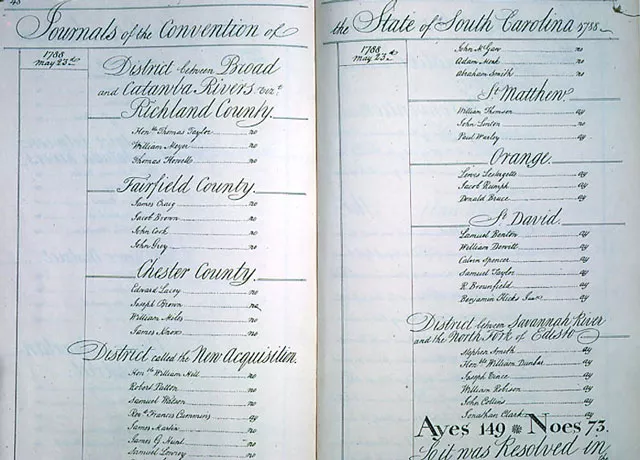
Delegates to a convention in Philadelphia in the summer of 1787 drew up a constitution to replace the Articles of Confederation. For the next year, supporters and opponents of the stronger national government embodied in their "federal plan" struggled to win the support of the people in the individual states. The new constitution would not become the law of the land until it had been ratified by nine states. Antifederalists, who opposed the constitution, argued that it threatened liberty by giving too much power to a President and a Congress who were too far removed from the people to understand their wants or respect their wishes. Federalists pointed out the difficulties that the Confederation government had faced because it could not raise revenues or regulate commerce. In South Carolina, the Federalists were mostly men from along the coast, merchants and planters involved in trade. Antifederalists predominated in the backcountry. Because the latter was underrepresented in the state apportionment system, there was little doubt about the outcome of South Carolina's constitutional ratifying convention, held from May 12-23, 1788, in City Hall, on the second floor of the Exchange Building in Charleston. Thomas Pinckney (see Thomas Pinckney) was chosen president of the Convention; his older brother Charles Cotesworth Pinckney (see Charles Cotesworth Pinckney), who had represented South Carolina in drawing up the Constitution in Philadelphia, chaired the committee that decided the rules for governing the convention. After two weeks of debate, the constitution was ratified by a vote of 149 to 73, the tally shown on the bottom right hand page of this Journal of the Convention. Note the places of residence for those who voted "Aye" and "Nay."
Courtesy of the South Carolina Department of Archives and History.
Standards
- 4.2.P Analyze the sequence of events that led to the establishment of the U.S. as a democratic republic.
- This indicator was developed to encourage inquiry into how land acquisition and the resulting border changes of the U.S. impacted the people of the western territories prior to Westward Expansion.
- 8.2.E Utilize a variety of primary and secondary sources to analyze multiple perspectives on the development of democracy in South Carolina and the United States.