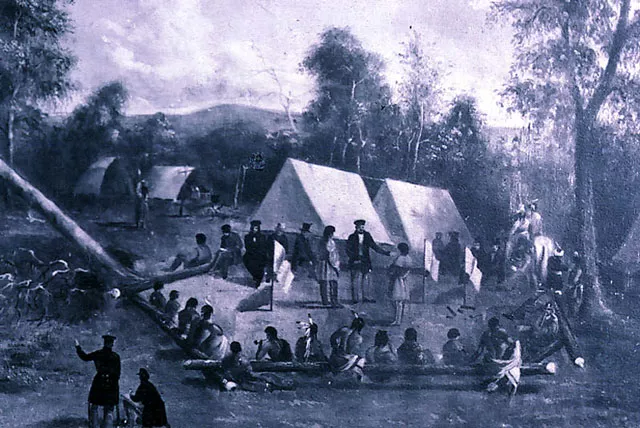
The Cherokee nation was gradually pushed out of the western Piedmont by the expanding European encroachment on their lands. The Cherokees in South Carolina had been hard hit by the attacks of Andrew Williamson in the Cherokee Campaign of the Revolution, July through October of 1776. By the Treaty of DeWitt's Corner following that campaign, the Cherokees ceded much of present-day Greenville, Pickens, Oconee, and Anderson Counties to the state, and South Carolina opened up the northwestern corner of the state to backcountry settlers. A final cession by treaty of Cherokee lands within South Carolina came in 1816. The Cherokee had by then largely moved further west, into Georgia and Tennessee. Despite a Supreme Court case (Cherokee Nation v. Georgia) in 1831 that upheld the legality of Cherokee ownership of lands, President Andrew Jackson in 1835 pushed through a series of measures that forced the Cherokee to move further west in a tragic episode known as "The Trail of Tears." The Cherokee Nation settled for a while on a reservation near Fort Gibson, Arkansas, where the South Carolinian Pierce Mason Butler (see Pierce Butler) visited them in 1843 in his work as an Indian agent for the federal government. Painting by John Mix Stanley.
Courtesy of the South Caroliniana Library.
Standards
- 4.3.CE Analyze the effects of government policies in promoting United States territorial expansion into the west.
- 8.2.CE Explain the economic, political, and social factors surrounding the American Revolution.
- Political and economic developments underscored how the colonists in British North America had become uniquely American, prompting the development of a new nation. Drawing on their experience under British rule, the founding generation created a government with shared powers between the state and federal institutions.
- This indicator was developed to encourage inquiry into the immigration and migration patterns of different groups within South Carolina, including their economic, political, and social power to do so. This indicator also promotes inquiry into an exploration of such ideas as the expansion of slavery and hostilities with the native peoples.
- This indicator was designed to encourage inquiry into the continuities and changes of the experiences of marginalized groups such as African Americans, Native Americans and women, as the U.S. expanded westward and grappled with the development of new states.