Tell Them We Are Rising: Successes and Failures of Reconstruction for People of Color

Students will determine major educational, social and political issues or problems facing African Americans following Reconstruction. Students will analyze the successes and failures of such institutions developed and evaluate their impact in the twenty-first century.
Lesson Partners: South Carolina State Library, National Parks Service, PBS LearningMedia
Essential Question
Essential Question: Determine if Historically Black Colleges and Universities were successful or not in creating political, social and educational opportunities for African Americans post Reconstruction?
Grade(s):
- 8
- 11
Subject(s):
Recommended Technology:
Smartboard
Internet
Chromebook/laptop
Other Instructional Materials or Notes:
Access to SC Public Library Databases needed.
Lesson Progression
1. Anticipatory Set:
a. Ask students: What is the American dream?
i. Ask students to determine how likely were African Americans to achieve the American dream post-slavery or the signing of the Emancipation Proclamation.
ii. What social, political and economic carryovers from slavery may still show up during Reconstruction?
b. Record student’s responses as a class or via Google classroom – students should use evidence to support their view from previous standards covered.
2. Continue with a discussion on the American dream and education. Compile a list of the students’ responses either on the Whiteboard/Smartboard/Google Classroom.
a. Ask the class "What is education for?” Ask students to consider the following propositions:
• To learn basic skills that will allow us to get jobs?
• To become "productive members of society?"
• To become good citizens?
• To instill certain moral and social values?
b. Ask students if they believe education will help African Americans achieve the American dream
3. Students will view material on life during Reconstruction –Explain what obtaining an education was like for African American post slavery.
i. Have students watch two videos detailing life for African American after the Emancipation Proclamation and the beginning of Jim Crow.
View video #1 – Life After Emancipation Proclamation Great Migration | The African Americans
o Students answer questions while viewing video:
• Three you learned about life after slavery.
• What was Jim Crow? What did Jim Crow look like?
• What happened to Thomas Moss?
o After viewing video students can complete the Successes and Failures of Reconstruction in South Carolina – Experiences of African Americans graphic organizer
View Video #2 - The Realities of Separate But Equal
• Students answer questions while viewing video:
• How did Charles Houston build a legal case against Jim Crow?
• Explain how Charles Houston saw himself as a soldier as a lawyer?
• What did Houston’s efforts help to lead to?
• What was the Negro Motorist’s Green Book?
• After viewing video students can complete the Successes and Failures of Reconstruction in South Carolina – Experiences of African Americans graphic organizer
4. Understanding the success and failures of Reconstruction (You can differentiate instruction in the various ways listed below)
a. Have students review The Era of Reconstruction pdf document. This document can be divided into groups for middle schoolers and then shared using a Jigsaw activity or shared via Google classroom.
i. Pages 9-27 – history in context Reconstruction
ii. Pages 23-38 – African American institutions
iii. Pages 33-38 – African American churches and civic organizations
iv. Pages 39-52 – African Americans and the right to vote
v. Pages 79-90 – Remaking the South after Reconstruction
vi. Each section can be analyzed using the Analyze History: Challenge, Choice and Changes handout
b. Have students search through Mind Map and take notes: Students can complete as a class or on their individual devices.
I. Visit Credo Reference
II. Type Reconstruction into search box (you may see Reconstruction era of the United States)
III. From the drop down box to the right click Mind Map
IV. Hit search
V. Students can go through the different sections using the Graphic Organizer Successes and Failures of Reconstruction in South Carolina – Experiences of African Americans
c. Have students read through the Britannica School reference for Reconstruction
i. You can switch from a 1, 2 or 3 Article Reading Level
ii. For the sections Origin of Reconstruction, Presidential Reconstruction, Radical Reconstruction, The end of Reconstruction have students complete either the Analyze History: Challenge, Choice and Changes handout or the Successes and Failures of Reconstruction in South Carolina – Experiences of African Americans graphic organizer
5. Now that students understand the successes and failures of Reconstruction, you will now move onto some of the specifics of how Reconstruction failed to protect the rights of African Americans by researching and learning about the following: (You can differentiate instruction in the various ways listed below)
a. Discriminatory groups and connection to the withdrawal of federal protection of freedmen
i. Have students read about why federal troops were sent to the South in this article – The Compromise of 1877
1. Explain why the troops were present.
2. Why were the troops asked to leave?
3. Explain what happened once the federal troops left.
ii. Have students watch the video clip - Slavery By Another Name | Radical Reconstruction
1. Explain what did the 13thand 14th amendment’s guaranteed
2. Explain what happens after federal presence of troops leaves in 1874?
b. Jim Crow laws -Analysis
i. Have students watch one or all of the following video clips about Jim Crow –
1. IslandThe Rise and Fall of Jim Crow | Edisto
2. The Rise and Fall of Jim Crow | Blacks and Whites in the New South
3. Resenting Prosperity and Equality | The African Americans
a. Write down three things learned about experiences of African Americans during Jim Crow
c. Have students choose three Jim Crow images to analyze from the Library of Congress
i. Students next access the Library of Congress Primary Source Analysis Tool
1. Select format – i.e. photographs and prints
2. Students can download and turn into teacher via Google classroom or print and turn in hard copy to teacher
d. Jim Crow laws – Research and inquiry
i. Have students read about Jim Crow using Britannica School
ii. You can switch from a 1, 2 or 3 Article Reading Level
e. Jim Crow buildings in South Carolina – Photo analysis
f. Voter restriction laws
i. Have students review the video - Reconstruction Brings White Resistance
1. What methods were used by white to ‘keep blacks in their place’?
6. Next have students look at African Americans responses to Jim Crow and discrimination overall
a. Students can begin by watching the video clip - The Rise and Fall of Jim Crow | Ida B. Wells: A Lifetime of Activism
i. Discuss three ways Ida B. Wells resisted discrimination of African Americans during this time period.
ii. What did Wells realize after the lynching of her friends?
7. In conclusion, the final assessment will have students evaluate the responses of African Americans, in the South – and South Carolina – response to failures of Reconstruction via education
a. Reiterate to students that during the Jim Crow era, many African Americans struggled to define the purpose of education. Booker T. Washington stressed vocational over cultural education, stating that "there is as much dignity in tilling a field as in writing a poem." On the other hand, W.E.B. Du Bois insisted that "the object of all true education is not to make men carpenters, it is to make carpenters men."
b. After watching the video Booker T. Washington and W.E.B. Du Bois: The Conflict have students discuss as a class or write down in a response to hand in: Who they believe had a valid point, DuBois or Washington.
c. Have students read - The debate over African American education.
i. Students must complete the graphic organizer - Who Was Right? DuBois vs. Washington
d. Have students research historically black colleges and universities in the South:
i. watch the video The Rise and Fall of Jim Crow | Booker T. Washington: An Education
ii. Education Among Freedmen Report of the Board of Education for Freedmen
1. While viewing the video clips have students consider
a. What was the purpose of creating the Tuskegee Institute?
b. How did the Hotzclaw family feel about an education?
e. Have students research the economic and educational status of African Americans today
i. PEW Research - Black-White household income
ii. PEW Research – Black-White college completion
iii. Students complete Argumentative Essay handout to determine – Are African Americans better of economically and educationally in the twenty-first century
8. Research the economic and educational impact of Reconstruction in the twenty-first century:
a. Review Historically Black Colleges and Universities
b. Watch video clips from Tell Them We Are Rising: The Story of Black Colleges and Universities
i. Middle or High School – Read An Uncertain Future for the Nation’s Oldest HBCU (from POV Reference Center – SC State Library Resource – search HBCU)
1. Discuss as a class when completed or have students submit Two-Column Note handout via Google classroom
ii. High School - Do you find any similarities in the 1974 article by Dr. Arthur Teele – The Contributions of Black Colleges and Universities? (resource from SC State Library – History Reference Center – enter keywords black colleges and universities)
1. Discuss as a class when completed or have students submit Two-Column Note handout via Google classroom
iii. High School – Have students listen to this audio – Traditional Black College and Universities in North Carolina (resource from SC State Library – History Reference Center – enter keywords black colleges and universities)
1. Discuss as a class when completed or have students submit Two-Column Note handout via Google classroom
iv. Top HBCUs Graduating African-Americans (from POV Reference Center – SC State Library Resource – search HBCU)
1. Discuss as a class when completed or have students submit Two-Column Note handout via Google classroom
2. What can you ascertain about the Allen University by looking through the images
a. Provide at least five images and explain your interpretation
Final Assessment: Determine if Historically Black Colleges and Universities were successful in creating political, social and educational opportunities for African Americans post Reconstruction? What evidence do you see in the twenty first century?
1. Have students view these video clips to understand what is an oral history interview?
a. Video #1
b. Video #2
c. Discuss as a class – What is an oral history interview? Why are oral history interviews important?
2. Find individuals to interview: Divide class into groups:
a. One group will interview people who attended an HBCU.
i. Example of questions for this group:
1. Do they feel HBCU’s are still needed today?
2. What are the experiences of those who attended/are attending an HBCU?
b. One group will interview African American high school seniors and those currently in college
1. Example of questions for this group:
2. What college would they like to attend and why?
3. Will they attend an HBCU or PWI? Why or why not?
4. What are their experiences at an HBCU or PWI?
5. Do they feel HBCU’s are still needed today?
3. Create account in StoryCorps
4. Have students listen to a few oral histories
5. Create interview questions
a. Sample questions:
• What inspired them to attend?
• Did they have a choice to attend an HBCU or PWI?
• Did they attend both and HBCU and PWI?
• What did they like and not like about attending an HBCU?
6. Record their experiences
7. Edit stories using app like Audacity
8. Upload experiences into StoryCorps
Butler, Pierce | South Carolina Public Radio
"B" is for Butler, Pierce (1744-1822). Soldier, planter, statesman. A native of Ireland, Butler was a major in the British army. In 1766, his regiment was transferred to South Carolina. He sold his...
View AssetButler, Susan Dart | South Carolina Public Radio
"B" is for Butler, Susan Dart (1888-1959). Librarian. Butler attended Avery Institute in Charleston, Atlanta University in Georgia, and McDowell Millinery School in Boston. For five years, she pursued...
View AssetThe Era of Reconstruction
This document can be divided into groups for middle schoolers and then shared using a Jigsaw activity or shared via Google classroom.
View ResourceLife After Emancipation Proclamation Great Migration | The African Americans
This video from The African Americans: Many Rivers to Cross describes the continued oppression of African Americans following the Emancipation Proclamation.
View ResourceThe Realities of Separate But Equal
The video from The African Americans: Many Rivers to Cross describes the efforts of Charles Hamilton Houston and Victor Hugo Green, both of whom fought for equality for African Americans.
View ResourceCredo Reference
Online encyclopedia reference provided by SC State Library.
II. Type Reconstruction into search box (you may see Reconstruction era of the United States)
III. From the drop down box to the right click Mind Map
IV. Hit search
V. Students can go through the different sections using the Graphic Organizer Successes and Failures of Reconstruction in South Carolina – Experiences of African Americans
Britannica School reference for Reconstruction
Online encyclopedia reference provided by SC State Library.
Britannica School reference for Reconstruction
i. You can switch from a 1, 2 or 3 Article Reading Level
i. For the sections Origin of Reconstruction, Presidential Reconstruction, Radical Reconstruction, The end of Reconstruction have students complete either the Analyze History: Challenge, Choice and Changes handout or the Successes and Failures of Reconstruction in South Carolina – Experiences of African Americans graphic organizer
The Compromise of 1877
Explain why the troops were present.
2. Why were the troops asked to leave?
3. Explain what happened once the federal troops left.
Slavery By Another Name - Radical Reconstruction
1. Explain what the 13th and 14th amendment’s guaranteed
2. Explain what happens after federal presence of troops leaves in 1874?
The Rise and Fall of Jim Crow - Edisto Island
In the turbulent years following the Civil War, freedmen and women knew that in order to survive and become truly independent, they needed land. The Freedmen’s Bureau also regarded land ownership as key to a successful future and began to allocate abandoned and confiscated Confederate land to former slaves. In this video segment from The Rise and Fall of Jim Crow, freedmen gather in a church on Edisto Island, South Carolina, to hear news from Freedmen’s Bureau commissioner General O. O. Howard regarding their land and their futures.
View ResourceThe Rise and Fall of Jim Crow - Blacks and Whites in the New South
The years immediately following the Civil War were rife with change for both whites and blacks in the new South. While some blacks were unable to throw off the chains of servitude and continued to do hard, ill-paid, subservient work, others, despite many obstacles, managed to enter into professions that led to the creation of a new black middle-class. For the most part, whites responded with fear to the attitudes of pride and assertion they observed in blacks, who they had previously considered inferior, and sought to make a legal separation between the races.
View ResourceResenting Prosperity and Equality - The African Americans
This video from The African Americans: Many Rivers to Cross describes how white people’s resentment of African Americans’ prosperity and their alleged achievement of equality bred violence.
View ResourceJim Crow article
Britannica School resource - Online encyclopedia reference provided by SC State Library.
Jim Crow buildings in South Carolina
Images of building in South Carolina during Jim Crow Era.
View ResourceReconstruction Brings White Resistance
After the Civil War, Radical Republicans in Congress believed former slaves would need support from the federal government to protect their new rights. Many white Southerners disagreed, often taking violent action to intimidate African Americans. This video, from The Rise and Fall of Jim Crow, shows some of the ways the South responded to Reconstruction.
The Rise and Fall of Jim Crow - Ida B. Wells: A Lifetime of Activism
As a young woman growing up during Reconstruction, Ida B. Wells experienced Jim Crow segregation when she was barred from travel on a train in the whites-only section. It was not until she observed the growing practice of violence toward African Americans that she began her crusade to stop lynching. This video shows Wells grow from school teacher to journalist to founding member of the NAACP.
Booker T. Washington and W.E.B. Du Bois: The Conflict
This video from The Rise and Fall of Jim Crow identifies two major leaders in the black community during the era of Jim Crow: Booker T. Washington and W.E.B. Du Bois. By the turn of the 20th century, Washington was an incredibly popular figure who, among many accomplishments, had become the leader of the Tuskegee Institute and started the National Business League. Washington maintained that African Americans could achieve economic progress and spiritual growth but only by accepting the confines of Jim Crow. Du Bois, on the other hand, attacked Washington’s methodology publicly and emphasized the importance of intellectual rigor and equality for African Americans in all aspects of American life, with no exceptions. Nowhere were his verbal assaults on Washington as strong as in his 1903 book The Souls of Black Folk.
Article - The debate over African American education
Online encyclopedia reference provided by SC State Library.
The Rise and Fall of Jim Crow - Booker T. Washington: An Education
After Reconstruction ended in the South and the difficulties of transitioning from slavery to emancipation became painfully clear, many southern blacks turned to education, especially for their children, as a way to prevail in a system of white dominance and violence. This video from The Rise and Fall of Jim Crow focuses on Booker T. Washington, a powerful political leader and educator who led a campaign to educate blacks throughout the South. Washington was born into slavery but learned to read and write. Later, as a freedman, he attended Hampton Institute and became a teacher. By the early 1880s, he was invited to be the principal of a new school in Alabama, the Tuskegee Institute.
View ResourceEducation Among Freedmen Report of the Board of Education for Freedmen
Library of Congress - report of the Board of Education for Freedmen
View ResourcePEW Research - Black-White household income
How wealth inequality has changed in the U.S. since the Great Recession, by race, ethnicity and income
View ResourcePEW Research – Black-White college completion
Demographic trends and economic well-being for Blacks and Whites.
View ResourceTell Them We Are Rising: The Story of Black Colleges and Universities
Directed by award-winning documentary filmmaker Stanley Nelson, Tell Them We Are Rising: The Story of Black Colleges and Universities examines the impact Historically Black Colleges and Universities (HBCUs) have had on American history, culture, and national identity. Beginning with the earliest attempts at education to today’s campuses.
View ResourceAn Uncertain Future for the Nation’s Oldest HBCU
SC State Library Resource
A resource for middle or high school students – From POV Reference Center – ( search HBCU)
The Contributions of Black Colleges and Universities
DISCUS - Resource from SC State Library – History Reference Center – enter keywords black colleges and universities.
View ResourceTraditional Black College and Universities in North Carolina
DISCUS - Resource from SC State Library – History Reference Center – enter keywords black colleges and universities)
View ResourceTop HBCUs Graduating African-Americans
DISCUS - SC State Library Resource – search HBCU - (from POV Reference Center)
Search HBCU
StoryCorps App
The app guides users through the interview experience, from start to finish with easy-to-use tools to help you prepare interview questions, record high-quality conversations on your mobile device, and upload the audio to the Library of Congress.
View ResourceAudacity
Free, open source, cross-platform audio software for multi-track recording and editing.
View ResourceStandards
- 8.3.P Analyze the Civil War Amendments (i.e., 13th, 14th, and 15th) as a turning point in the economic, political, and social structures of South Carolina.
- This indicator was developed to encourage inquiry into the changes that served as a catalyst for Reconstruction. The indicator was also designed to promote inquiry into how these actions affected the economic, political, and social conditions in the South.
- 8.4.CC Analyze continuities and change in the African American experience in the period of Reconstruction and Jim Crow eras within South Carolina.
- This indicator was developed to encourage inquiry into the successes and failures of Reconstruction, beginning with the Port Royal Experiment, in South Carolina. This indicator was written to explore development of the Constitutions of 1868 and 1895 and to analyze the evolution of restrictions for African Americans from the Black Codes in 1866 through the Plessy decision in 1898.
- USHC.2.CX Contextualize the perspectives on the role of the federal government in securing natural rights during the period 1830–1877.
- This indicator was developed to encourage inquiry into how events such as the Indian Removal Act, the Civil War, and Reconstruction prompted examination of the federal government's role in protecting natural rights. In addition, this indicator supports inquiry into instances where disputes arose over the power of the federal government over state governments.
- USHC.2.CC Differentiate the patterns of continuity and change within the development of sectionalism and reunion.
- This indicator was developed to encourage inquiry into how the legislative and judicial branches responded to sectionalism, emancipation, westward expansion, and early industrialization. Inquiry into Reconstruction as a significant political and social turning point in United States history is supported by this indicator.
- Grade 3: Read grade-appropriate irregularly spelled words.
- RI.LCS.11 Analyze and critique how the author uses structures in print and multimedia texts to craft informational and argument writing.
- I Inquiry-Based Literacy Standards
- I Inquiry-Based Literacy Standards
Tell Them We Are Rising: Successes and Failures of Reconstruction for People of Color
School: Lakeview Middle School
Grade(s): 10
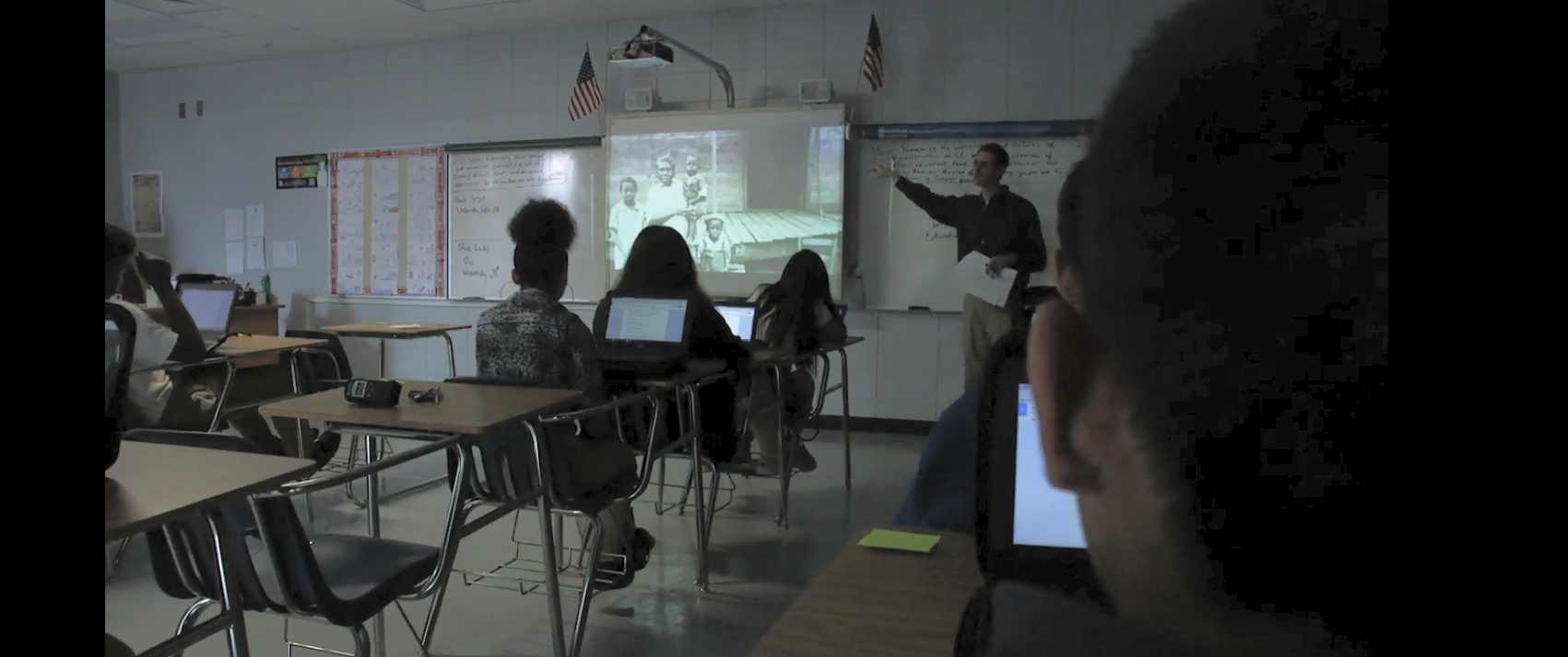
Mr. Joseph combined traditional lecture with media from PBS Learning Media and documentary to enhance student learning. Students recorded their responses during the lesson on their laptops.Lesson Feedback