Sunset Times with Smack Dab in the Middle of Maybe
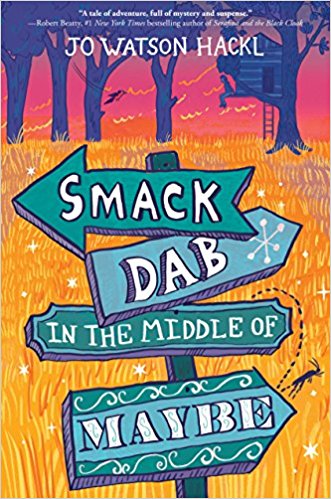
In Smack Dab in the Middle of Maybe, sunset times are important for solving the clue trail. Students can use the book as a starting point to learn more about sunrise/sunset times and the rotation of the Earth.
Lesson Created By: SamanthaBell, Jo Hackl
Essential Question
What natural patterns can be seen in nature and how do they affect our environment?
Grade(s):
- 8
Subject(s):
Recommended Technology:
Computer and projector
Computers for student use
Other Instructional Materials or Notes:
Smack Dab in the Middle of Maybe by Jo Hackl
Lesson Progression
INTRODUCTION:
In Smack Dab in the Middle of Maybe, Cricket realizes she must take into account the change in sunset times in order to figure out a clue.
1. On the board, write down the definitions of sunrise and sunset. (Reference: http://curious.astro.cornell.edu/about-us/161-our-solar-system/the-earth...)
Sunrise – the time when the upper edge of the disk of the rising sun is on the horizon
Sunset - the time when the upper edge of the disk of the descending sun is on the horizon
2. Using a computer and a projector, watch this video as a class: “Earth’s Rotation and Revolution: Crash Course Kids 8.1” (https://www.youtube.com/watch?v=l64YwNl1wr0)
3. Tell the students that because of the Earth's tilt on its axis, the path of the Sun across the sky varies. This causes the rising and setting times of the sun to change.
MAIN LESSON
1. Instruct the students to re-read Chapter 40 in Smack Dab in the Middle of Maybe.
2. In the chapter, Cricket realizes that the sun sets at different times on different days. The sun sets five minutes later on March 6 than it did on February 28 of that same year. As a class, use the NOAA Solar Calculator to find the sunset time for your city today. Then find the sunset time for your city five days earlier. What’s the difference in time? https://www.esrl.noaa.gov/gmd/grad/solcalc/ (You may also need to go over how to convert military time to standard time, as this site uses military time.)
INDEPENDENT PRACTICE
3. As a class, use the NOAA Solar Calculator to research the sunrise/sunset times for your hometown for three more days of the year. Make sure the four days reflect the four different seasons: one day in the summer, one in the fall, one in the winter, and one in the spring. Write the name of your city, the dates you chose, and the sunrise/sunset times on the board.
4. Instruct the students to choose one other city to research regarding sunrise/sunset times. It may be a place where relatives or friends live, a place they want to visit, or another city that interests them.
5. Have the students use the NOAA Solar Calculator to research the sunrise/sunset times of the city they chose for the same dates listed on the board. https://www.esrl.noaa.gov/gmd/grad/solcalc/
6. Have the students share their findings with the class. Write down the information on the board as the students present it.
EXTENSIONS:
Cricket notices that it takes the sun about 5 minutes to move across her hand. Find a spot in the classroom where the sun is shining. Mark the center of it with a piece of tape. Wait five minutes, then mark the center again with another piece of tape. What is the distance between the two pieces?
Choose a spot in the classroom where the sun will shine. As a class, observe and record how the sunlight moves across that spot throughout the day. Take and record measurements each hour.
Earth’s Rotation and Revolution: Crash Course Kids 8.1
Introduces rotation and revolution
View ResourceStandards
Assessments
Student presentations