Rabbit Study with Smack Dab in the Middle of Maybe
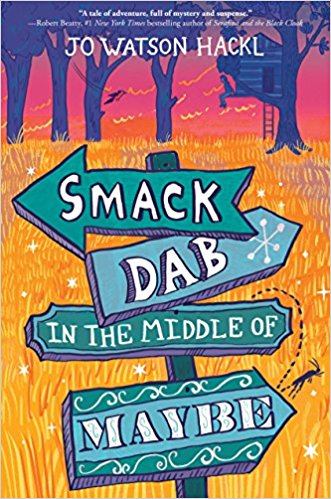
In Smack Dab in the Middle of Maybe, the main character Cricket finds a clue stating that she should “look like a rabbit”. Cricket later realizes that the clue means she should see the world from a rabbit’s point of view. Students can use the novel as a starting point for learning more about a cottontail rabbit’s appearance, habitat, diet, behavior, and lifecycle.
Lesson Created By: SamanthaBell, Jo Hackl
Essential Question
What is the relationship between living things and their environment?
What makes a source reliable?
Grade(s):
- 7
Subject(s):
Recommended Technology:
Computer and projector for videos and class discussion
Computers for student use
Other Instructional Materials or Notes:
Smack Dab in the Middle of Maybe by Jo Hackl
Lesson Progression
INTRODUCTION
Using a projector, show the students the videos below featuring cottontail rabbits in the wild.
http://www.arkive.org/rabbit/oryctolagus-cuniculus/video-00.html (Overview)
http://www.arkive.org/rabbit/oryctolagus-cuniculus/video-05.html (Grooming)
http://www.arkive.org/rabbit/oryctolagus-cuniculus/video-06a.html (Young Rabbits at a Warren)
http://www.arkive.org/rabbit/oryctolagus-cuniculus/video-06b.html
(Swimming)
http://www.arkive.org/rabbit/oryctolagus-cuniculus/video-06c.html (Running)
http://www.arkive.org/rabbit/oryctolagus-cuniculus/video-12.html (Male Rabbits Fighting)
As a class, discuss what the students saw. What things did they expect to see? What things surprised them?
MINI-LESSON:
1. The videos the class watched came from a website called Arkive. Arkive was created by the nonprofit organization of filmmakers and scientists that create stories about the natural world so people will want to help conserve and protect it. Introduce Arkive as a trusted site for research.
2. Explain what reliable research sources are.
3. Using the computer and projector, show them the two websites they will be using to research Cottontail Rabbits:
“Eastern Cottontail Rabbit” – National Geographic
https://www.nationalgeographic.com/animals/mammals/e/eastern-cottontail-...
“Eastern Cottontail” – BioKids – University of Michigan
http://www.biokids.umich.edu/critters/Sylvilagus_floridanus/
4. Show them two websites that are not considered reliable, such as:
“Cottontail Rabbit” – Wikipedia https://en.wikipedia.org/wiki/Cottontail_rabbit
“Facts About Cottontail Rabbits” – Mom.me http://animals.mom.me/cottontail-rabbits-1901.html
5. Ask the students: What makes the first two sources reliable? Why would the second two sources be considered unreliable?
6. Ask the students to find one more source about cottontail rabbits. Discuss if the sources they found are considered reliable or unreliable.
MAIN ACTIVITY:
1. Break the class up into five groups.
2. Provide each group with a topic to cover about cottontail rabbits: Appearance, Habitat, Behavior, Diet, and Lifecycle.
3. Instruct the students to research the information using the two reliable websites introduced earlier. Inform the students that although they may find different information on the sites, it shouldn’t be contradictory. If they discover some facts are contradictory, instruct them to write down the contradictory facts and where they found them. Then have them do research from other reliable websites to confirm the facts.
“Eastern Cottontail Rabbit” – National Geographic https://www.nationalgeographic.com/animals/mammals/e/eastern-cottontail-...
“Eastern Cottontail” – BioKids – University of Michigan
http://www.biokids.umich.edu/critters/Sylvilagus_floridanus/
4. Instruct the groups to write down what they learn from the sites about their particular topic. Have each group choose one member to present their findings to the class.
5. Instruct the other students to write down the facts presented by the group member. After every group has finished presenting, each student should have a page of notes about the five topics covered.
6. At the end of Chapter 15 in Smack Dab in the Middle of Maybe, Cricket finds a clue that says “Look like a rabbit.” In Chapter 16, Cricket tries to figure out what the clue means. Have the class read Chapter 16 again.
7. Based on what the students have learned about cottontail rabbits, have them answer the following questions:
Do you think a rabbit made the trail Charlene followed to find food? Why or why not?
Cricket figures out that she should be looking close to the ground and even be searching for something buried in the dirt. Are there other things she could do to “look like a rabbit”?
CLOSING ACTIVITY:
As a class, brainstorm other books or stories that feature rabbits (examples: Peter Rabbit, Alice’s Adventures in Wonderland, Winnie the Pooh, The Tortoise and the Hare.) How are these rabbits similar to real cottontail rabbits? How are they different?
EXTENSIONS:
Create a poster highlighting the information you learned about cottontail rabbits.
Most likely, cottontail rabbits aren’t the only rabbits that live in your area. Research to find out what other types of rabbits live nearby. Create a chart comparing the different species.
Create a chart showing the differences between how a human sees the woods and how a wild rabbit sees the woods.
Research other reasons why animals create trails.
Standards
- Ecology: Interactions of Living Systems and the Environment
- 7.EC.5 The student will demonstrate an understanding of how organisms interact with and respond to the biotic and abiotic components of their environments.
- 7.EC.5A In all ecosystems, organisms and populations of organisms depend on their environmental interactions with other living things (biotic factors) and with physical (abiotic) factors (such as light, temperature, water, or soil quality). Disruptions...
- 7.EC.5B Organisms in all ecosystems interact with and depend up on each other. Organisms with similar needs compete for limited resources. Food webs and energy pyramids are models that demonstrate how energy is transferred within an ecosystem.
- 7.EC.5 The student will demonstrate an understanding of how organisms interact with and respond to the biotic and abiotic components of their environments.
- 2 Partnership for The 21st Century Skills
Assessments
Students write a short report about cottontail rabbits.