Rivals in Orbit: How the Space Race Began and Ended in Cooperation
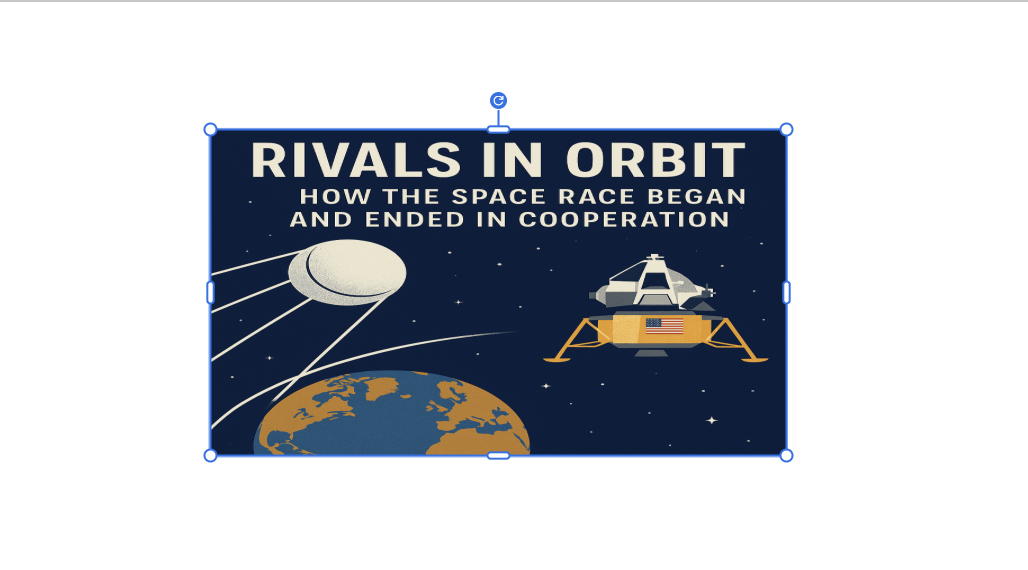
In this lesson, students explore how Cold War rivalry between the United States and the Soviet Union expanded beyond Earth and into outer space. Using the History in a Nutshell video series and short primary-source excerpts, students trace major turning points from Sputnik to the Apollo-Soyuz mission to understand how competition in space shaped national pride, innovation, and international cooperation.
Essential Question
How did Cold War competition between the United States and the Soviet Union transform from rivalry into cooperation through the Space Race?
Grade(s):
- 5
Recommended Technology:
Other Instructional Materials or Notes:
Lesson Progression
Do Now (5-7)
- Prompt: "Imagine another country launches something into space that you can see in the sky every night. How might you feel, and what might your government do?"
- Students write 3-4 sentences, volunteers share responses aloud.
- Teacher records student ideas in three columns: Feelings / Concerns / Actions and then transitions by connecting their prediction to real 1957 reactions when the Soviet Union launched Sputnik.
Mini Lesson: Setting the Stage (5)
- Show a world map. Identify the United States and Soviet Union.
- Provide an overview of the Cold War. Create a simple T-Chart labeled "United States" and "Soviet Union." Under each, list: Type of Government, Goals, and Fears.
HIN Video Part 1 (25-30)
- Distribute Part 1 Guided Notes.
- Play History in a Nutshell: The Space Race, Part 1.
- Use the Video Pause Guide (Part 1) to stop at key scenes and facilitate short discussions.
- Students record notes and fill in the event/effect chart.
- Reinforce cause/effect reasoning after each pause using guided questions.
- Post evidence sentence starters to support 5.4.E skills:
- "According to Part ___ of the video, ..."
- "One detail on the card shows ... which means ..."
- Encourage students to use these stems when sharing or writing about evidence.
Cause --> Effect Timeline (10-12)
- Distribute pre-cut Event Cards: Sputnik (1957), Explorer 1 (1958), NASA (1958), Alan Shepard (1961), Yuri Gagarin (1961), JFK Moon Goal (1961), John Glenn Orbits (1962).
- Pairs arrange event cards in order on desks. For each, students complete "Because of _______, the United States decided to _______."
- Teacher should walk around and ask guiding questions.
Exit Ticket (3-5)
- Prompt: Which event do you think most changed U.S. goals in space? Explain why.
- Collect before dismissal.
Day 2: From Problem-Solving to Partnership
Warm Up (5)
- Turn & Talk: "Turn to a partner and share two things you remember from yesterday and one question you still have."
- Briefly collect 2-3 examples aloud to refresh context.
HIN Video Part 2 (25)
- Distribute Part 2 Guided Notes.
- Play History in a Nutshell: The Space Race, Part 2.
- Use the Video Pause Guide (Part 2) to stop at key scenes and facilitate short discussions.
- Students record notes and complete the Turning Points Table (Section C).
- Reinforce cause/effect reasoning after each pause using guided questions.
Perspective Analysis (Group Task) (15-18)
- Divide students into groups and give each group A Perspective Card Set.
- Student Directions:
- Read each card.
- Identify if it shows a U.S., Soviet, or shared perspective.
- Write one short sentence explaining how that person or group felt and why.
- Teacher circulates and asks scaffolding questions.
- When finished, students Share Out. Record examples on the board under U.S. Views / Soviet Views / Shared Feelings.
Writing Task: Evidence-Based Response (10-12)
- Prompt: Choose one Space Race event. Describe what happened, how people felt in at least one country, and why it mattered. Use evidence from at least two sources (video or cards).
- Model a quick example.
- Differentiation:
- Provide sentence starters for emerging writers.
- Challenge advance students to compare both nations feelings.
Reflection & Closure (3-5)
- Discussion Prompt: "How can competition sometimes lead to cooperation?"
- Exit Ticket (1-2 sentences): "Name one way competition led to cooperation. Cite a card or video detail."
- Link back to the essential question and summarize the lesson.
- Collect writing for assessment.
Teacher Notes
Differentiation:
- Day 1: Use the word bank and partially completed notes to scaffold vocabulary.
- Day 2: Limit perspective card sets to 3-4 cards; allow oral discussion before writing.
The Space Race, Part 1
Part 1 briefly outlines the Cold War, and how the "Space Race" got started, with the Soviets' launching of Sputnik, in October, 1957. Next came the U.S. competing with the Soviets to launch a man into...
View AssetThe Space Race, Part 2
Gemini is the not widely known bridge between Mercury, and the Apollo Program. Gemini would serve as the test-bed for Apollo; to prepare NASA for trips to the moon. After the successes with the Gemini...
View AssetThe Space Race Photo Gallery
This photo gallery includes the following images: United States Air Force Pilot Charles E. "Chuck" Yeager Bell X-1 Sputnik National Advisory Committee for Aeronautics (NACA) Logo President Dwight D...
View AssetThe Space Race Trivia Quiz | History in a Nutshell
This quiz will test your knowledge on the history of the race to the moon, between the United States and the Soviet Union! How much do you know about the Space Race? Find out via the quiz below!
View AssetThe Space Race Trivia Quiz - Teacher Resource | History in a Nutshell
This quiz will test your knowledge on the history of the race to the moon, between the United States and the Soviet Union! How much do you know about the Space Race? Find out via the quiz below!
View AssetBibliography And Works Cited For Episode 4: The Space Race | History In A Nutshell
Aerospace: The Challenge. Center For Aerospace Education Development. 1979. From The Earth To The Moon. Executive Producer Tom Hanks. Produced By Brian Grazer, Ron Howard, and Michael Bostick. HBO...
View AssetRivals in Orbit Guided Notes
View ResourceRivals in Orbit Video Pause Guide
View ResourceRivals in Orbit Perspective Cards
View ResourceRivals in Orbit Event Cards
View ResourceStandards
- 5.4.CX Contextualize the tension between the United States and the Soviet Union during the Cold War.
- This indicator was developed to encourage inquiry into how the United States' and Soviet Union's governments adopted different ideologies leading to distrust and tension. This indicator was also developed to enocourage inquiry into events surrounding the Cold War, such as the space race, the arms race, and proxy wars (i.e., Korean and Vietnam Wars).
- 5.4.E Analyze multiple perspectives on the economic, political, and social effects of the Cold War, Space Race, and Civil Rights Movement using primary and secondary sources.