Basic French for use in the school context. Includes vocabulary for basic school supplies and classes.
Vocabulary used in this episode:
School / L'école
- pencil / le crayon
- paper / le papier
- eraser / la gomme
- book / le livre
- scissors / les ciseaux
- crayons / le crayon de couleur
- ruler / la règle
- pen / le stylo
- flag / le drapeau
- blackboard / le tableau
- map / la carte
- door / la porte
- desk / la table/le pupître
- teacher / le professeur
- student / l'élève
Lesson 107 – Visiting in the School
Objectives
- To learn words related to school
- To learn words for school supplies
- To learn about school in a French-speaking country
Culture
In France school usually begins early in the morning and ends around four or five p.m. The students generally walk to school, although some do ride a bus. The students and teachers are able to go home for an extended lunch break that usually lasts 1 to 2 hours. The students who live too far from school to go home for lunch eat at the school lunchroom (la cantine) and are supervised as they play on the black top outside the school or work in study hall. Students usually have 2-2 1/2 months off for a summer break. Schools in some countries have different schedules because of the weather conditions in that particular country. For example, in the Caribbean schools do not start until late September and go thru mid-July because of hurricane season. Public school is free and mandatory to children ages 6 thru 16. Many students who can afford it go to private schools.
Before Viewing the Video Lesson
- Tell your students to watch and listen carefully as you get out a book bag and put ten different school supply items in the book bag. Tell them the name of the item as you put it in the book bag. Use the following items (colors can be changed or not used if this is too much for your students to remember) a yellow pencil, a purple crayon, white paper, a green book, scissors, a brown ruler, a pink eraser, white glue, a flag and a map. Close the book bag and put it on the table. Ask the students to number 1 through 10 on a piece of paper and to write all the items that you put into the book bag. Give them an appropriate amount of time to do so then pull out the items one by one and check the lists.
- Tell them that in today’s lesson they will be learning words related to school. Do they think the items they used will be seen in the program? Ask them to watch for these items.
- What do they think school would be like in a French-speaking country? Tell them that school in France is sometimes very different from school in some other francophone countries.
- Discuss uniforms at school, especially if your students do not wear uniforms. Do they think it is a good idea or not? If this is a controversial issue in your community, you may want to avoid this discussion.
Description of the Video Lesson
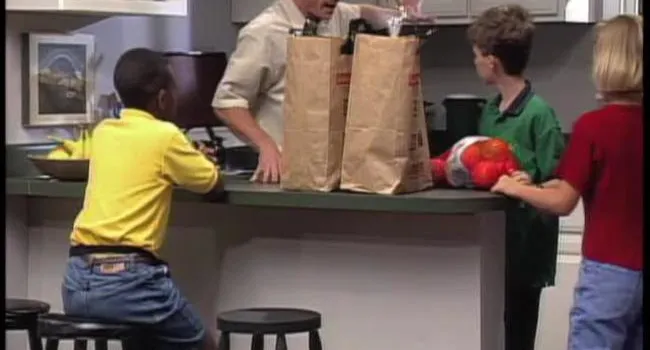
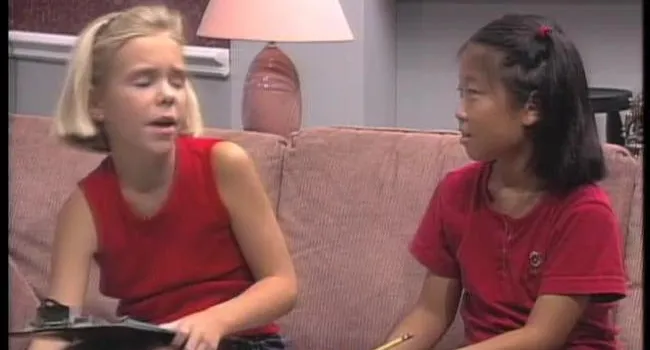
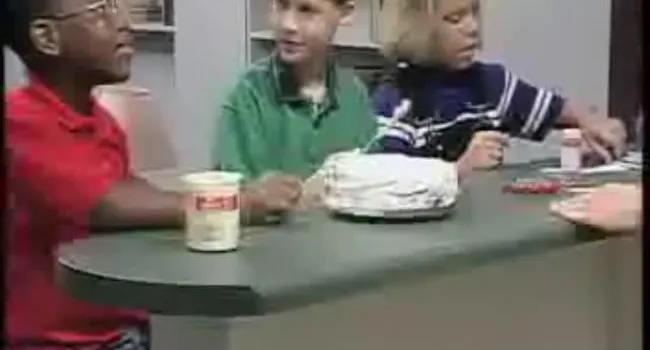
The kids come in tired, and Jay brings a bag of school supplies with him that Monsieur Dubois wanted. Fabien and Ryan come in before with a small model of a desk. They learn pencil (le crayon), paper (le papier), and laugh at the word eraser (la gomme). Then they look at Jay’s three (trois) books (les livres).
Count books
un, deux, trois, quatre, cinq, six, sept, huit, neuf, dix
The children also learn scissors (les ciseaux), crayons (les crayons de couleurs), ruler (la règle), and pen (le stylo).
The school day activities
Beginning with a school bus arriving at school, we see students going to class, eating lunch and doing school work.
Review
le drapeau, le tableau, la carte, la porte, la table, le livre, le papier, le crayon, les ciseaux, le crayon de couleur, la règle, le stylo
Pretending to be in a classroom situation, the group identifies teacher (le professeur), students (les élèves), blackboard (le tableau), map (la carte), and flag (le drapeau). They discuss the colors of the French flag (rouge, bleu, blanc). With the model brought earlier by the children they learn desk (le pupître) and chair (la chaise).
Song
At school with les élèves – students, le professeur – teacher, le crayon – pencil, l’école –school, la chaise – chair, le livre – book, le stylo -pen
Count school supplies
un, deux, trois, quatre, cinq, six, sept
- le livre
- le crayon
- le papier
- le stylo
- le crayon de couleur
- la règle
- les ciseaux
- les élèves
- le professeur
- la carte
- le drapeau
- le tableau
- le table
- la porte
Follow-up Activities
- Use the First Step en Français Again video lesson to review the emphasized vocabulary.
- Review the vocabulary words related to school and school supplies. Hold up different items and ask Qu’est-ce que c’est? (What is this?) The students would answer C’est le/la _____ (It is ____).
- Use the book bag and items from introductory activity # 1 again. Pull one item out at a time and ask for the French word. Count the items. Encourage expressions like “I have” (J’ai…) or “There is” (Il y a…).
- Do the activity that Monsieur Dubois did with the students regarding which item you use to erase, measure, write, color, etc. You can just do the activity rather than using the verbs to describe the activity.
- Play a game with the school supplies from the vocabulary list (like putting them in a bag where students can’t see them). Without looking at the item, the student must identify it just by feeling it and then tell the French word for the item. Practice expressions like “I have a _____.” (J’ai un/une…).
- After these follow-up activities, let students view the video lesson again so they can respond and practice with the children in the lesson.
Supplemental Activities
- Make a large map of the world drawing only the country outlines. Students can practice identifying and labeling Francophone countries. Place classroom objects on the map and have students identify the object and the country it is placed on.
- Play the rock/ scissors/ paper game in French- pierre, ciseaux, papier, un, deux, trios!
- Make flags of the different Francophone countries. Display them in the classroom with a map of the country.
- Label all possible items in the classroom with the French word.
- If your school does not require uniforms, have a uniform day in your class. Ask all students to wear the same or similar clothes. Discuss what this feels like, using expressions “I like…” or “I don’t like.”
Remember to use the vocabulary words in context as much as possible in class during the next week. This should be especially easy since there are words related to school and school supplies. Continue to add to the First Step en Français suitcase folder.