First Step en Francais Lesson 103: Shopping in the Grocery Store
Lesson Vocabulary
| Colors | Les couleurs |
| green | vert |
| red | rouge |
| orange | orange |
| yellow | jaune |
| purple | violet |
| Fruits | Les fruits |
| banana | la banane |
| orange | l’orange |
| apple | la pomme |
| grapes | les raisins |
| Vegetables | Les légumes |
| potatoes | les pommes de terre |
| carrots | les carottes |
| tomatoes | les tomates |
| cabbage | le chou |
| breakfast | le petit déjeuner |
| lunch | le déjeuner |
| dinner | le dîner |
| milk | le lait |
| bread | le pain |
| salad | la salade |
| chicken | le poulet |
| cheese | le fromage |
| dessert | le dessert |
| wine | le vin |
Grade(s):
- Pre K
- Kindergarten
- 1
- 2
- 3
- 4
- 5
Subject(s):
Recommended Technology:
Other Instructional Materials or Notes:
Recipe for crêpes
Les Crêpes Crêpes, originally a Breton dish, are a treat at any time in France. In cities and towns, they are often sold from vendors on the street. They are quick and easy to make and can be eaten with delicious fillings such as cheese, mushrooms, chocolate, jelly, or even ice cream.
Ingredients:
• 150g plain flour
• 1/4 teaspoon salt
• 2 eggs
• 300ml (1/2 pint milk)
• 1 tablespoon oil
• oil for cooking
Preparation time: 10 minutes
Cooking time: 15-20 minutes
Sift the flour and salt into a bowl and make a well in the center. Break in the eggs and add 150 ml of the milk. Beat in the flour from the sides of the bowl until you have a thick, smooth batter. Gradually add the rest of the milk. Heat a little oil in a frying pan, then pour it off, leaving a very thin coating on the base of the pan. Pour in just enough batter to cover the base of the pan thinly. Tip the pan from side to side to make sure the batter is spread evenly. When bubbles appear on the surface, and the underside is nicely browned, turn the crêpe over with a spatula and cook on the other side for one to two minutes. Make the rest in the same way, re-oiling the pan and reheating it again for each one. To keep hot, place a saucer upside-down on a large plate over a pan of simmering water. As the crêpes are cooked, drape them over the saucer. If you are going to keep them for a long time or are going to re-heat them, cover the plate with a bowl.
Lesson Progression
Before Viewing the Video Lesson
1. Review previous vocabulary, especially numbers, since items at the grocery store will be counted.
2. Tell students that in today’s lesson they will learn more colors. Review the other colors learned in the last lesson. What other colors do the students think will be included?
3. If the students were to go to the grocery store on their way home from school, what would they see? In this lesson the students will learn the names of some fruits and vegetables.
Follow-up Activities
1. Use the First Step en Français Again video lesson to review the emphasized vocabulary.
2. Review vocabulary words related to color from this lesson and lesson two. Use color circles like those used in the lesson to name colors. Add labels to things in the room for these colors. Avoid using words in isolation.
3. Review names of fruits and vegetables. Use color circles to tell what color these fruits and vegetables are. Take the week’s lunch menu and replace the names of any known French words for the fruits and vegetables offered at lunch.
4. Discuss the meals as shown in the program. How are they like the meals served in the students’ homes and how are they different? What would the students have expected as a “typical” French meal? Many students are familiar with some things the French eat, such as crêpes (a pancake-like food) and escargots (snails). What are some other foods they associate with French culture? Try to avoid mixing languages during this discussion.
5. After these follow-up activities, let students view the video lesson again so they can respond and practice with the children on the lesson.
Supplemental Activities
1. With a large bowl of water and some fresh fruit, play a game where students discover which fruits float and which do not. This would be a good time to discuss why some things float and some do not. Why would these types of fruits float? Are the students surprised at any of the things that float and the things that do not float?
2. A Gouin series is an activity used by foreign language teachers where all steps in an activity are given in order. This can be done using the food (or imaginary food) taught in the lesson. For example: Take an orange, slice the orange, squeeze the orange, pour the juice into a glass, drink the juice. Repeat the same steps over and over in the target language until the students can do the series by themselves.
3. Continue the art activity begun last week using the new colors today.
4. If possible, serve some of the dishes shown as part of these meals. Maybe your room parents would be willing to prepare a typical meal and serve it to your class. Instead of the meal, a tasting party would be fun. Ask each student to bring to class something that they think is traditionally a food in a French-speaking country. This might be a good research idea for the students to look up using resources in the media center or using the internet. Students may be surprised to find that different countries have different kinds of traditional foods. Why do they think there would be differences? Would the climate and geographical location of the country play any role in the types of foods eaten? Are specific foods associated with certain holidays?
Remember to use the vocabulary words in context as much as possible in class during the next week. This should be especially easy since these are words related to foods and colors. Add to the First Step en Français suitcase folders.
Teacher Notes
Culture
The French are know world-wide for their haute cuisine (the kind that expensive restaurants serve). Cooking at home is much simpler but still a very special part of the culture. Often the meals are prepared with fresh products from the local market or specialty shops. Bread is a very important basic food in France and is eaten at most every meal. French bread is most commonly known as a baguette - a long crusty roll with a very soft white center. It is generally purchased unpackaged each morning at the boulangerie (bakery). It must be eaten the day it is bought because it goes stale and becomes extremely hard after one day.
Information for the Teacher
French nouns have a gender and therefore the definite article associated with the noun is either masculine or feminine. The article is taught as part of the noun. The masculine article is le. The feminine article is la. The plural form for both masculine and feminine is les. Many adjectives have masculine and feminine forms; therefore, the gender of the noun and the form of the adjective must agree. For example: The book is green (le livre est vert) and The leaf is green (la feuille est verte). In English the closest comparison would be the agreement between masculine and feminine names with pronouns - he/she, him/her, his/hers.
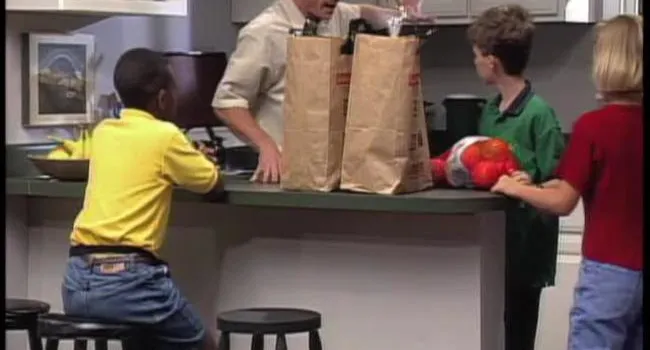
First Step en Français 103: Shopping at the Grocery Store
Learn to use French to speak about the fruits and vegetables you eat. Also covers numbers and colors. Vocabulary used in this episode: Colors / Les couleurs green / vert red / rouge orange / orange...
View Asset