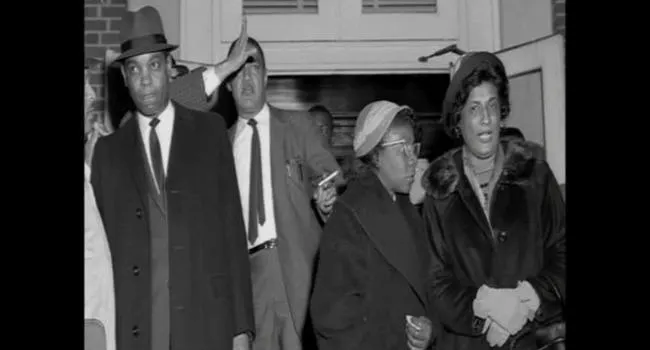
In the 1950s and early 1960s, Southern states fought against desegregation, and the last state to comply was South Carolina. In 1963, Harvey Gantt was able to peacefully integrate Clemson College, though his success was not without challenges. This is his story.
Harvey Gantt grew up in the segregated South, a period where schools, and many other government and public buildings were “separate but equal.” Harvey was born in Charleston, and his father worked in the Charleston ship yard, providing a comfortable life for the family. While Christopher and Wilhelmina Gantt protected their children from the full impact of the Jim Crow society, they were well aware that changes needed to be made. The South Carolina NAACP won many civil rights battles, and when a petition for equal educational advantages was denied, this resulted in the lawsuit known as “Briggs vs Elliot,” led by Charleston attorney Thurgood Marshall. “Briggs vs Elliot” became part of the famous “Brown vs Board of Education,” which declared segregation of public schools as unconstitutional. While some state leaders and business people attempted to circumvent the Supreme Court ruling, the NAACP remained vigilant in its fight for state leaders to fall in line with the federal ruling.
In the 1950s and early 1960s, Southern states fought against desegregation, and the last state to comply was South Carolina. In 1963, Harvey Gantt was able to peacefully integrate Clemson College, though his success was not without challenges. This is his story.
Harvey Gantt grew up in the segregated South, a period where schools, and many other government and public buildings were “separate but equal.” Harvey was born in Charleston, and his father worked in the Charleston ship yard, providing a comfortable life for the family. While Christopher and Wilhelmina Gantt protected their children from the full impact of the Jim Crow society, they were well aware that changes needed to be made. The South Carolina NAACP won many civil rights battles, and when a petition for equal educational advantages was denied, this resulted in the lawsuit known as “Briggs vs Elliot,” led by Charleston attorney Thurgood Marshall. “Briggs vs Elliot” became part of the famous “Brown vs Board of Education,” which declared segregation of public schools as unconstitutional. While some state leaders and business people attempted to circumvent the Supreme Court ruling, the NAACP remained vigilant in its fight for state leaders to fall in line with the federal ruling.
Standards
- 5.4.CC Analyze the continuities and changes of race relations in the United States and South Carolina following the Supreme Court decisions of Briggs v. Elliott and Brown v. Board of Education.
- 8.5.CX Analyze the correlation between the Modern Civil Rights Movement in South Carolina and the U.S.
- This indicator was designed to foster inquiry into the role of South Carolina in the Modern Civil Rights Movement, to include the influence of court cases such as Briggs v. Elliot and Flemming v. South Carolina Electric and Gas. This indicator was also developed to promote inquiry into the relationship between national leadership, protests, and events and South Carolina leadership, protests and events, such as the Friendship Nine and the Orangeburg Massacre.
- USHC.5.CC Evaluate continuities and changes during the Civil Rights Movement and other subsequent movements for equal rights.
- This indicator was developed to promote inquiry into thematic continuities and changes into how marginalized groups sought and won legal rights. Inquiry into the leadership, methods, and outcomes of modern equal rights movements are supported by this indicator.
Resources
Brown v. School District No.20
The month of February in the South Carolina African American History Calendar features the case of Brown v. School District No. 20, Charleston, SC. This lesson explores the issues of the case, the...
View LessonThe Students of Brown vs. School District No. 20 - Charleston
The South Carolina African American History Calendar February honoree is the case of Brown vs. School District 20, Charleston. This lesson will highlight the significance of the case, the impact it...
View LessonThe Education of Harvey Gantt Learning Activity
In 1960, a talented African-American student from Charleston, Harvey Gantt, graduated from high school and decided to become an architect. Clemson College was the only school in South Carolina that...
View AssetEducation of Harvey Gantt: The Road To Clemson | Carolina Stories
When Harvey was a junior at Burke High School, he joined the NAACP Youth, and then in February, 1960, the “sit-in” protests began, with which the NAACP became heavily involved. These “sit-ins” became...
View AssetHarvey Gantt | Carolina Snaps
Uncover the inspiring story of Harvey Gantt, the first black student to break barriers at Clemson University and later become Charlotte's first black mayor.
View AssetHarvey Gantt | Road Trip
Harvey Gantt was born on January 14, 1943. On January 1963, Harvey Gantt of Charleston, South Carolina, became the first black student to enroll at Clemson College (now Clemson University). Gantt, at...
View AssetHarvey Gantt Admitted to Clemson University | History of SC Slide Collection
The first integration of public higher education in South Carolina came at Clemson University. The student who successfully sued for admission with the help of his NAACP attorney, Matthew Perry (left)...
View AssetBriggs v. Elliott | The World of Cecil
This segment explores the early 1950s and the significant role South Carolina, particularly Clarendon County, played in the civil rights movement. It discusses Thurgood Marshall's arrival in South...
View Asset