Nonflowering plants

Toggle Filters

Filter By:

Clear Filters

Grade Levels

close

Grade

Resource Type

close

Resource Type

Downloadable Content

close

Downloadable Content
Congaree Swamp (S.C.) Stop 4 - Bald Cypress And Papaw
   - Episode 6 Congaree Swamp (S.C.) Stop 4 5

Video

Grades

  • 3
  • 4
  • 5
  • 6
  • 7
  • 8
  • 9
  • 10
  • 11
  • 12
Congaree Swamp (S.C.) Stop 4
Episode 5
At the next stop, Rudy and Jim analyze more of the plants found in the area: Hackberry trees, and Switch Cane dominate the area. A healthy Poison Ivy can be seen completely encasing a dead oak tree.
Bulls Island (S.C.) Stop 5 - The Ghost Beach | NatureScene
   - Episode 12 Bulls Island (S.C.) Stop 1 1

Video

Grades

  • 3
  • 4
  • 5
  • 6
  • 7
  • 8
  • 9
  • 10
  • 11
  • 12
Bulls Island (S.C.) Stop 1
Episode 1
Bulls Island was one of the most heavily damaged areas in South Carolina by Hurricane Hugo. Rudy and Jim visit Bulls Island to observe how nature is healing itself after the deadly hurricane. Here at...
Bulls Island (S.C.) Stop 5 - The Ghost Beach | NatureScene
   - Episode 12 Bulls Island (S.C.) Stop 2 5

Video

Grades

  • 3
  • 4
  • 5
  • 6
  • 7
  • 8
  • 9
  • 10
  • 11
  • 12
Bulls Island (S.C.) Stop 2
Episode 5
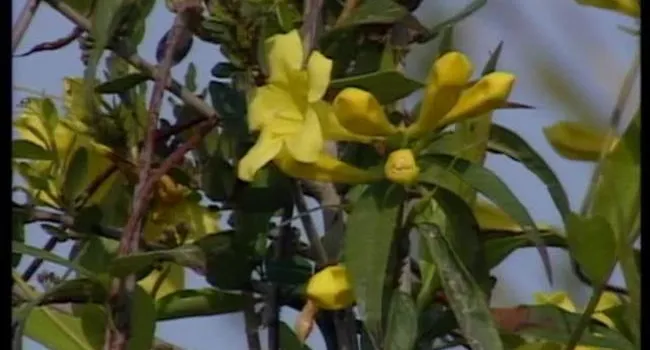
At the same stop, vines and flowering plants can also be seen growing in this area. We see Yellow Jessamine, and Toadflax.
Bulls Island (S.C.) Stop 5 - The Ghost Beach | NatureScene
   - Episode 12 Bulls Island (S.C.) Stop 3 7

Video

Grades

  • 3
  • 4
  • 5
  • 6
  • 7
  • 8
  • 9
  • 10
  • 11
  • 12
Bulls Island (S.C.) Stop 3
Episode 7
At the same stop, Rudy and Jim find more plants typical of barrier islands: Devil’s Walking Stick, Prickly Ash, and Buckthorn. In a shady area close by, Rudy and Jim find a resting Eastern Cottonmouth...
Bumblebee | Bulls Island Natural Area (S.C.) Bulls Island (S.C.) Stop 4 9

Video

Grades

  • 3
  • 4
  • 5
  • 6
  • 7
  • 8
  • 9
  • 10
  • 11
  • 12
Bulls Island (S.C.) Stop 4
Episode 9
The Dike – Vast fields of Cord Grass populate this area. The fresh water impoundments, with much lower levels of salinity, are perfect places for shore and sea birds such as Yellowleg birds, Black...
Japanese Honeysuckle and Carolina Yellow Jessamine | Forty Acre Rock (S.C.) Forty Acre Rock (S.C.) Stop 5 8

Video

Grades

  • 3
  • 4
  • 5
  • 6
  • 7
  • 8
  • 9
  • 10
  • 11
  • 12
Forty Acre Rock (S.C.) Stop 5
Episode 8
Rudy and Jim discuss the process of exfoliation, which commonly takes place on rock outcroppings such as this one. Here, on this island of soil, we see more yellow jessamine, moss, red cedar trees...
Flowering Dogwood | Forty Acre Rock (S.C.) Forty Acre Rock (S.C.) Stop 3 6

Video

Grades

  • 3
  • 4
  • 5
  • 6
  • 7
  • 8
  • 9
  • 10
  • 11
  • 12
Forty Acre Rock (S.C.) Stop 3
Episode 6
Vernal Pools - Red Cedar trees commonly populate these rock outcropping areas. Lichens break down the rock surface, creating the dirt in which plants can grow. Black Rock Moss Haircap Moss...
Mayapple | Appalachian Cove (S.C.) | NatureScene Appalachian Cove (S.C.) Stop 2 5

Video

Grades

  • 3
  • 4
  • 5
  • 6
  • 7
  • 8
  • 9
  • 10
  • 11
  • 12
Appalachian Cove (S.C.) Stop 2
Episode 5
When pieces of trees fall to the ground, nature has a way to recycle that debris. A species of mushroom known as the False Turkey Tail helps break down the rotting wood, adding nutrients to soil in...
Silkworm Moth | Appalachian Cove (S.C.) | NatureScene Appalachian Cove (S.C.) Stop 4 9

Video

Grades

  • 3
  • 4
  • 5
  • 6
  • 7
  • 8
  • 9
  • 10
  • 11
  • 12
Appalachian Cove (S.C.) Stop 4
Episode 9
The cove got its shape from streams of water periodically carving out the rock. Witch Hazel and Rhododendrons are species of plants which benefit from the moisture of nearby streams.
Silkworm Moth | Appalachian Cove (S.C.) | NatureScene Appalachian Cove (S.C.) Stop 5 11

Video

Grades

  • 3
  • 4
  • 5
  • 6
  • 7
  • 8
  • 9
  • 10
  • 11
  • 12
Appalachian Cove (S.C.) Stop 5
Episode 11
In the same stop, Rudy and Jim talk about the plants growing on a nearby rock: moss, Walking Fern, and another Canada Violet. On a nearby tree, Rudy and Jim find a cocoon of a Large Silkworm Moth.