Bird Survival Through Adaptations

A series of historical illustrations by naturalist, Mark Catesby, will be used as a foundation for students to assess how adaptations contribute to a species ability to survive in a particular environment.
Lesson Partners: College of Charleston, Charleston County School District, Catesby Commemorative Trust
Essential Question
How do observable variations among birds influence their survival in a habitat, finding food, finding mates and defending themselves and their territory?
Grade(s):
- 6
Subject(s):
Recommended Technology:
Power Point; video playing; 1-to1 technology as a modification to drawing, tablets if necessary for researching habitats and pictures of birds from primary source, Java software permission for day 6
Other Instructional Materials or Notes:
List of science, consumable supplies given
Lesson Progression
Entire Lesson Progression including all the details are here: https://goo.gl/JxLfzR
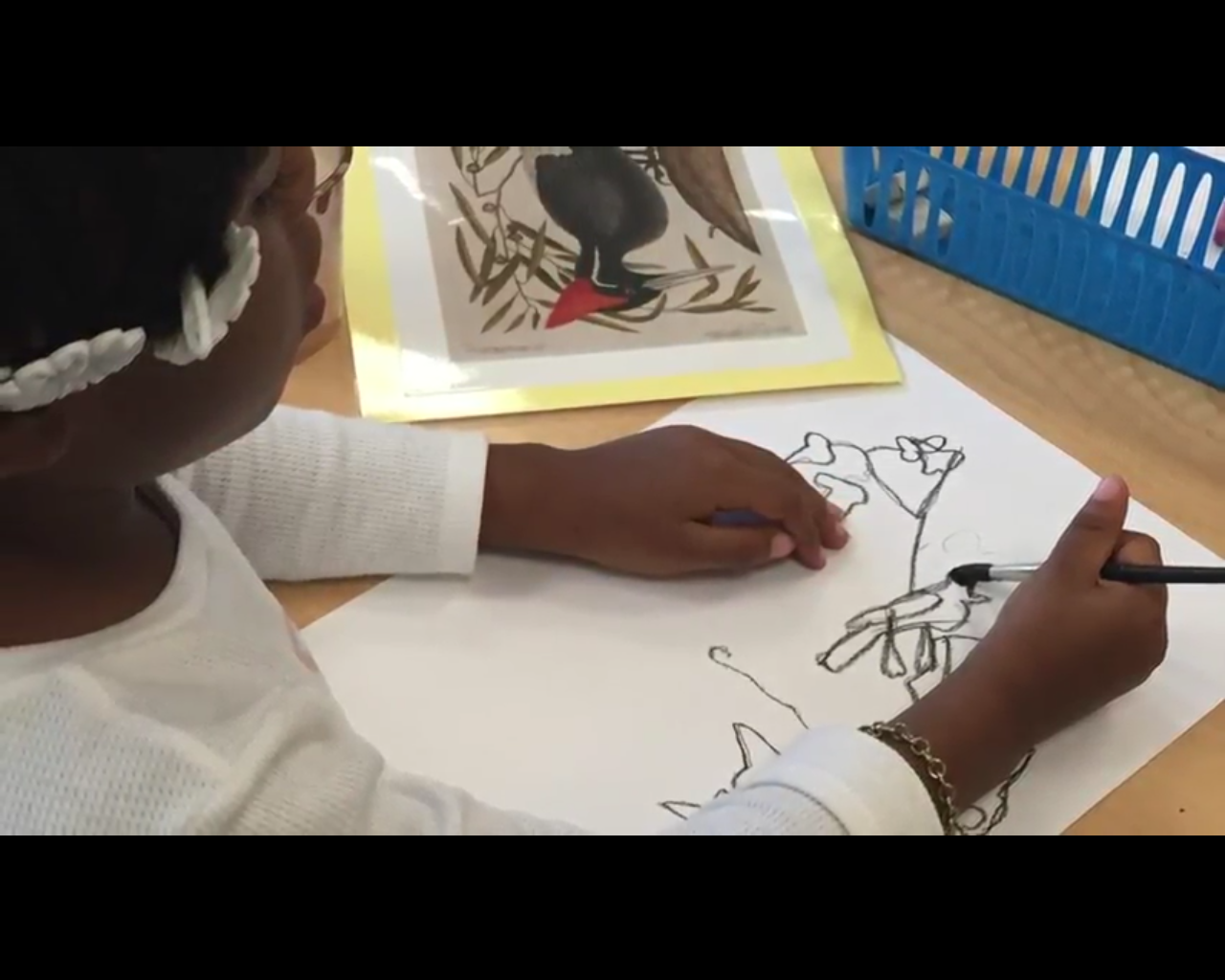
Day 1 - Draw a Catesby Bird
Lesson details are found here goo.gl/J20db6
Who likes birds? What are some local birds? Where do you find them? What are some characteristics of birds? What do they eat? Has anyone drawn pictures of birds? The purpose of this lesson is to determine how birds adapt to their environment. What qualities or characteristics of birds allow them to survive in a habitat?
Day 2 – Bird Beak Form and Function
Lesson details are here: https://goo.gl/vBp7OA
Characteristics of Birds
Show some pictures of the students’ Alien birds from the previous day. Pair students and have them compare and contrast their Alien birds. List some characteristics that are common and different. Develop a comparison table. Have students copy this table into their science notebooks.
Day 3 – Bird Beak Form and Function
Lesson details are found here: https://goo.gl/KeC3J7
Characteristics of Birds
Go through Beaks and introduce students to the habitats and environments of different birds. Focus on the characteristics of the beaks and why they might help the bird live in a particular habitat or environment.
Day 4 - Bird Adaptations and Environment
Lesson details are found here: https://goo.gl/g7QBTJ
Landscape
Discuss Landscapes. Deconstruct the different “grounds” of a landscape and how to create details that make it look realistic. Discuss a list of characteristics for each different landscape.
Background - This is the farthest area in the drawing or diorama.
- The sky and horizon line (where the sky meets the ground) are included as part of the background.
- The basic environment is established here with mountains, volcanoes, open prairies, etc.
- Objects appear very small here.
- There are little to no details on objects in the background.
- Because the distance, the saturation (or intensity) of a color appears to be much lighter than in the foreground.
Middle Ground - This is the middle area of the drawing or diorama
- Objects in this area overlap the background and are overlapped by the objects in the foreground.
- The objects appear to be larger than the background, but smaller than the foreground.
- There are some details in the object.
- The saturation of color is at a medium level.
Foreground - This is the very front of the drawing or diorama.
- All objects in the foreground overlap everything behind it.
- Objects appear to be larger because of the proximity to the viewer.
- Details such as tree bark, feathers on birds, and leaf veins are visible.
- The colors in the foreground are usually very bright and vivid.
Day 5 - Migratory Adaptations
Lesson details are found here: https://goo.gl/inZvWe
Habitats
Presentation on the definition of habitats, animal characteristics, bird adaptations, and symbiotic relationships between plants, animals, and habitat
Day 6 - Environmental Catastrophe and Adaptations
Lesson details are found here: https://goo.gl/16HT2p
Introduction: Adaptations to the Environment
Run a simulation of rabbits and predators. Teacher can demonstrate the simulation or have students complete it themselves. Everyone will have to update Java and download the program. This will introduce the topic of natural selection and relate it to adaptations for the birds.
Day 7 - Being a Scientist like Catesby
Lesson details are found here: https://goo.gl/heg32s
What is a scientist?
Scientist presentation to introduce the students to the world of being a scientist. What are some actions that scientists do? List them in your science notebooks. What have the students done over the past week that mimics what a scientist does?
Teacher Notes
Day 1: Task 7 is extra. It can be used on any day if time allows or other activities progress quickly. Page 7 has the characteristics of 4 birds.
Day 2: Teacher can photocopy pages 10 and 11 to pass out to students. Labels for Stations are at the end of the Unit packet.
Day 3: Pages 13-14 can be printed and handed out to students to place in their science notebooks. Pages 15-17 can be used instead of the online website. Guided Notes are on page 18.
Day 4: Writing the characteristics of the birds and habitats are the most important part of this activity. Groups can be assigned a scribe who can record what others discuss.
Day 5: Guided Notes are on page 25. Teachers determine the extent of argumentative writing with depth and style.
Day 6: There are other natural selection simulations. You will have to download the applet from the site prior to demonstrating. Students can also do these types of simulations themselves using their 1 to 1 technologies. Groups can proceed to different catastrophes or stay with just one. You can print pages 28-29 to give to students.
Day 7: The questions for the DBQ are suggestions. Each teacher may focus on different aspects of the primary source letters (e.g., writing style, grammar, and language use).
Smithsonian Magazine Article - "Mark Catesby's New World"
The artist sketched American wildlife for Europe's high society, educating them on the creatures living among the unexplored lands
View ResourceBook - The Natural History of Carolina, Florida and the Bahama Islands
Entire book and diary of Mark Catesby, including drawings of birds, beasts, fishes, serpents, insects, and plants: particularly, the forest--trees, shrubs, and others
View ResourceThe Adventures of Mark Catesby-Unknown Explorer of The New World
Overview of naturalist Mark Catesby (1683-1749) crossed the Atlantic to Virginia. Catesby cataloged the flora and fauna of the Carolinas and the Bahamas by gathering seeds and specimens, compiling not
View ResourceStandards
- Life Science: Diversity of Life – Classification and Animals
- 3 Use critical thinking skills to justify mathematical reasoning and critique the reasoning of others.
- I Inquiry-Based Literacy Standards
- RI.MC Meaning and Context
- RI.MC.5 Determine meaning and develop logical interpretations by making predictions, inferring, drawing conclusions, analyzing, synthesizing, providing evidence, and investigating multiple interpretations.
- RI.MC.7 Research events, topics, ideas, or concepts through multiple media, formats, and in visual, auditory, and kinesthetic modalities.
- W Writing
Assessments
Embedded in each days lesson progression...
Bird Survival Through Adaptations
Grade(s): 5 7 8
The Project-based Lesson results in a scientific exploration of bird adaptations to environmental habitats as students journey through activities to represent the work of a naturalist from the 18th century.Lesson Feedback