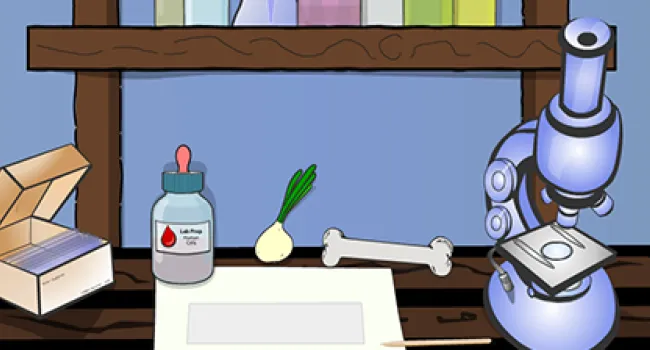
In this activity, students use a virtual biology lab to perform investigations and learn lab procedures using compound and dissecting microscopes to look at a variety of animal and plant cells.
COMPOUND MICROSCOPE
- Compound Microscope Diagram: Students can use this diagram to label the parts of a compound microscope.
- Compound Microscope Diagram (Master)
- Using the Compound Microscope: A worksheet containing guidelines for simple activities involving the use of a real compound microscope, with problems to calculate its magnifying power and places to record your observations.
- Using the Compound Microscope (Master)
DISSECTING MICROSCOPE
- Dissecting Microscope: Students can use this diagram to label the parts of a dissecting microscope.
- Dissecting Microscope (Master)
Standards
- Life Science: Organization in Living Systems
- 7.L.3 The student will demonstrate an understanding of how the levels of organization within organisms support the essential functions of life.
- 7.L.3A Cells are the most basic unit of any living organism. All organisms are composed of one (unicellular) or many cells (multicellular) and require food and water, a way to dispose of waste, and an environment in which they can live in order to surv...
- 7.L.3A.2 Analyze and interpret data from observations to describe different types of cells and classify cells as plant, animal, protist, or bacteria.
- 7.L.3A.3 Develop and use models to explain how the relevant structures within cells (including cytoplasm, cell membrane, cell wall, nucleus, mitochondria, chloroplasts, lysosomes, and vacuoles) function to support the life of plant, animal, and bacteri...
- 7.L.3A Cells are the most basic unit of any living organism. All organisms are composed of one (unicellular) or many cells (multicellular) and require food and water, a way to dispose of waste, and an environment in which they can live in order to surv...
- 7.L.3 The student will demonstrate an understanding of how the levels of organization within organisms support the essential functions of life.
- Science and Engineering Practices
- 7.S.1 The student will use the science and engineering practices, including the processes and skills of scientific inquiry, to develop understandings of science content.
Resources
Don’t “Cell” Yourself Short
In this introductory lesson, students will use microscopes to examine plant, animal, and bacteria cells to lay the foundation for further study. Additional instruction is needed for students to master...
View LessonMicroscopic Life
Students will investigate structures of protists and fungi by a) creating a KWL chart of the different types of protists b) observing videos and completing an online investigation and drawing...
View Lesson