Microscopic Life

Students will investigate structures of protists and fungi by a) creating a KWL chart of the different types of protists b) observing videos and completing an online investigation and drawing conclusions about these different microscopic organisms – how the specialized structures of each microorganism allow for movement and obtaining energy. c)They will construct 2-D how models of each protist and explain how each moves and obtains energy using specialized structures. c)Students will analyze informational text to argue whether a sample fungus is parasitic, symbiotic or saphrophytic. d)Students will learn how to use compound and dissecting microscopes from the Hobby Shop simulation.
Lesson Partners: S2TEM Centers SC, Knowitall.org
Essential Question
How do the structures of protists allow them to move and obtain energy?
Grade(s):
- 6
Subject(s):
Recommended Technology:
- Either a computer with internet connected to a smartboard for teacher guided or a Chromebook/laptop/tablet for 1:1
For extension of lesson:
- A device with camera capability such as a phone, iPod, or iPad that can be turned into a microscope
- A computer/laptop on which to download pictures and a place to share them.
Other Instructional Materials or Notes:
- Sticky Notes (3 different colors)
- Chart paper or legal size paper for KWL chart
- Lab sheets for students
- Card Sort (Map and pieces)
- The Fungus Files Reading Material p.2-5 (numbered 8-11) for students
- Scissors
- Ziploc Bags for Storage of cards
- Disciplinary Literacy instructor sheets
- KWL
- Card Sort
- Bounce Card
- Exit Tickets
- Highlighting
- Matchbook Definitions
- Anticipation Guide
Lesson Progression
Divide students into groups of not more than 4 to a team
Engage- Give each group a piece of chart paper or a large piece of paper to create a KWL chart and a stack of the same color sticky notes. (KWL Disciplinary Literacy sheet attached) KWL is a strategy that models the active thinking students engage in before beginning a new unit of instruction or topic of study. It can be used prior to an inquiry investigation, learning activity, or reading an informational text selection. The KWL utilizes a graphic organizer to categorize the three activities students will do prior, during, and after lesson to inform them about their learning of the topic. Students will identify what they KNOW (K), WANT to know (W), and LEARNED (L). Have students create a column for KWL. Tell the students that they are going to individually record a response to a question (see bold print below) you give on a sticky note. Tell them to write as many answers as they can think of but to use a different sticky note for each response. Give the students 5 minutes to record their responses and then have the students stick all sticky notes together in the K column of the KWL chart. Tell students that they will review these again later in the lesson.
Ask students: What are some things you think you KNOW about protists?
- Show the introductory video on protists (video is 3 minutes 11 seconds) from this website https://youtu.be/0-6dzU4gOJo.
After students have watched the video, give each group a different color sticky note than used before and have each student answer the following question. Make sure that they use a different sticky note for each response.
- Ask students: What might be some things you WANT to know about protists?
Have students stick all these sticky notes together in the W column of the KWL chart. Remind them that they will review these responses later in the lesson. (Give 2 minutes for students to respond).
- Ask the students to read through the sticky notes as a group and then have each group share out one K or W with the class. (2 to 5 minutes depending on class size). Take up the KWL chart to use for tomorrow’s lesson.
Explore- (Instruction on protists and how to use the virtual labs- 20 minutes). Print out the lab sheet observations sheet pdf from the website in advance for students so that the students can fill in the blanks for the video notes as you explore amoeba together.
Explain that they will work as a class to complete the notes on one type of protist, the amoeba, and then for 1:1, they will complete the remaining two virtually on their own.
Go to http://labs.7bscience.com/lab-1---amoebas.html (worksheet to download is at the top). Have students fill in the blanks for Part 1 as they read or you may read as they are copying the information. You may need to enlarge the print on the screen for those having difficulty seeing the information. For Part 2, have the students draw the amoeba before the video starts, then stop the video at 15 seconds and then at 30 seconds. For Part 3, have the students read the informational text and highlight or underline the identified parts and functions (nucleus, contractile vacuole and food vacuole). For Part 4, have the students label the diagram.
- Have the students complete the remaining observation labs (just like they did with the Amoeba):Paramecium http://labs.7bscience.com/lab-2---paramecium.html and Euglena http://labs.7bscience.com/lab-3---euglena.html
The worksheet for the student has the web address printed across the top of the student page. The teacher will need to download and print off the student copies in advance unless students will be working to submit the documentation electronically.
Create a matchbook definition for one of the following:
- What is a protist?
- What is an amoeba?
- What is a paramecium?
- What is a euglena?
A matchbook definition is where students give a short, concise definition that will fit on a matchbook.They may also choose to draw a picture (See Disciplinary Literacy Instruction Sheet of this strategy).They may reference their lab worksheets during this time (15 minutes: 10 to create, 5 to share out).
The teacher may choose to collect the lab worksheets at the end of the class period.
End Day 1
Day 2
**Explore-Students not finished with the lab should be given the opportunity to finish the previous day’s lab at the beginning of class**
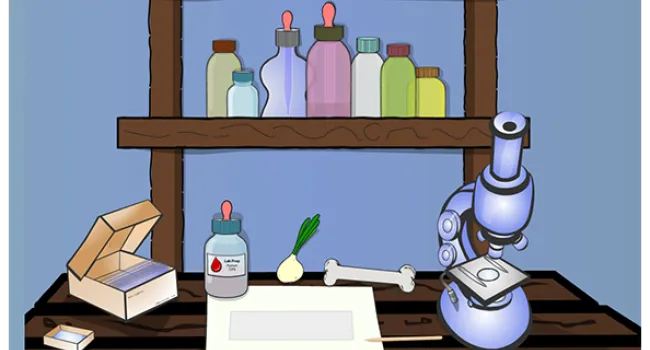
As they finish, students will review how to use a microscope by going to (http://knowitall.org/interactive/microscopes-hobby-shop)
This website can be used to introduce basic microscopy to students.Students will go to the website and explore how to use a compound and dissecting microscope.This can be done on a 1:1 device or on a smartboard.The interactive portion is a quick review. As an extension later, students can create a foldable, brochure or infographic of the information about the two types of microscopes, how to use them and what specimens they can observe using each type of microscope.
Engage - Card Sort (see Disciplinary Literacy instructor Sheet)
Print the protists sort map and pieces for each set of students.
Divide the class into small groups of no more than 4 students. Give out the handout with the protists pieces (cards) and have students cut out the pieces. Give each team of students a protist map. Have students place the cards (words and pictures) in the correct protist column.
Circulate the room and check for teams that get them placed correctly. Review correct answers. (See Teacher Answer Key) Have students place pieces in the Ziploc bag when finished.
Divide the class into small groups. (4 or fewer students to a group).
- From the lab reflection questions http://labs.7bscience.com/protist-labs.html , have students review their answers to the following questions and revise and add to their thoughts. Students will use the bounce cards (see disciplinary literacy strategy instructor sheet) to share their learning with their groups of 4.
- Students can choose to either “Bounce” ideas off what other students said, “Sum It Up” or rephrase what classmates said in a more concise way or “Inquire” to clarify and understand what classmates meant by asking probing questions. Students will discuss the questions as a group and then share out with the whole class.
Question 1: Argue a position on this claim: "A paramecium is an example of a simple organism." Do you agree or disagree? Why? How would you respond to someone who holds the opposite position? Support your answer with evidence from the paramecium lab.
Question 2: You place millions of euglena into a container and place it by the window. The entire container is a bright green color as the euglena swim freely. You cover half the container, block out the sunlight. At the end of the day, you return to the container and find that all the euglena are now on the uncovered side. Explain why this happened. Your answer must include the words: eye spot (stigma), sunlight, and photosynthesis. Use the informational text you have been provided on euglena and the data you collected from your lab to construct your explanation.
Evaluate-KWL chart completion
On a different color sticky note than previously used for the KWL chart, have students draw and label a 2-D model of either a Euglena, Paramecium, or Amoeba. Have them indicate the distinguishing characteristic or specialized structure each uses for movement (flagellum/cilia/false foot (pseudopod). Have the students place these on their group KWL chart from yesterday.
Ask: What are some things you’ve LEARNED about protists? Give students 5 minutes to record additional things they have learned on a separate sticky note of the same color.These sticky notes will go in the L column of the KWL chart from yesterday. Give students time to read all the sticky notes they have in the L column. Have them go back to the K and W stickies and see which ones they can move to the L column now. Tell students they are things that they confirming what they thought they knew, through the online research and reading. Also, they should have affirmed the things they indicated they wanted to know, and learned the answer to, from the research and reading.
Day 3
Driving Question: How do fungi obtain energy?
Engage-Video https://www.youtube.com/watch?v=b5rluxtABGA
After viewing the video, tell students that they will be learning about fungi today and how these organisms obtain energy. Students will read the informational text below and complete an anticipation guide (see Disciplinary Literacy Instructor Sheet). The students will only need to complete the true or false (top part) of the worksheet before reading. Students will read the text to find out if their answer choices are correct and the evidence (give the page number and highlight and underline the answer in the text.
Explore- Informational text on fungi
http://www.viethmms.com/~nama/docs/0.1_Fungi_The_Hidden_Kingdom.pdf
Have students complete the True or False Questions #1-7 from the “How Mouldy is Your Memory?” sheet as an anticipation guide (see Disciplinary Literacy Instructor Sheet). Once students are finished, they will compare their responses with an elbow partner. Students will argue their evidence from the text and come to a consensus. Review the answers with the class.
Have students go back to page 9 and reread the first paragraph. See if students can pick out the 3 types of fungi and how they obtain energy. Have students underline or highlight this information. Give students a sample fungus and see if they can determine if it is parasitic, symbiotic or saphrophytic.
Analyze and Interpret Data from Interactive Lab on Microscopic Protists and Fungi
http://www.glencoe.com/sites/common_assets/science/virtual_labs/LS09/LS09.html
This is recommended as a 1:1-Independent but could be done as a class. Have students go to the link. Tell them they are going to explore fungi. Have them click on the slides in the slide box until they see Penicillin and Rhizopus. These will be the two they will focus on during class today. Have students follow the directions on the left side of the page. They should go through the field notes, habitat, nutrition, locomotion, and reference if needed in order to collect data for the table. They should type in their findings in the table/graph (icon is below the print button). You may have students print out the data table or save and submit electronically.
For early finishers or if time permits, have students go back and look at slides of protists and add this information to the data table.
Evaluate-Students can complete an exit slip/ticket (see Disciplinary Literacy Instructor Sheet) to answer the question: How do fungi obtain energy?
- Virtual Lab-Protista - http://vsprotista.weebly.com/virtual-lab.html
- DIY videos showing how to make a microscope camera to add to iPhone, iPod to view live specimens or prepared slides so that students can capture what they are seeing on slides
- Videos of science topics - http://www.watchknowlearn.org/Category.aspx?CategoryID=2303
- Create an infographic on harmful protists or fungi
- Students design an experiment on fungi
Teacher Notes
Teacher notes are included throughout the lesson description. Please refer to the lesson progression section.
- Lesson resources
- File type: PDFs are included, websites listed within lesson
- Files description – The files are disciplinary literacy strategies with the exception of “Protists Card Sort” which is a student handout and “
- Web links- title, description and URL
- http://labs.7bscience.com/protist-labs.html This website contains the three protists that students will investigate along with videos and reflection questions. The student worksheets are available to download. Copyright 2010-2017 Pete Ower
- http://sc6thgradescience.weebly.com/6l5a1-how-protist-euglena-paramecium--omeba--fungi-obtain-energy.html This website contains the protists card sort (Briana Everhart) and other videos and resources.
- https://www.youtube.com/watch?v=0-6dzU4gOJo&feature=youtu.be
Introduction to Protists video Published on Nov 8, 2012
This HD dramatic video choreographed to powerful music introduces the viewer/student to the microscopic kingdom of the Protists. It is designed as a motivational "trailer" to be shown in Biology classrooms in middle school, high school and college as a visual introduction to the amazing world of these tiny creatures.
- http://www.viethmms.com/~nama/docs/0.1_Fungi_The_Hidden_Kingdom.pdf
- This site provides the informational text on fungi that students use on day 3 of the lesson.
Fungi—The Hidden Kingdom OBJECTIVE • To provide students with basic knowledge about fungi BACKGROUND INFORMATION The following text provides an introduction to the fungi. It is written with the intention of sparking curiosity about this fascinating biological kingdom.
- https://www.youtube.com/watch?v=b5rluxtABGA What is a fungus? - Naked Science Scrapbook Video
Published on May 25, 2012 Fungi are a biologically important, and often overlooked Kingdom of organisms. In this Naked Science Scrapbook we find out what a fungus actually is, how they live and how they cause and fight disease. Plus, we see that many of our favorite meals wouldn't be the same without them.
This is a virtual lab on microscopic protists and fungi. Students can record data in a lab journal and in a data table. Students select and view slides to investigate and classify microscopic organisms.
Needed Websites:
- http://media.knowitall.org/interactive/microscopes-hobby-shop
- http://labs.7bscience.com/protist-labs.html
Protist Labs. (n.d.). Retrieved February 13, 2017, from http://labs.7bscience.com/protist-labs.html
- https://youtu.be/0-6dzU4gOJo - Day 1 Video
Gregorio Education Productions. (2012, November 08). Introduction to the Protists. Retrieved February 13, 2017, from https://youtu.be/0-6dzU4gOJo
6.L.5A.1 HOW PROTIST (EUGLENA, PARAMECIUM & OMEBA) & FUNGI OBTAIN ENERGY. (n.d.).
Retrieved February 14, 2017, from http://sc6thgradescience.weebly.com/6l5a1-how-protist-euglena-paramecium...
The Fungus Files. (n.d.). Retrieved February 9, 2017, from http://www.viethmms.com/~nama/docs/0.1_Fungi_The_Hidden_Kingdom.pdf
- https://www.youtube.com/watch?v=b5rluxtABGA Day 2 Video
NakedScientists. (2012, May 25). What is a fungus? - Naked Science Scrapbook.
Retrieved February 14, 2017, from https://www.youtube.com/watch?v=b5rluxtABGA
Glencoe. (n.d.). How can microscopic protists and fungi be catergorized?
Retrieved February 14, 2017, from http://www.glencoe.com/sites/common_assets/science/virtual_labs/LS09/LS0...
Microscope Interactive | Hobby Shop
In this activity, students use a virtual biology lab to perform investigations and learn lab procedures using compound and dissecting microscopes to look at a variety of animal and plant cells...
View AssetMatchbook Definitions
Matchbook Definitions is a meaningful writing strategy used to help students better learn key vocabulary related to specific content or a topic of study.
View ResourceHighlighting
Highlighting provides an active reading strategy that helps focus the reader to identify key concepts or topics and their supporting ideas.
View ResourceExit Slips or Exit Tickets
Exit Slips is a strategy that provides an opportunity for students to reflect on their learning.
View ResourceCard Sort
Card Sort is an activity in which student group a set of cards with words or pictures into certain categories.
View ResourceBounce Cards
This strategy by Himmele and Himmele provides students with a tool to help them engage in dialogue about content in a productive way.
View ResourceAnticipation Guide
An Anticipation Guide is a comprehension strategy that is used to guide pre-reading, during reading, and after reading activities.
View ResourceK-W-L and Variations
KWL is a strategy that models the active thinking students engage in before beginning a new unit of instruction or topic of study.
View ResourceFungi—The Hidden Kingdom
The following text provides an introduction to the fungi. It is written with the intention of sparking curiosity about this fascinating biological kingdom.
View ResourceStandards
Assessments
The evaluation process, any rubrics, questions, etc. – Formative assessments are listed throughout the lesson, especially in the form of disciplinary literacy strategies as explained.
Evaluate-Students can complete an exit slip/ticket (see Disciplinary Literacy Instructor Sheet) to answer the question: How do fungi obtain energy?
- Virtual Lab-Protista - http://vsprotista.weebly.com/virtual-lab.html
- DIY videos showing how to make a microscope camera to add to iPhone, iPod to view live specimens or prepared slides so that students can capture what they are seeing on slides
- Videos of science topics - http://www.watchknowlearn.org/Category.aspx?CategoryID=2303
- Create an infographic on harmful protists or fungi
- Students design an experiment on fungi