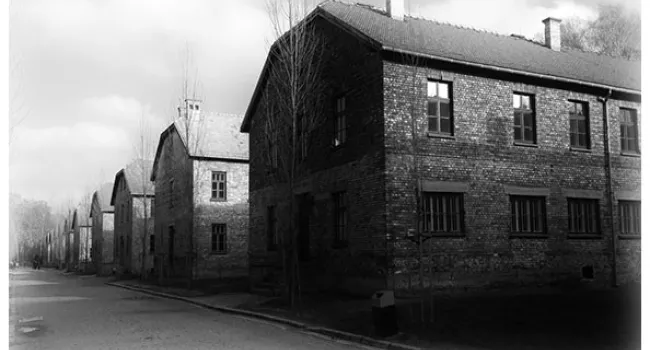
"I felt like this can't be happening. Why would it be happening? People acted worse than animals, and it was people I knew. What happens to people to bring something like this on?"—Trude Heller, Greenville Holocaust Survivor
"Genocide is always a conscious choice. It is never just an accident of history." —Irving Horowitz, Author
"The ideal state is that in which an injury done to the least of its citizens is an injury done to all."--Solon, Athenian Statesman
Seizure of power gave the Nazis enormous control over every aspect of German life. The Nazis could use the machinery of government, the police, the courts, the schools, the newspapers and radio, to implement their racist beliefs. In April 1933 Hitler began to make discrimination against Jews government policy. All non-Aryans were expelled from the civil service. A non-Aryan was defined as anyone who had Jewish parents or two or more Jewish grandparents. In this same year the government called for a general boycott of all Jewish-owned businesses and passed laws excluding Jews from journalism, radio, farming, teaching, the theater, and films.
Nuremberg Laws
In 1934, Jews were dismissed from the army. They were excluded from the stock exchange, law, medicine, and business. But it was the Nuremberg Laws of 1935 that took away the citizenship of Jews born in Germany and labeled them subhuman. With these laws Hitler officially made anti-Semitism a part of Germany's basic legal code. Under these laws, marriage between Jews and German citizens was forbidden. Jews were not to display the German flag and could not employ German servants under 45 years of age. These laws created a climate in which the Jews were viewed as inferior people. The systematic removal of Jews from contact with other Germans made it easier for Germans to think of Jews as less human or different.
German Jews lost their political rights. Restrictions were reinforced by identification documents. German passports were stamped with a capital "J" or the word Jude. All Jewish people had to have a recognizable Jewish name. Jewish men had to use the middle name Israel; Jewish women the middle name Sarah. These names had to be recorded on all birth and marriage certificates.
SS Gains Power
Hitler's position was challenged from within the Nazi party by the SA, an abbreviation for the German word for storm troopers. Also called brown shirts, they were Hitler's private army. In 1934 Hitler ordered a purge of the SA by the SS, the elite group of soldiers who served as his personal bodyguard. The Night of Long Knives ended any challenge to Hitler's position of power. Once the SS State was created, resistance to the Nazi regime was destroyed. Communists, Catholics, Jews, intellectuals, and others were the targets of the Gestapo, or secret police.
Dachau Is First Concentration Camp
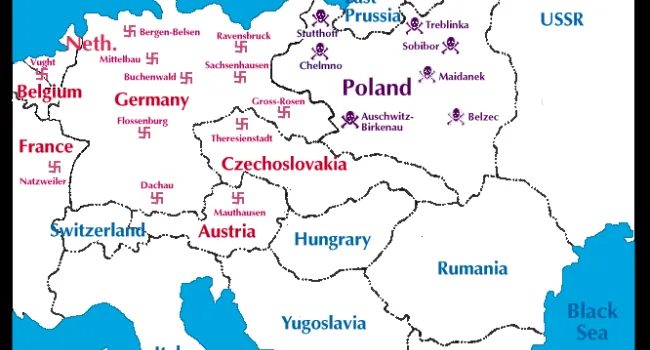
The SS were responsible for setting up concentration camps throughout Germany. Anyone suspected of disloyalty or disobedience could be sent there. The first concentration camp was at Dachau close to Munich. It was built to hold political dissenters and enemies of the state. No charges had to be filed against the detainees. No warrant for their arrest was necessary; no real evidence was required.
In 1935, Hitler reintroduced the military draft in violation of the Versailles Treaty. In 1936 German troops occupied the Rhineland. That same year Hitler signed an agreement with Mussolini to establish the Berlin-Rome Axis.
Night of Broken Glass
On November 9, 1938, the Nazis carried out what the German press called a spontaneous demonstration against Jewish property, synagogues, and people. Dr. Josef Goebbels, the propaganda minister, claimed the demonstration was in reaction to the shooting of a lower-level diplomat at the German embassy in Paris. A young Jewish boy attempted to assassinate the ambassador because his father had been deported to Poland. Throughout Germany fires and bombs were used to destroy synagogues and shops. Store windows were shattered, leaving broken glass everywhere. By the time it ended, nearly 100 people had been killed. That night became known as the Night of Broken Glass, or Kristallnacht. German documents found later showed that Kristallnacht had been carefully planned weeks in advance by the Nazis.
In March 1938, German troops marched into Austria and met no resistance. Austria became a part of greater Germany. This Anschluss, or joining, would be justified under the Treaty of Versailles, which stated that all people of one nationality had the right to live under one government.
Hitler next seized the Sudentenland, an area where many Germans lived. For a short time he persuaded the British Prime Minister, Neville Chamberlain, that he was right in doing so. But when he invaded and occupied the rest of Czechoslovakia, no justifications could be found.
World War II Begins
Poland would be next. On September 1, 1939, German forces, spearheaded by tanks and bombers, marched into Poland and crushed all organized resistance. England and France declared war against Germany on September 3, 1939, and the world was once again at war.
CREDIT: The map above is licensed under the Creative Commons Attribution-Share Alike 3.0 Unported
Standards
- 5.3 Demonstrate an understanding of the economic, political, and social effects of World War II, the Holocaust, and their aftermath (i.e., 1930–1950) on the United States and South Carolina.
- 6.5.CE Explain the impact of nationalism on global conflicts and genocides in the 20th and 21st centuries.
- This indicator is intended to encourage inquiry into the significant causes of World War I and the impacts of the Treaty of Versailles, including its failure to prevent future global conflicts.