The Swamp Fox, The Wizard Owl, and The Gamecock
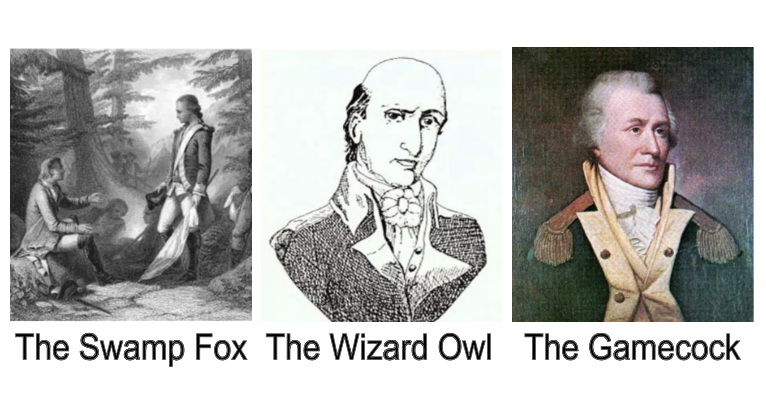
Comparing Revolutionary War Partisans: Francis Marion, Andrew Pickens, and Thomas Sumter
Essential Question
How did the leadership styles and military strategies of Francis Marion, Andrew Pickens, and Thomas Sumter contribute to the success of the Southern Campaign during the American Revolution, and what impact did geography and local militias have on their effectiveness?
Grade(s):
- 8
Subject(s):
Recommended Technology:
Laptop/Chromebook
Other Instructional Materials or Notes:
Lesson Progression
Introduction
As students enter the classroom, have the following prompt on the board:
Do you have a nickname? If so, what is it and what is the story behind it? (If no nickname, share the story behind your first or last name)
Once students are settled and have responded to the prompt, share with students that every name has a story and allow them the opportunity to share their story with the class. When finished, display the pictures of Francis Marion, Andrew Pickens, and Thomas Sumter labeled with their nicknames. Briefly introduce these men as prominent partisan leaders from South Carolina during the American Revolution and that they earned their nicknames due to their unique military tactics, leadership styles, and characteristics during their war efforts.
Ask students: What story do you think is behind the nicknames “The Swamp Fox,” The Wizard Owl,” and “The Gamecock?”
Give students time to share their ideas and then explain to them that today they will determine the roles of Francis Marion, Andrew Pickens, and Thomas Sumter in the American Revolution and compare the military strategies and contributions they made to win the war.
Direct Instruction
The teacher should provide a biographical overview of each figure, focusing on their background, role in the war, and legacy. This may be done in whole group or through the use of expert groups in a jigsaw.
Use a map of South Carolina to explain how the terrain of the state influenced military tactics. Discuss how Marion used swamps to evade British forces, how Pickens combined diplomacy with Native Americans with his military skill, and how Sumter led direct raids against British outposts.
Define guerilla warfare and explain how hit-and-run tactics were used to disrupt British supply lines and communication.
Comparative Analysis
Allow students to research and take notes, completing the graphic organizer with the three leaders' military tactics, geography of their operations, major battles, leadership style, nicknames, and legacy. The teacher may provide students with the biographical overview for each or provide students with short excerpts from primary sources.
Have students create a Venn Diagram comparing and contrasting their findings.
Class Discussion
After students complete their graphic organizer and Venn Diagrams, bring the class together to discuss their findings.
The teacher may ask the following guiding questions:
How did geography influence each leader's tactics?
Why do you think they were effective against the British?
What were the differences in leadership styles between, Marion, Pickens, and Sumter?
How do these men represent different aspects of Southern resistance to British occupation?
Conclusion
Have students respond to the following prompt:
Which leader do you think had the most significant impact on the Southern Campaign, and why?
What do you think was the most important factor in the success of these leaders?
Refer back to student venn diagrams and summarize the key similarities and differences between Francis Marion, Andrew Pickens, and Thomas Sumter.
Thomas Sumter | History of SC Slide Collection
Thomas Sumter (1732-1832) was, at his death, the last surviving general of the Revolutionary Army. Born in Charlottesville, Virginia, he fought in the French and Indian Wars as a Virginia militia man...
View AssetAndrew Pickens | History of SC Slide Collection
Born in Edgefield, Governor Andrew Pickens (1779-1838) studied at the College of New Jersey (now Princeton). During the War of 1812, he served as a colonel in the U.S. Army and in later stages of the...
View AssetGeneral Francis Marion, a.k.a. "Swamp Fox" | History of SC Slide Collection
General Francis Marion inviting a British officer to share his meal. With the British in charge of the city of Charleston, the war in South Carolina became one of guerilla warfare, with the British...
View AssetPickens, Marion, Sumter, Part 1 | Palmetto Heritage
Hosts Ellen Rodillo-Fowler and Nathan Dawson guide viewers through this edition of Palmetto Heritage, which spotlights three significant South Carolina figures: Thomas Sumter (The Fighting Gamecock)...
View AssetPickens, Marion, Sumter, Part 2 | Palmetto Heritage
While the British tangled with Andrew Pickens in South Carolina’s upstate, Francis Marion’s patriots fought the British in the Pee Dee region. Marion was known as “The Swamp Fox” due to his effective...
View AssetPickens, Marion, Sumter, Part 3 | Palmetto Heritage
Thomas Sumter was determined to drive the British out from South Carolina. “The Fighting Gamecock” earned his moniker due to his tenacity in battle. A band of British assassins attempted to sneak into...
View AssetLetter from General Nathanael Greene to Francis Marion, the Swamp Fox
View ResourceSC Revolutionary War Period Maps
View ResourceAmbush Francis Marion and the Art of Guerrilla Warfare
View ResourceStandards
- 8.2.CO Compare the motives and demographics of loyalists and patriots within South Carolina and the colonies.
- This indicator was developed to encourage inquiry into the economic, political, and social motivations of the patriots and the loyalists in the era of the American Revolution.
- 8.2.CX Contextualize the roles of various groups of South Carolinians as the colonies moved toward becoming an independent nation.
- This indicator was developed to encourage inquiry into the motivations of colonists during the American Revolution and the progression of conflict and failed compromise that ultimately led to revolution.
- 8.2.E Utilize a variety of primary and secondary sources to analyze multiple perspectives on the development of democracy in South Carolina and the United States.