South Carolina Voices: Lessons from the Holocaust - Teaching Lesson Six

The Holocaust lessons were created to help students learn about the Holocaust from the testimonies of Holocaust survivors.In lesson 6 the conditions in the camps are described in detail.The goal of this lesson is to focus on the Holocaust experiences of South Carolinians to personalize the experience for students.
Lesson Partners: ETV Education, Knowitall.org, South Carolina Council on the Holocaust
Grade(s):
- 7
- 10
- 11
Subject(s):
Recommended Technology:
Computers with internet access and a projection devise to project maps.
Other Instructional Materials or Notes:
The materials for this lesson are two maps (to be projected) depicting the locations of the concentration centers and killing centers, and the number of Holocaust deaths in areas across Europe. These two maps are currently under construction.
Lesson Progression
Motivate: This activity has two purposes. It familiarizes students with the area in which the Holocaust took place and illustrates through map study the total commitment of the Nazis to the Final Solution. As the Nazis began losing the war, trains, transports, and manpower were desperately needed for the German war effort. Despite the economic and military costs of doing so, the Nazis continued to use these resources in the effort to murder Jews.
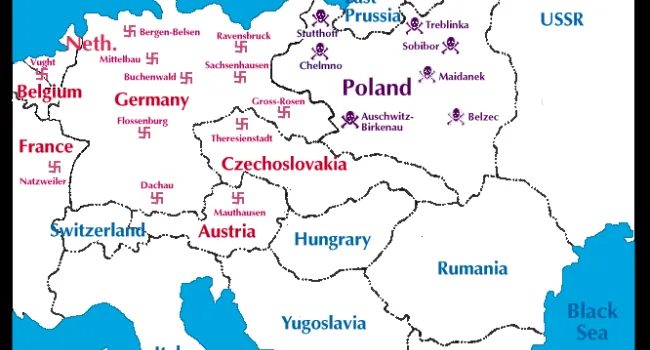
Before displaying these maps, make a digital copy of each one. Display the copy depicting the killing centers on a projector, covering the key to the map. Ask students what area of the world is shown on the map. (Central and Eastern Europe) Have students make guesses about what the symbols on the map might represent. With the map key still covered, have students name the countries in which the swastikas are found and the country in which the skull and crossbones symbols are located (Poland). Encourage students to again make guesses about what these symbols, based on their locations, might represent. Uncover the key. Make sure students understand that a death camp or killing center was specifically designed for mass murder.
Develop: Use the following questions to help students think critically about the information on the map.
1. Why do you think Poland was chosen as the site for the death camps? (Students should recognize that the Nazis chose an area that was far from Western Europe. They wanted a place where their activities were less likely to be observed and had many rural and isolated areas. In addition, a strong tradition of anti-Semitism had long existed in Eastern Europe, particularly in Poland. The Germans were assured of the cooperation or at least the indifference of the local people.)
Before the Holocaust, Poland had the largest Jewish community of any European nation occupied by the Nazis. About 3.3 million Jews lived there. They made up around 10 percent of the population. By war's end, more than 90 percent of Poland's Jews had been killed by the Nazis.
In prewar Poland, as in much of Eastern Europe, official government policies of anti-Semitism prevented Jews from raising their standard of living. Only a very small percentage of the Jewish population were professionals or landowners. Most were small traders, craftspeople, or laborers.
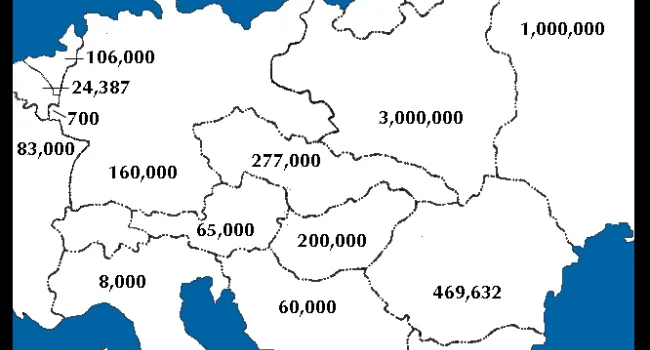
Next, overlay the transparency depicting the number of Holocaust deaths on the transparency depicting the killing centers. Explain that this map shows the numbers of Jews killed by the Nazis in each country. Ask:
1. What countries lost the largest number of people? (Poland, Estonia, Latvia, Lithuania, Germany/Austria lost the largest number of people. In these countries 90 percent of the Jewish population were killed.)
2. Which countries lost the fewest people? (Italy, Denmark, Finland) Italy, Germany's partner in the war, had fewer of its Jewish citizens killed than many Nazi-occupied countries whose governments had opposed the Nazis.
3. Why do you think railroads were important to the Final Solution? (As the map indicates, the transport of captives from all parts of Europe to Poland was a massive undertaking for the Germans. It required transport trains or trucks, military personnel, and supplies.)
4. For what else were trains, trucks, and manpower needed at this time? (They were needed to fight the war against the Allies.)
5. What do these maps suggest about the importance of the Final Solution to Hitler and the Nazis? Why were the Germans willing to risk undermining the war effort? (The Nazis considered the Final Solution as important as winning the war.)
Trains moved Jews to killing centers while troops for the front lines were shunted onto sidings. Even when the military situation worsened and the Germans were clearly losing the war, the mass murders continued. As trains and other transports became scarce, victims were force-marched to the death camps. War plans could be changed, but not the plans for the Final Solution.
Teacher Notes
Extend: Have students report on why such countries as Denmark and Italy were able to save so many of their citizens. In many countries local people did not have the same hatred of the Jews the Nazis did. When anti-Semitism became the official policy of the Italian Fascist party, the party lost supporters.
Although the Italians did, at the urging of the Germans, pass discriminatory laws against Italian Jews, Mussolini's government refused to take part in the efforts to exterminate the Jews and consistently refused to deport Jewish residents. Jews in occupied Yugoslavia, France, and Greece were protected from deportation by Italian officials.
When, however, the Germans overthrew the Italian government in 1943, Italian Jews, and Jews under their protection in occupied areas, were sent to the killing centers.
Holocaust | Seared Souls: S.C. Voices of the Holocaust
The conditions in the camps are described in detail. In the camp, a line formed consisting of the able-bodied men and another for the old, pregnant women, young children, mothers with young children...
View AssetHolocaust Timeline
Learn the series of events that led to the Holocaust and related events that occurred during this period.. 1933 January 30: Hitler appointed chancellor of Germany. March 5: Hitler receives strong vote...
View AssetHolocaust Glossary | Holocaust Forum
Learn key terms from the Holocaust. Anti-Semitism. Acts or feelings against Jews; takes the form of prejudice, dislike, fear, discrimination, and persecution. Aryan. A term used by the Nazis to mean a...
View AssetConcentration Camps and Killing Centers
Map showing the locations of the Nazi Concentration Camps and Killing Centers
View ResourceHolocaust Deaths
Map showing the number of deaths (per country) in the areas controlled by the Nazis durning WWII.
View ResourcePart 6: Holocaust | Seared Souls: S.C. Voices of the Holocaust
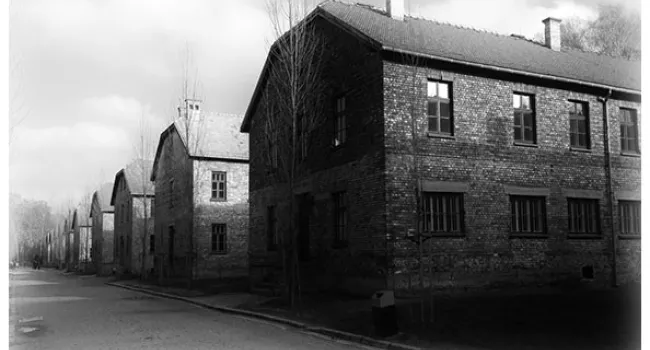
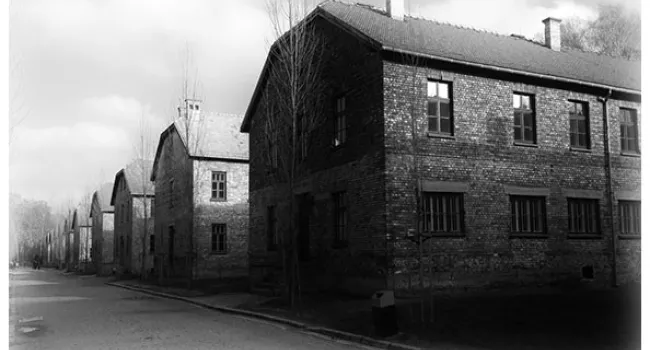
The conditions in the camps are described in detail. In the camp, a line formed consisting of the able-bodied men and another for the old, pregnant women, young children, mothers with young children. The barracks were bitter cold. There were no bathrooms and there was no water. The meals consisted of what they called soup, which consisted of water and a few pieces of cabbage or potato peels. The bread was made with sawdust.
View ResourceHolocaust Resource Guide
Teaching about the Holocaust is often limited by teachers' familiarity with the subject and the amount of time available for this topic. The materials in this guide were designed with these concerns in mind.
View ResourceIntroduction - The ETV Holocaust Forum
Thanks to a grant from the South Carolina Council on the Holocaust, ETV created a forum on the Holocaust to provide teachers access to a variety of resources when teaching their students about this tragic chapter from human history.
Standards
- 7-4 The student will demonstrate an understanding of the causes and effects of world conflicts in the first half of the twentieth century.
- WG-4 The student will demonstrate an understanding of the characteristics of culture, the patterns of culture, and cultural change.
- USHC-7 The student will demonstrate an understanding of the impact of World War II on the United States and the nation’s subsequent role in the world.