South Carolina Voices: Lessons from the Holocaust - Teaching Lesson Five
The Holocaust lessons were created to help students learn about the Holocaust from the testimonies of Holocaust survivors. Lesson 5 deals with the sad legacy of Concentration Camps.The goal of this lesson is to focus on the Holocaust experiences of South Carolinians to personalize the experience for students.
Lesson Partners: ETV Education, Knowitall.org, South Carolina Council on the Holocaust
Grade(s):
- 7
- 10
- 11
Subject(s):
Recommended Technology:
No technology necessary, but computers with presentation software and internet access may aid in completion of the lesson progression.
Other Instructional Materials or Notes:
Handout 5A: Rudy at Auschwitz, Handout 5B: Ben at Auschwitz; Handout 5C: Pincus at Auschwitz; Handout 5D: Renee in a Work Camp; Handout 5E: Bluma in a Concentration Camp
Lesson Progression
Motivate: Draw a continuum on the chalkboard: at the left write TOTAL ACCEPTANCE; in the middle, PREJUDICE; and at the far right, TOTAL REJECTION/DEATH.
Explain that the term "Total Acceptance" describes a society in which the poorest, least powerful people and the highest, most powerful people in the society are all subject to the same laws. In such a society the civil and human rights of all individuals are equally respected. At the other end of the continuum, the term "Total Rejection" describes a society in which the state is all-powerful and individuals have no rights. The midpoint on this line is "Prejudice," where the rights of minorities begin to suffer.
Have volunteers draw X's at the points on the line where, in the 1990s, they would put their own community, South Carolina or the United States. As a variation on this lesson allow all the students to make a human continuum by standing in front of the three terms, Total Acceptance, Prejudice, or Rejection/Death, either written on the board or on construction paper taped to a wall or board. Or have the students work together in groups to reach a consensus conclusion. One student from the group can stand to create the human continuum or place the group's X on the board. Have students give reasons for their or their groups' choices.
Develop: Then focus on Germany in the late 1930s and early 1940s. Have volunteers locate on the continuum where such actions as the Nuremberg Laws, Kristallnacht, and ghettoization of the Jews fall on the continuum. Emphasize that Hitler's treatment of the Jews was not an abrupt move from protection of human rights by the government to genocide. It was a steady progression from laws limiting civil rights, to ghettos, to the Final Solution, a plan for the complete annihilation of the Jewish people. Along the way, the Nazis skillfully built popular support by playing on existing fears or hatred of Jews.
In Poland and other parts of Eastern Europe, the Nazis could count on age old anti-Semitic feelings. Nazi propaganda was used to justify mass murders of the Jews with claims that the Jews were a threat to national security, that the extermination of the Jewish race would preserve the racial purity of the Aryan race or claims that the Jews were criminals who threatened public safety.
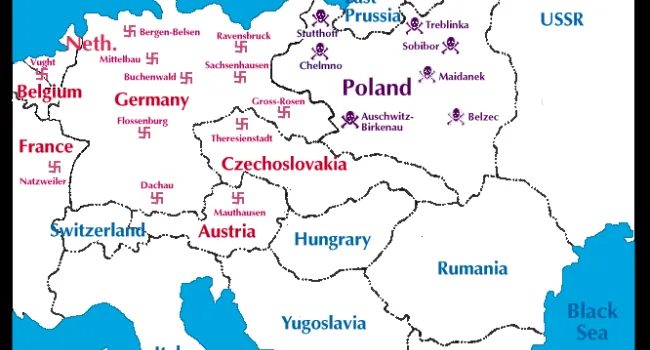
Although this lesson focuses on how the Nazis carried out mass murders, discussion should also focus on why the Germans were able to carry out this program which required enormous manpower and cooperation from local populations. Divide the class into five groups. Give each group a different handout. Before starting, have each group locate the places named in its readings on a map of Europe. If a detailed map is not available, you may want to look at the maps in Martin Gilbert's The Macmillan Atlas of the Holocaust, available in many public and college libraries.
Next, have groups read and prepare a group reaction statement expressing their feelings about what they have read. The reaction statement might take the form of a poem, picture, or an audio or video sound or sight collage using passages from the readings. Encourage students to be creative in their responses. After all groups have shared their reaction statements with the class, use the following questions to compare handouts:
1. What part did Auschwitz and other concentration camps play in Hitler's Final Solution?
2. What evidence can you find that the Nazis tried to hide what they were doing at these camps from both the prisoners and the outside world? Why do you think they tried to hide their actions?
3. What kept most people from trying to escape from the trains going to the camps? From the camps? How successful do you think escape attempts were?
4. Why do you think there was "the selection"? When did it take place? What was one punishment for hiding food?
5. What parts of this experience seemed to be most unbearable for the survivors whose testimonies you have read? What parts do you think would be most terrible for you? Other members of your family?
6. In his testimony about life in the death camp, Pincus said, "To survive in Auschwitz, you had to get a break." What did he mean? What was his break? What helped some of the other victims survive? (Among the things students might mention, are personal courage, the help of others, religious faith, resourcefulness or cleverness, determination to survive, luck, or the ending of the war. In the case of Bluma, having her sister to care for helped her survive.)
7. In what ways were the experiences of the people you have read about alike? (Students might suggest that all of these people had lost their homes, jobs, personal possessions, their identity, and all control of their lives. They all lived in fear and uncertainty, but tried, in accordance with their abilities, to react in a way that would help them survive.)
Teacher Notes
Extend: In 1992, newspaper and news magazine accounts of events in the former Yugoslavian republic of Serbia suggested parallels between Serbian treatment of Muslim minorities in that country and Germany's treatment of the Jews. Have several volunteers read and report to the class on these more recent events.
After students' reports, discuss reasons for the comparisons and compare and contrast the response of the international community to these two events.
The Abyss | Seared Souls: S.C. Voices of the Holocaust
In 1939 and 1940, more than 70,000 Germans and Austrians, such as the chronically sick and the mentally retarded, had been gassed in six special euthanasia institutions. The euthanasia program became...
View AssetHolocaust Glossary | Holocaust Forum
Learn key terms from the Holocaust. Anti-Semitism. Acts or feelings against Jews; takes the form of prejudice, dislike, fear, discrimination, and persecution. Aryan. A term used by the Nazis to mean a...
View AssetHolocaust Timeline
Learn the series of events that led to the Holocaust and related events that occurred during this period.. 1933 January 30: Hitler appointed chancellor of Germany. March 5: Hitler receives strong vote...
View AssetHANDOUT 5A: RUDY AT AUSCHWITZ
Rudy and his family stayed in the Theresiendstadt ghetto for almost two years. Then in 1944, they were told to prepare to move. In the selection below, Rudy describes what happened next.
View ResourceHANDOUT 5B: BEN AT AUSCHWITZ
Ben Stern spent six months in the Kielce ghetto and then was taken to a forced labor camp called Henrykow. In 1943 the Kielce ghetto was disbanded and the people in it sent to concentration camps. In this reading, Ben recalls his experiences in the Auschwitz (Ow-Switch) concentration camp in Poland.
View ResourceHANDOUT 5C: PINCUS AT AUSCHWITZ
In 1942 Pincus and his brother were taken from the Bochnia ghetto where they had lived for around two years to the Auschwitz (Ow-Switch) concentration camp in Poland.
View ResourceHANDOUT 5D: RENEE IN A WORK CAMP
In 1941 Renee was taken from the Kozenice ghetto to a labor camp in a Polish town called Skarzysko (Scar-Jess-Ko). In this camp, the men and women were separated. Renee worked in an ammunition factory. She and her mother stayed in this camp for three years. They were able to keep Renee's younger brother with them. Next they were sent to the Polish city of Czestochowa (Chest-Ta-Hoe-Va). In this reading she tells about her life there.
View ResourceHANDOUT 5E: BLUMA IN A CONCENTRATION CAMP
Bluma Goldberg was born in Poland in a small town called Pinczow (Pin-Shawv). When the Nazis invaded her town in 1939, they set fire to most of it. Bluma's house was destroyed and the family moved in with an uncle. In 1942, the family heard rumors that the Germans were rounding up all the Jewish people. Bluma and her sister spent several months hiding in the dense forests near their village. After learning that someone had informed on them, they decided to turn themselves in to the Nazis.
View ResourceLessons from the Holocaust Resource Guide
Teaching about the Holocaust is often limited by teachers' familiarity with the subject and the amount of time available for this topic. The materials in this guide were designed with these concerns in mind.
View ResourceIntroduction - The ETV Holocaust Forum
Thanks to a grant from the South Carolina Council on the Holocaust, ETV created a forum on the Holocaust to provide teachers access to a variety of resources when teaching their students about this tragic chapter from human history.
Standards
- 7-4 The student will demonstrate an understanding of the causes and effects of world conflicts in the first half of the twentieth century.
- WG-4 The student will demonstrate an understanding of the characteristics of culture, the patterns of culture, and cultural change.
- USHC-7 The student will demonstrate an understanding of the impact of World War II on the United States and the nation’s subsequent role in the world.