Catesby Onstage

Early American naturalists were both artists and scientists; they studied the movement of animals in their natural habitats to better understand their behavior and to document the diversity of life around them. They kept journals, took notes and often made several different images of the same animals. Because of their work, we know much more about animal behavior and how it relates to their habitat. We also have volumes of beautiful drawings that seek to capture the animal’s essence.
Choreographers use the same processes as artists and scientists. They study their topic and often take notes on what to include in their choreography. They improvise, edit, and rehearse their work to help communicate their idea to an audience in ways that can be entertaining, informative, and memorable.
In this unit, the students will recreate the processes choreographers use to create dances. Focusing on South Carolina habitat, the students will study animals that are native to South Carolina and discuss how their physical characteristics have been adapted for survival in their habitat. Using print media, video resources, and the drawings of Mark Catesby, the student will gather data about how an animal moves and how that relates to the world in which they live. The student will summarize their findings in brief descriptions of the animal’s physical characteristics, and sequence the movement and text into a storytelling dance.
Lesson Created By: Erin Leigh, Adjunct Professor College of Charleston
Lesson Partners: College of Charleston, Catesby Commemorative Trust, Charleston County School District
Essential Question
What processes do artist and scientists share that help them communicate their ideas?
Grade(s):
- 1
- 3
Subject(s):
Recommended Technology:
SMART technology, device and speakers to play music, tablets (at least 1 per group) and access to the internet, Adobe reader
Other Instructional Materials or Notes:
i.e. Internet Browser access
Lesson Progression
The following question will drive the lesson progression and will aid students in answering the essential question:
- What can we learn about animal habitat by studying their physical characteristics and movement?
Day 1
Like scientists, the students will observe the movement of an animal and record their findings. Using the heron as an example, the teacher leads the class through a discussion in which the class observes the heron through video and the drawings of Catesby. The class creates a list of words together that describe the heron’s use of their body, space, time and energy (see BEST Dance Elements Teacher Handout). The class records the list of words on one side of the board. At the same time, the teacher prompts the students to consider how the body structure of the heron helps it survive in the marsh and records the student’s responses on the other side of the board.
The teacher reminds the students about appropriate dance behavior in the room. Students spread out in the room and improvise to each of the words associated with the heron’s movement as the teacher prompts them. Once they have finished improvising, like a scientist, the students will collaborate as a class to summarize their finding in a paragraph. Like a writer, the students should make their paragraph interesting to read. Together the class writes a brief paragraph on the movement of herons in its habitat. Here is an example:
“Herons are very big birds and it’s not easy for them to lift off the ground. Once in the air, they swoop with wide wings and soar along the coast with their neck tucked safely in. Herons nest together in trees. They dance about on their long, thin legs while they wade in the slow-moving water. Staring closely on their prey, their long-pointed bills help them pick for fish and dig in the sand for crabs.”
Teacher reads the summary while the students improvise to the words. If time, the students can select specific movements to do at the same time to the words so that everyone in the class is moving in unison. The teacher divides the class in half and each half of the class performs the movement to the words. The class discusses how well they captured the essence of the heron’s movement and how they could improve their dancing in the future.
Day 2
Focusing on the lizard (Carolina anole), students observe the movement of the lizard and compare it to the heron. The lesson proceeds similarly to Day 1 but now the class compares the differences in body structures between the lizard and the heron and how that helps each adapt to their habitat. The teacher shares pictures of marshes and the students create a list of animals that they hypothesize might live in the marsh and animals that wouldn’t be able to survive there. Students also compare the different movement choices between improvising like a heron versus a lizard.
Day 3 & 4
Students are divided into small groups and each group is given a different animal native to South Carolina. Students research their animal and its habitat using their tablets. Using the same process modeled on Day 1 and 2, students generate a list of words (collecting data) that describe the way their animal moves (using the BEST Dance Elements Student Handout) and write a brief paragraph describing the animal and its movement. Students should be careful to make sure that their paragraph helps the audience understand the animal’s movement is related to habitat and edit their paragraph so it is engaging and memorable to read. Students create their movement to represent their animal and refine their choreography so that it captures the essence of their animal and is engaging and memorable to watch. Students practice performing their movement to the words.
Day 5
Each group performs their choreography for the class. Before the performance, the teacher guides a quick discussion on appropriate audience behavior. Before performing, the group tells the class which animal they had and what they observed about how the animal’s body structure and movement relates to its habitat. Once each group has performed, the class discusses the differences and similarities they noticed in the choreography. Each student reflects on the similarities between how choreographers and scientists observe and record animals and how they communicate their ideas to the audiences.
See sheet on BEST Dance Elements (See Resources)
Appropriate dance behavior in the classroom includes moving in place and through space without touching another person, desk, wall or object; moving with focus; and starting and stopping when the teacher prompts.
Audience behavior includes paying attention, not talking or planning, and showing respect.
Teacher Notes
Catesby PowerPoint includes Catesby drawing, video, images of marshes, that correspond with the lesson and additional Catesby drawings that can be printed for group choreography. The teacher can use the BEST Dance Elements Teacher Handout to prompt discussions and improvisations. The student/s can use the BEST Dance Elements Student Handout to record their choreography ideas.
Appropriate dance classroom behavior includes: 1) moving through the space without touching another student, desk, object, or wall; 2) following direction to the teacher’s movement prompts; 3) moving with focus and imagination.
Appropriate audience behavior includes: 1) body and eyes facing the performers; 2) showing respect by not talking, laughing, or planning; 3) giving the performers all your attention.
Standards
- Life Science: Environments and Habitats
- 1-3 The student will demonstrate an understanding of the principles of American democracy and the role of citizens in upholding those principles.
Assessments
Choreography rubric:
- The group created movement that represented the animal.
- The group’s choreography was interesting and memorable.
- The group’s text summarized the animal’s body structure, movement, and habitat.
- The group worked together from start to finish.
Scale: (1) not at all, (2) somewhat, (3) usually, (4) to a considerable extent, (5) consistently
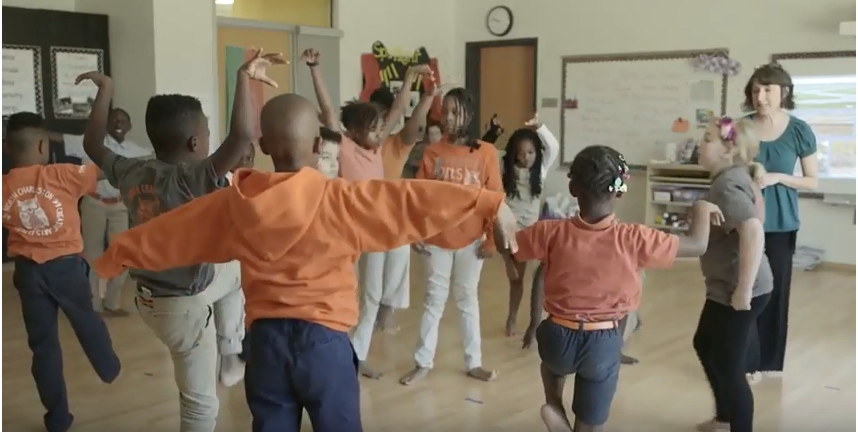
Catesby Onstage
School: North Charleston Creative Arts Elementary
Grade(s): 5
The lesson was a dance performance project created by Erin Leigh, Choreographer and Dance Educator at the College of Charleston. It features the drawings of Mark Catesby. An English naturalist who came to S.C. to record the plants and animals in their natural habitat. The drawings were used as a jumping off place for students to learn dance movements that correlate to animal movements and habitat. The performance and class were presented at the North Charleston Creative Arts Elementary School. To learn more about Mark Catesby visit, PBS LearningMediaLesson Feedback