Remembering the Real Meaning of Memorial Day
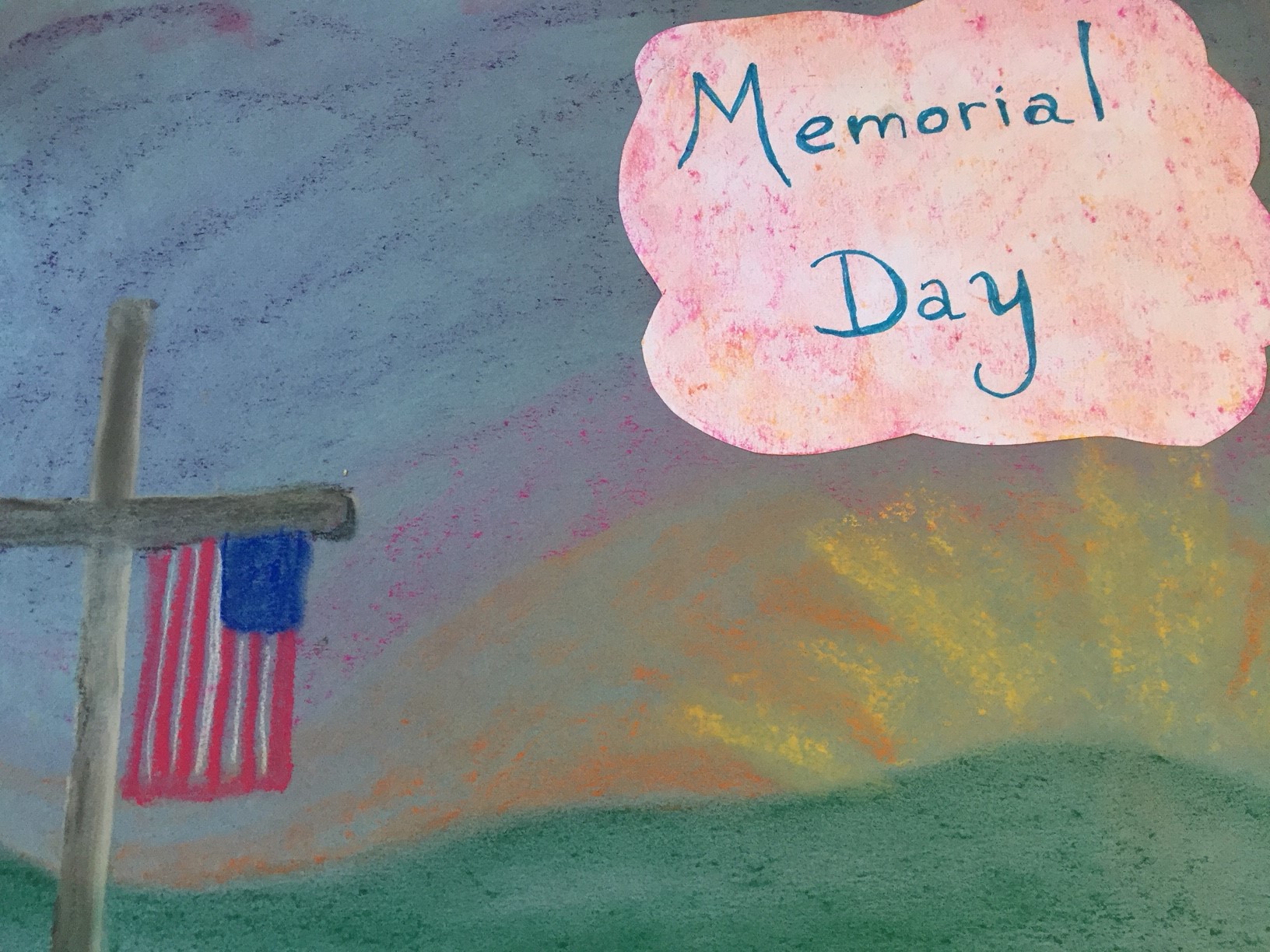
After learning about the origin and customs of Memorial Day, the students can connect to various online sites showing the important memorials that have been constructed to honor soldiers who were killed during U.S. wars and conflicts. They will learn about military funerals & burial flag folding, special sites such as Arlington National Cemetery, and the very somber and serious approach taken by our military to honor fallen soldiers and their families. After discussions and viewing the sites offered, students will choose to write a poem or poems pertaining to the themes of Memorial Day, and illustrate them. Instructions will be given on how to write a haiku, diamonte, or lantern poem, and how to use simple watercolor paint kits or soft pastels to illustrate or add "mood" to their poem creation.
Lesson Created By: katherine bradley
Essential Question
Students will have an understanding about the importance of honoring fallen soldiers, and the nature of the sacrifice given when someone loses their life in service for their country. Hopefully feelings evoked by discussions, seeing the various memorials,and learning about military customs, will help them understand the great effort and ceremony that is provided for a dignified burial to servicemen and women who are lost in the line of duty. Also, they will understand that the U.S. has set aside this special day in the year to especially remember and honor the soldiers who have been lost in battle.
Grade(s):
- 4
- 5
Subject(s):
Recommended Technology:
Teacher's computer and smartboard
Student 1:1 devices
Other Instructional Materials or Notes:
-white or light colors of construction paper
-Small water color kits w/ brushes & water cup...or markers & crayons
-"scratch" notebook paper to write memorial day "word bank", for use w/ poem
*OPTIONAL: soft drawing pastel chalks and/or chalk pencils, black or any color paper
Lesson Progression
1." WHAT IS MEMORIAL DAY?"
[Teacher will LEAD a discussion, & keeps students involved by asking for comments occasionally, such as "Does anyone have a relative or neighbor who is in the Armed Forces?" "What are the different branches of the Armed Forces, can you list some or all?" "How do you recognize that someone is serving in the military when you see them?" ,etc. always adjusting the depth of the discussion to the particular age level, & comprehension level of the students. ALWAYS BE SENSITIVE to the fact that someone may have a parent or relative stationed overseas, and we don't want to bring on feelings of fear about the relative's safety.]
2. Memorial Day is a military day of remembrance, which honors all soldiers who have died while on duty serving our country. The very first Memorial Day was called DECORATION DAY but was not an official holiday. During the Civil War years, women in the south began "decorating" soldiers' graves with flowers and flags, and this soon became a tradition for both the South and the North. After the Civil War ended a Union officer, General John Logan, initiated a formal "DECORATION DAY" for the graves of Union Soldiers throughout the states at locations where soldiers had died. It was first observed on May 30, 1868, as an official day of remembrance.
By 1882 the name MEMORIAL DAY had begun to be used instead of DECORATION DAY. It has become an occasion to honor those who have perished in any war or military action. ** Even though the original date was May 30, in 1968 Congress voted to change it to the last Monday in May to accommodate a 3-day weekend, and this was adopted in all 50 states by 1971. Some veterans and other citizens have not been happy about this, because of the large emphasis now placed on Memorial Day as the official "beginning of summer." They argue that the solemn occasion of honoring our deceased patriots has been overshadowed by families heading off on vacation and pursuing other pastimes on the 3-day weekend. WHAT DO YOU THINK ABOUT THAT? [Take time for student comments & opinions.]
3. WAYS TO RECOGNIZE AND HONOR MEMORIAL DAY: Nowadays, volunteers place flags on the graves of deceased soldiers, and citizens visit cemeteries and memorials to honor the men and women who died while fighting in battles or other dangerous military assignments to protect our country. **" Can you think of other ways we could honor the families who have lost soldiers? " [discuss] Some of the places people visit to honor our soldiers are in or near Washington, DC, our nation's capital. Some of these are:
*ARLINGTON NATIONAL CEMETERY, Arlington County, Va. [across the Potomac River from Washington DC] This cemetery is reserved for the burial of soldiers who have died in defense of our country. The U.S. Army controls the oversight of this 643-acre cemetery. All tombstones in the cemetery are of uniform size and design, and every Memorial Day, soldiers place small American flags on each grave; during the winter, a wreath with a red ribbon is laid upon graves. "THE TOMB OF THE UNKNOWNS" is a special large monument made of marble, wherein lie those soldiers killed and unable to be identified before burial. The Army has an Honor Guard [small group of soldiers] that patrols this tomb, 24 hours a day in ALL WEATHER...and this has been done every day since it was constructed in 1937!
*WORLD WAR I MEMORIAL, Washington, DC: This memorial is in Pershing Park and is the site of a beautiful park named for the famous General Pershing of WW I fame. A memorial wall with benches, beautiful flower gardens and a pond honor all the soldiers of WWI. In the winter, the pond freezes and becomes an ice rink, helping families enjoy the park in the cold weather.
WORLD WAR II MEMORIAL, Washington, DC: This memorial is located near the Reflecting Pool on the Mall in Washington. The Reflecting Pool consists of TWO TRIUMPHAL ARCHES: a Pacific Arch, and an Atlantic Arch, [? where are those names f],?] , which commemorate the areas of the world where many of the WWII battles were found, on these 2 oceans and the land that was near them. Also, there is a FREEDOM WALL, a curved wall which is covered by 4,048 gold stars, EACH STAR representing 100 SOLDIERS who died in the war. At the center is a beautiful fountain, backed by a semi-circle of 56 tall, granite pillars.
THE KOREAN WAR MEMORIAL, Washington, DC: This memorial is located not far from the Lincoln Memorial, and included in this area is a MURAL WALL of polished black granite, etched with photo-style pictures of soldiers, in scenes of combat during the war.There are also 19 larger-than-life STAINLESS STEEL SOLDIERS, sculpted in their combat uniforms, who seem to be "patrolling" through the park, just as they did through the terrain in Korea. A UNITED NATIONS wall lists all the nations who were involved in the war. THE REFLECTION POOL is at one end of the memorial for families and visitors to sit and vist, pray or meditate.
THE VIETNAM WAR MEMORIAL, Washington, DC: This memorial contains the full names of every American soldier that was killed in that war, from 1955-1975. 58,200 soldiers are memorialized there with their names carved onto black marble panels, placed in order by the date on which they died in service of our country.
[If possible, take time to show the pictures attached for each monument.]
These memorials are beautiful tributes that are built by our country to honor the SACRIFICE of those who gave their lives in the servic of our country's ideals of freedom. Millions of people visit these memorials each year; some of them are family members or friends of deceased soldiers; others are citizens who want to quietly pay their respects to the memory of brave soldiers who have died to protect our country.
****************************************************************************************************************
LARGE PARADES honoring the men and women of The Armed Services [what DOES that phrase mean?...discuss] are organized in many cities on Memorial Day, including New York, Chicago, and Washington, DC. A large MEMORIAL DAY CONCERT is held on the West Lawn of the U.S. Capitol each year. Army and Navy bands and orchestras play patriotic music, and guests speak about our soldiers. Lots of soldiers attend this concert and are honored, you can spot them sitting in the audience.
[watch the 2 short videos introducing the 2018 Memorial Day Concert/ PBS]
This concert is BROADCAST TO ALL AMERICAN TROOPS AROUND THE WORLD, AND IN THIS COUNTRY, and can be seen by viewers on SCETV ,SUNDAY, May 26, 8:00 pm and also 9:30 pm.
***********************************************************************************************************************
FLAG PROTOCOL FOR MEMORIAL DAY
On Memorial Day morning, the American flag is hoisted quickly to the top of the flag pole [called the "staff"], then slowly lowered down to "half-staff" from morning until 12:00 noon to remember our deceased soldiers. AT NOON, the flag is then raised to the top of the flagpole, to signify that our soldiers will always be "held high" in our memories, as we continue to strive for liberty and justice in their absence.
TRADITIONS FOR THE BURIAL OF U.S. SOLDIERS: When soldiers die, whether while on duty in the military, or when they've been retired, they are entitled to a military-style funeral with "honors." Honors means that certain customs are performed to show appreciation for the service of the soldier, and the hardships the familiy may have been through while the soldier was away from home.
1. Families can request burial at a military cemetery or in one of their own choosing.
2. The military will always provide at least 2 HONOR GUARDS, who will handle all the flag ceremony details. Sometimes a large funeral will require more HONOR GUARDS.
3.HONOR GUARDS are uniformed in their "dress" uniforms, with white gloves.
4. The casket of the deceased soldier is draped in a full-sized American flag.
5. After the service is finished, a lone bugler will play the solemn song "TAPS", which also has words when it's sung, the first line beginning with "Day is done" .This tune is played nightly by a bugle for soldiers at bedtime, which is called LIGHTS OUT at military bases[A bugle is very similar to a trumpet, but without the valve "buttons" that the musician pushes. The breath control alone changes the pitch, and it's difficult to learn, but a beautiful sound!] [LISTEN: TAPS on bugle, and TAPS sung with lyrics....which one do they like better? Which feels more solemn, uplifting, or sad to you?]
6. After TAPS is played, the HONOR GUARDS perform a "flag folding" ceremony that reduces the flag into a small triangle with only the stars on the blue "field" showing. They solemnly walk to the soldier's "next of kin" [discuss this term] and bend on one knee, holding out the flag for them to accept. The soldier then softly speaks a "condolence" [ "The U.S. Army appreciates the sacrifice your loved one made for our nation", etc. ] , removes one of their white gloves , and shakes the hand of the family member . Then the honor guards march into position to wait for the family to stand up.[Depending on the maturity & age of your students, and whether someone has lost a relative recently, you may want to view the FLAG FOLDING CEREMONY on the provided site.]
SOME OF THESE MILITARY TRADITIONS ARE DECADES OR EVEN HUNDREDS OF YEARS OLD.
**********************************************************************************************************************
Below is a true story about one of the most famous poems in the world - IN FLANDERS FIELDS - & the origin or a Memorial Day symbol, the Red Poppy flower. [READ THE FOLLOWING 'STORY' TO THE STUDENTS]
World War I, fought from 1915-1918 was one of the deadliest wars to be fought at the time. Canada, the U.S., and many European soldiers died in battles, which were fought in several European countries.
A Canadian doctor who volunteered for service in WWI, had the unfortunate experience of watching his best friend die of battle wounds. After his dear friend was buried, and having seen so many soldiers dying in his medical tent, he wandered off into the fields and sat down in grief, and began to write a poem. He named the poem IN FLANDERS FIELDS, because this was the name of a field where he saw a terrible battle. This field, located in the country of Belgium, had been a beautiful, quiet green pasture with red poppies blooming throughout; but serious battles and repeated bombings created a ravaged hillside strewn with barbed wire, burned trees, deep mud trenches, and the remains of soldiers.
The doctor's name was Lieutenant Colonel John McCrae, and he wrote a very beautiful but sorrowful poem , which describes his feelings of loss from all of the war's ravages...but it also expresses the hope for "help" from the living , to carry on with the important work when necessary. When writing, he seemed to express how the beautiful red poppies, which would pop up even after the ground was bombed and torn, gave him hope that there was still beauty left in the world, and that people would carry on and try to create a better life together.
[see IN FLANDERS' FIELDS attachments in videos]
*************************************************************************************************************************
ART AND WRITING PROJECTS FOR MEMORIAL DAY.... After hearing about, seeing, and discussing MEMORIAL DAY, we're going to write very simple poems, and add some type of artwork, as a way of thinking about the feelings of MEMORIAL DAY. The Goal: It would be nice if this poem honors any of the feelings of a soldier, but is not just an attempt to show the gruesome side of war.
Step 1.) On scrap paper, each student should make a "word list" of any words about Memorial Day, a military life, a soldier's sacrifice, his/her environment,locations of battles , things the soldier misses, etc. This won't be used exclusively, but will help give a sense of the feelings of Memorial Day and a soldier's life & sacrifices.
Step 2.) Teachers will read the sample poetry forms from this site, and explain each form from the directions below.
Step 3.) Choose a poetry form, and work on your first draft, on scrap paper.
Step 4.) Paint or use pastel chalks to give some color to your paper. It does not have to be a complete illustration, or it can! Anything you want that will SET THE MOOD of your poem.
[ Look at samples on Google Slides]
1.)HAIKU - draw 3 lines five syllables here
seven syllables right here
five syllables here
Haiku poetry should relate to a topic, but also try to :
-relate to NATURE somehow, possibly including a hint of a season
-refers to one or more of the 5 senses,
-is written in the PRESENT TENSE.
2.)DIAMANTE = 7 lines, with "parts of speech" as follows:[it makes a "diamond" shape]
Line 1= noun
Line 2= adj. adj.
Line 3= verb verb verb [that relates to the the noun & adj.'s above it]
Line 4= noun noun noun noun [things that can relate to the first noun above]
Line 5= verb verb verb
Line 6= adj. adj.
Line 7= noun [ a synonym of Line 1 noun]
[Sometimes it helps students to go ahead and paint something on their paper, even just the lines where their syllables/poetry will go, just to loosen up; many times the actual painting, invites the mind to "open up" and expand in more creative literary directions .Before they write their poem onto the painting however, they should feel happy with the wording on their scrap sheet.]
3.) LANTERN= 5 lines, used to describe a feeling, thing, or abstract idea. It resembles the shape of a Japanese lantern, in it's final form.
Line 1= word
Line 2= word word
Line 3= word word word
Line 4= word word word word
Line 5= word ( a synonym of the first word in a poem)
Teacher Notes
This is a lot of information, but as you're going through some of the MEMORIALS, that would be a great time to show the actual photos of them on the Smartboard for class viewing and discussion. Always solicit information from the students about the feelings they've experienced in memorials, or what they IMAGINE it would feel like to visit one of the memorial sites/which one they'd most like to visit & why? And what things neighborhoods, churches, schools could do for MEMORIAL DAY.
Sample - Haiku poem/ Memorial Day
Sample: A haiku poem,once finalized on scrap paper, is printed on an illustration created by student
Sample: A diamonte poem, once finalized on scrap paper, is printed on drawing paper in the middle of an illustrated "frame". The "frame" can utilize patriotic symbols, colors, or symbols of a soldier's life & struggles, such as helmet, boots, etc.
A sample of a diamonte poem.
View Resourcea sample of a "lantern" poem
a lantern poem is created on scrap paper, and then printed neatly on drawing paper. A "frame" of patriotic symbols, etc. can be added around the edges of the poem to enhance the patriotic feeling of the poem.
View ResourceIn Flanders Fields - Song and Slideshow
In Flanders Fields - the poem has been set to music and is sung by a children's choir, and has actual photos of WWI
View ResourceHow to Fold the American Flag
Instructions for ceremonial flag folding of the American Flag
View ResourceHistory of Memorial Day
[weblink] description] The Department of Veterans' Affairs has provided a short video giving a summary of Memorial Day.
View ResourceImage - Arlington National Cemetery
The image below is a view of Arlington National Cemetary
View ResourceWall of Remembrance
The weblink below is a view of part of the Wall of Remembrance, The Vietnam War Memorial
View ResourceDiamante poem - sample
Student will write a diamonte poem on scrap paper, as well as drawing an illustration reminiscent of American patriotism, WWI, soldier references [i.e. boots, helmets, etc.]with enough room/space in the middle to "frame" the poem. After finalizing the rough draft of poem, the student will neatly "letter" the poem ON the drawing.
View ResourceField of Flags
A beautiful short video of a school that asks all students to participate in arranging 6000+ American flags to represent the number of soldiers who have lost their lives in the battles of Afghanistan & Iraq. The teacher who organized the project speaks, students comment on the project, etc.
View ResourceStandards
- 4-6 The student will demonstrate an understanding of the causes, the course, and the effects of the American Civil War.
- VA.CR Creating - I can make artwork using a variety of materials, techniques, and processes.
- I Inquiry-Based Literacy Standards
- I.1 Formulate relevant, self-generated questions based on interests and/or needs that can be investigated.
- I.3 Construct knowledge, applying disciplinary concepts and tools, to build deeper understanding of the world through exploration, collaboration, and analysis.
- I.4 Synthesize information to share learning and/or take action.
- W.MCC Meaning, Context, and Craft
- W.MCC.1 Write arguments to support claims with clear reasons and relevant evidence.
- W.MCC.2 Write informative/explanatory texts to examine and convey complex ideas and information clearly and accurately through the effective selection, organization, and analysis of content.
- W.MCC.3 Write narratives to develop real or imagined experiences or events using effective techniques, well-chosen details, and well-structured event sequences.
Assessments
1. Ask students to write a letter to an imaginary soldier, and ask them THREE specific questions about difficulties about military life.
2. Then they write a "reply" letter on another paper answering those questions but also tell THREE things that are rewarding about serving one's country.
3. A different way to do this might be to SWAP LETTERS with another student [randomly]after writing the 1st soldier letter, and write the reply to ANOTHER'S person's letter.
[Try to use some vocabulary that you have learned about the military or Memorial Day, if possible.]