The Radiated Tortoise - Natural Selection and Conservation (9-12)
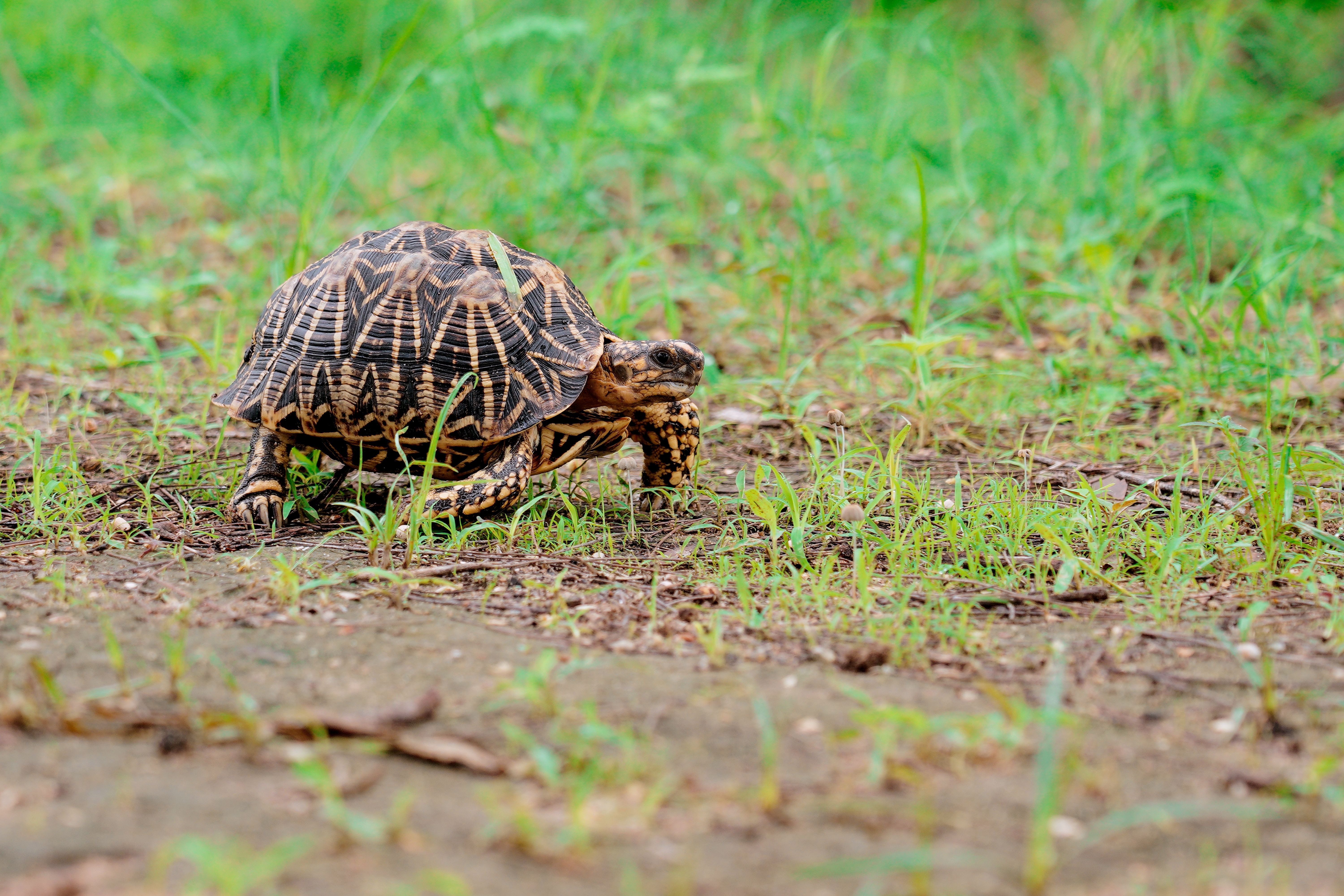
This lesson asks Biology 1 students to apply the four-factor model of evolution (potential to increase in number, heritable genetic variation, competition for limited resources, differential survival and reproduction) to a concrete example: the radiated tortoise's shell patterning and its role in survival. Students then extend their thinking to consider carrying capacity and biotic/abiotic limiting factors in the tortoise's native spiny forest habitat, and evaluate how conservation programs function as a designed solution to reduce human impacts on biodiversity. The lesson closes with a written, evidence-based explanation connecting trait variation to differential survival, and a design-evaluation task around real conservation strategies.
Essential Question
How does natural selection lead to adaptation in a population, and why do some adapted species still require human intervention to avoid extinction when environmental change is rapid and human-caused?
Grade(s):
- 9
- 10
- 11
- 12
Recommended Technology:
Device with internet access and a large display/projector for whole-class video viewing
Individual or small-group devices for the Research Guide and data lookup (IUCN Red List, AZA program pages, peer-reviewed sources)
Speakers/audio capable of being clearly heard throughout the room
Optional: spreadsheet or graphing tool for the Advanced extension's population-recovery modeling
Other Instructional Materials or Notes:
Printed or digital copies of the Viewing Guide and the four-factor evolution graphic organizer
List of pre-approved sources for the Research Guide (IUCN Red List, AZA/EAZA program pages, peer-reviewed journal databases) if you want to control source quality
Teacher note: this lesson references real, ongoing conservation efforts and a real, verified trafficking case type (customs seizures of radiated tortoises have occurred repeatedly) — framing this as a current, real-world case increases engagement and supports evidence-based argumentation
Lesson Progression
| Time | Segment | What Happens |
| 5 min | Before Watching | Students predict how slow reproduction affects adaptability to fast change. |
| 3 min | Vocabulary Preview | Briefly introduce key terms. |
| 8–10 min | Viewing | Show the video. Students complete the Viewing Guide. |
| 12–15 min | Discussion | Small groups work through discussion questions, applying the four-factor evolution model; share out. |
| 12–15 min | Assessment | Students write their evidence-based explanation. |
| Remaining time / Day 2 | Research Guide | Students select one prompt, gather sources, and prepare a cited response. |
| Extension (optional) | Conservation Solution Evaluation | Students evaluate and refine real conservation strategies. |
Teacher Notes
This lesson assumes prior instruction on the mechanisms of natural selection; it applies rather than introduces the four-factor model.
Emphasize that natural selection acts on existing heritable variation — it does not "create" new traits in response to need. Watch for this common misconception in student writing.
The contrast between the tortoise's slow life history and rapid human-caused change is the conceptual core of this lesson; make sure discussion explicitly surfaces this tension before students write.
If students haven't practiced evidence-based scientific explanations before, model one example response as a class before releasing them to write independently.
Remediation
For students whose written explanation omits one or more of the four evolution factors, or who show the common misconception that an individual tortoise can change its own pattern to survive better (rather than variation existing before selection acts on it):
Provide a four-box graphic organizer labeled with each factor (population growth potential, heritable variation, resource competition, differential survival/reproduction) and sentence starters for each, using the tortoise example, before students revise their full written explanation.
Run a quick true/false diagnostic ("A tortoise can change its own shell pattern during its lifetime to survive better") to surface the misconception directly, then re-teach using a well-established example (such as peppered moth coloration) before returning to the tortoise.
Pull a small group to rebuild the carrying-capacity connection using simplified, concrete numbers for biotic/abiotic limiting factors rather than the abstract habitat description alone.
Offer a short one-on-one conference on the written explanation, then allow a revision and resubmission for partial credit recovery.
Differentiation
Struggling Readers / English Language Learners
Provide a graphic organizer that breaks the four-factor evolution model into separate boxes with tortoise-specific sentence starters for each.
Pre-teach "carrying capacity," "generation time," and "adaptation" with visual models or short clips before viewing.
Allow the Research Guide to be completed with a partner, with responses given verbally and recorded.
Students with IEPs / 504 Plans
Allow the video to be paused at key moments for extra processing time.
Provide extended time for the written explanation, or allow a scaffolded outline to be completed first before full prose.
Offer sentence frames for each of the four evolution factors.
Advanced / Gifted Students
Require students to locate and cite actual population trend data (e.g., from the IUCN Red List) in their written explanation rather than relying only on the video.
Challenge students to model, using simple proportional reasoning, how a population with a 100+ year generation time might recover more slowly from a 50% population decline than a species with a 5-year generation time, given equivalent reproductive rates.
Offer an independent extension: research and critique a real proposed or implemented conservation policy (e.g., CITES listing, anti-trafficking legislation) using the B-LS2-7 design-evaluate-refine framework.
Extension
Conservation Solution Evaluation: Using the B-LS2-7 standard directly, have students research and evaluate two real, competing conservation strategies for the radiated tortoise (e.g., ex-situ breeding programs vs. in-situ habitat protection and anti-poaching enforcement). Students should identify criteria for success, evaluate each strategy against those criteria using evidence, and propose a refinement or combination of strategies, presented as a short position paper or class debate.
Suggested Additional Reading
The Beak of the Finch: A Story of Evolution in Our Time by Jonathan Weiner — a Pulitzer Prize-winning account of natural selection observed directly in Darwin's finches; a strong pairing with the natural selection standard (B-LS4-4).
The Sixth Extinction: An Unnatural History by Elizabeth Kolbert — explores human-caused biodiversity loss and extinction risk; pairs well with the conservation/biodiversity standard (B-LS2-7).
The Song of the Dodo: Island Biogeography in an Age of Extinctions by David Quammen — examines why species on isolated islands (like Madagascar) are especially vulnerable to extinction; ties directly into carrying capacity and limiting factors (B-LS2-1).
Silent Spring by Rachel Carson — a foundational text on human environmental impact; useful as background context for the conservation-solutions discussion.
Note: these are trade books written for general adult/YA audiences, not textbooks. Preview excerpts for classroom fit and consider assigning selected chapters rather than full texts.
Radiated Tortoise — Natural Selection and Conservation (9-12)
This document goes along with the Radiated Tortoise — Natural Selection and Conservation (9-12) lesson.
View AssetStandards
- B-LS2-1. Use mathematical and/or computational representations to support explanations of biotic and abiotic factors that affect carrying capacity of ecosystems at different scales.
- B-LS4-4. Construct an explanation based on evidence for how natural selection leads to adaptation of populations
- B-LS2-7 Design, evaluate, and refine a solution for reducing the impacts of human activities on biodiversity and ecosystem health.
Assessments
Primary Assessment (Evidence-Based Explanation): Have students write an evidence-based explanation responding to the prompt: "Explain how natural selection could act on shell-pattern variation in radiated tortoises, and evaluate why this species' life history traits make it especially vulnerable to rapid, human-caused environmental change." Students must reference all four factors of the evolution model and connect at least one life history trait (generation time, clutch size) to vulnerability.
Scoring Guidance: A strong response names all four factors (population growth potential, heritable variation, resource competition, differential survival/reproduction) accurately applied to the tortoise example, and draws an explicit, correct link between slow reproduction/long generation time and reduced capacity to adapt to fast change — rather than a general statement like "the tortoise is endangered because of habitat loss."
Formative Check: Use completed Viewing Guides and small-group discussion participation as an informal, ongoing check for understanding before students begin the writing task.