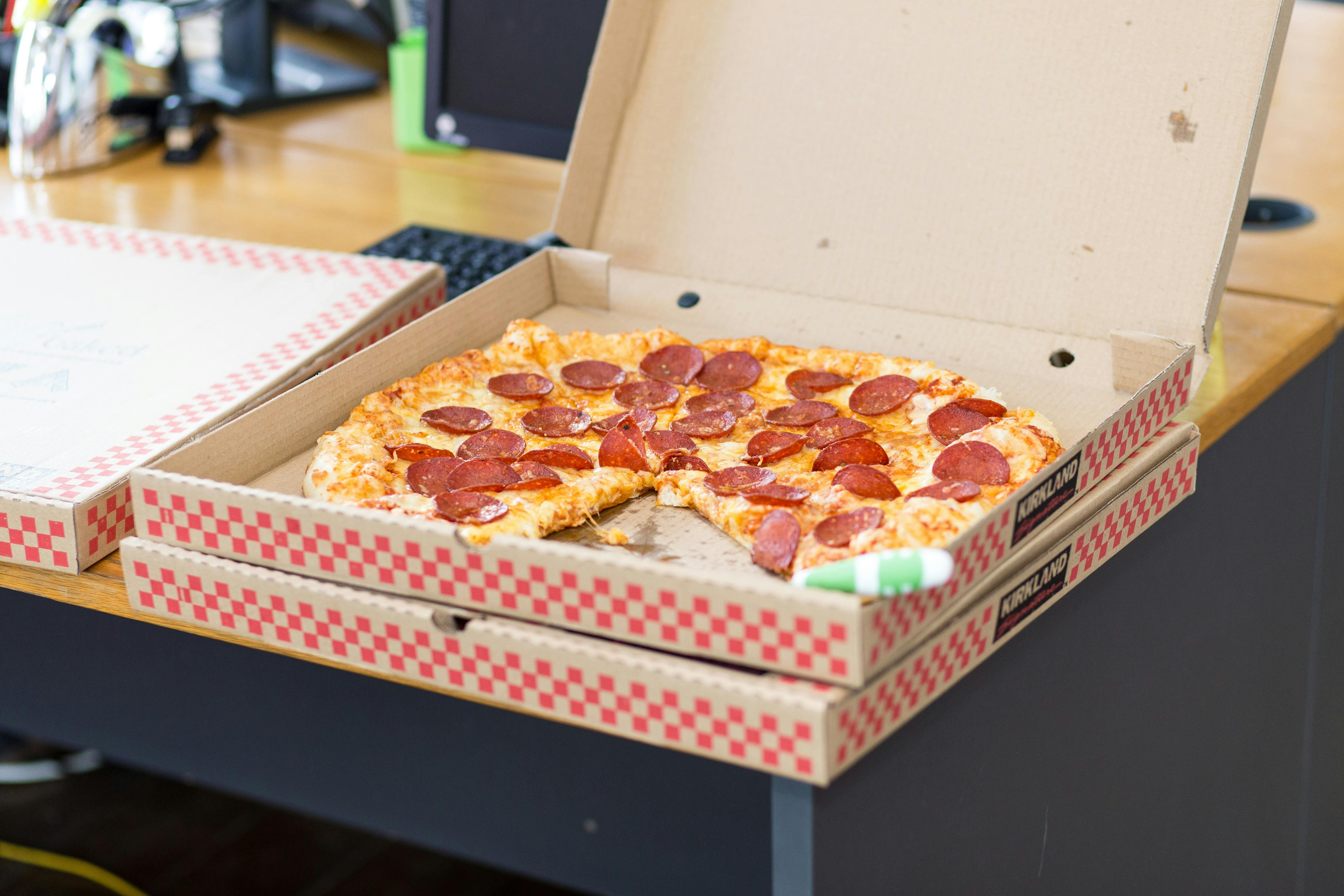
1. Gain Attention | Show students pictures of pizzas cut into different slices (halves, fourths, eighths). Ask students to brainstorm in their math notebooks which mathematical concept they think this math lesson may utilize. | Students record their thinking in their notebooks and share their ideas with the class about what the pizzas may represent. |
2. Inform Learners of Objectives | Confirm that the lesson will be working with fractions. “Today we will be identifying and representing equivalent fractions using manipulatives and drawings.” “This will help us when we are adding and subtracting fractions with unlike denominators. We can use this knowledge later to create common denominators.” Have students restate the objective in their own words to a shoulder partner. | Mentally, students either confirm or reject their initial hypotheses. Students listen to the objective. Students reword the goal for the lesson and verbalize it to a peer. |
3. Stimulate Recall of Prior Learning | Begin by showing students a whole pizza pie and asking how to represent it numerically. Record accurate response(s) beside the visual. Display ½ of a pizza. Repeat the process by asking for a numeric representation and record. Call on a student to explain where the digits 1 and 2 came from and what they represent. Tie in vocabulary terms such as numerator and denominator. Display 2/4 of a pizza and repeat the process. | Students explain that the entire pizza represents 1/1 or the whole number one. Students identify the visual model as ½, explain where the numerator and denominator came from, and use vocabulary terms. Same as above. |
4. Present the Content | Ask students to identify any patterns that they notice between the ½ and the 2/4 models that are labeled at the front of the room. Address student ideas. Record thoughts of students and allow peers to respond to one another, either affirming or disputing claims. Confirm that both represent the same value, though they have different numerators and denominators. Highlight that the relationship between each fraction’s individual numerator and denominator remains the same (numerator doubled is the denominator). “What is 3 x 1? 1 x 15? 29 x 1? 1,000 x 1?” “What is the pattern with those questions?” “Any time we multiply any number times one, the multiplication property of one means that the value will stay the same. Now we will use this information to help us show one fraction in multiple ways. Let’s take the fraction ⅓ and show it in another way. If I want to keep the value of the fraction the same, what should I multiply the fraction by? “Correct, we will multiply by one to keep the value the same. Even though I want the value to remain constant, I need to show this one differently so that I don’t get the same numbers in the numerator and denominator. Let’s look back at the whole pizza we worked with in the beginning. We said that this was 1/1.” Cut the pizza in half. “Has the value of the pizza changed?” “How else can I numerically represent this pizza now?” “Correct. Now if we had this amount of pizza, (display ⅔), and wanted to show another way to record the same amount of pizza, what should I multiply by to keep the value the same?” “How else can we show 1?” Record 2/2 on the board. Work through 2/3 x 2/2 = 4/6. Ask students how the model could be altered to show 4/6 instead of ⅔. Cut each slice in half. Complete another example with the class. Ask students how to get ⅘ shown as tenths. | Students search to make meaning of the mathematical representations, using prior knowledge. Students take risks to engage in class dialogue, while also comparing and contrasting their own thinking patterns to those shared. Students record the example in their notebooks for later reference. Students answer each question. Students identify that each question involves the multiplication property of one. Students indicate that the fraction should be multiplied by one to keep the value the same. Students ponder whether or not the cut has impacted the value or amount of pizza, determining it has not. "No." Students identify 2/2 as a new way to record the pizza model’s value. "We can multiply by one." "2/2" Students apply their new skills to answer the question. |
5. Provide Learning Guidance | Provide students two opportunities to apply their new learnings with their shoulder partners. - Create an equivalent fraction to ⅖.
- Create an equivalent fraction to ⅚.
The teacher circulates the room and provides feedback not already given by the students to each other. Select two students to complete the problems and model think-alouds to the class. Confirm appropriate applications. | Partner A leads the first problem and partner B gives feedback and either confirms or questions the solution. Reverse the roles for the second problem. The selected students complete the problems in front of the class, explaining their thinking process. |
6. Elicit Performance (Practice) | Provide students with “Pizza Fraction Models” practice worksheets. Students practice labeling visual models and creating equivalent fractions as well as producing corresponding model representations. | Students complete the independent practice task. |
7. Provide Feedback | Circulate the room during independent practice and provide necessary scaffolds. Question students to focus their attention to specific details in order to empower students to self-correct if necessary. Have students swap papers with their shoulder partners. Ask them to use a differently colored writing utensil that their partner used to give feedback on their partner’s task. This may include check marks and smiley faces, question marks, or written responses. Optional: Students may utilize a “glow and grow” feedback model to leave a note on something their partner has done well and something that may make their partner’s work even stronger. | Students continue their performance tasks and answer any posed questions. Students provide feedback to one another using a differently colored writing utensil. |
8. Assess Performance | After students have had time to complete the performance practice task, provide feedback to one another, and review received feedback, call the class back together. | Students are called upon to share in front of the class for each question. They answer questions asked of them by the teacher and the other students. |
9. Enhance Retention and Transfer | In subsequent lessons, the teacher will revisit the concepts addressed in this lesson. The lessons will build on these skills to include addition and subtraction of fractions with unlike denominators. For example, ⅔ - ¼. Students will apply their knowledge of equivalent fractions to generate common denominators in assessments at the end of these lessons. | Students participate in formative and summative assessments within the progression to assess learning outcomes when applying these skills. |