Part 4: Colony of a Colony - Beyond Barbados: The Carolina Connection

Power was a commodity in Barbados that easily transferred to Carolina. Cultural beliefs and practices influenced Carolina’s economy and helped shape the “place” that would become South Carolina.
Lesson Created By: Lisa Ray and Lewis Huffman
Lesson Partners: ETV Education, SC NATIONAL HERITAGE CORRIDOR
Essential Question
How can the concept of “place” be explained through social interactions?
Driving Question: Ruthless is a word used to describe the Barbadian planter culture and the Goose Creek Men. How did the transfer of the Barbadian culture influence Carolina’s economy?
Grade(s):
- 4
- 6
- 8
Subject(s):
Recommended Technology:
Internet access
White board or projector for group work
Tablets or laptops for individual and group work
Other Instructional Materials or Notes:
Lesson Progression
- The teacher will divide the class into working groups of seven students. Each student will be assigned a topic about which they will take notes.
- Students within the group will share information discerned and discovered in “real time” using Google Keep. This is a Google application that is part of the Google suite of programs in Google Drive. This is a free application that is an extension of Google Docs and allows students to work collaboratively. It can be accessed through Google Drive, or by going to https://keep.google.com/u/0/.
- Beyond Barbados: The Carolina Connection is divided into six individual short modules. The modules show a connection that is chronological and will help students answer a driving question that is connected to the individual modules. Collaborative work on the six modules will lead to overall conclusions that can be made about an overarching essential question.
- Each module is a separate lesson with an individual driving question and evaluation. Each separate module will include a grading rubric for ease of assessment. The grading rubric is found in the assessment section and in the resources.
- The work of each module is meant to be completed within a class period. (45 to 50 min.)
- Each of the driving questions is intended to help students answer the essential question.
- It is important to remember that with both the driving and essential questions, students must analyze and interpret data, which can lead to many conclusions. Students are graded on the process and the validity of their conclusions. Each group may infer data differently and therefore reach different conclusions.
- Students will be asked to use Google Keep so that they can take/share notes within their group.
- Once all notes are taken, each group member will be expected to share a “topic discovery” with the class, as prompted by their teacher. The teacher will create a slide of each topic, listing student observations and notes taken from the video. The teacher will add to the notes if appropriate.
- The slide presentation will be shared with students for their review and to help answer the driving question..
- Once the teacher is satisfied that students understand expectations, the teacher will show the first module to the whole class. Each module will be shared with the groups so that students can review and take notes based on their individual topics. Notes taken by students will be shared within their group and with the teacher.
- Modules are designed to be shown chronologically.
- Notes taken for each topic, from each group, will be shared with the class.
- The groups will be asked to answer the driving question based on the total information, from each topic which has been shared with the class. Each group will post their answer on a slide, which can be added to the class presentation of topic notes.
Teacher Notes
When grouping, it is not always possible to have equal groups of seven students to cover each topic. To help teachers make pertinent decisions concerning topics and group composition, we have provided bullet points about each topic which is intended for teacher use. This information is a teaching tool to help you, the teacher, decide how groups should be arranged and how topics can be divided among students and/or groups. The answers provided are suggestions, teachers can add to, or take away from, the bullets provided. All information can be changed to fit teacher and student needs.
Barbados to Carolina
- Rice attracted successful Barbadian planters to Carolina
- Parish names in Carolina were the same - St. Phillip, St. Thomas, Christ Church, St. George, St. Andrews
- Family names from Barbados came to Carolina - Middleton, Drayton, Colleton, Yeamans
The Goose Creek Men
- Middletons were early immigrants to Carolina
- They were part of a group of Englishmen who established themselves on a tributary of the Cooper River called Goose Creek
- The Goose Creek Men were a political faction of planters from Barbados and England
- They viewed the Lord Proprietors as incompetent and selfish and mostly opposed them
- They knew how to control commerce and international business
- They understood agriculture
- They were hard working and often unscrupulous
- They used enslaved labor to make money
- They were very independent and didn’t like to be told what to do, especially by the government
- They controlled SC politics for 60 years
- Arthur Middleton, son of one of the original Goose Creek Men, became the first royal governor in the 1720s
- Goose Creek men were ruthless, not only did they wield political power, but they were known for their illegal activities, like the enslavement of indigenous people and participating in commerce with pirates
Carolina Barbadians
- They wanted to distinguish themselves from the average English colonist
- They lived in the same manner as they had in tropical Barbados
- They settled mostly in the Low Country
- They helped to establish a defiant, self-reliant way of doing things in SC
Carolina Economics
- Carolina Barbadians used shortages of resources in Barbados as a economic driver in Carolina
- Because lumber was needed in Barbados - lumber became an export from Carolina to Barbados
- Because cattle was needed on Barbados - Cattle became an export to Barbados
- Because slaves were needed on Barbados - Native Americans were enslaved and sent to Barbados - there are Native American communities today, on Barbados, that are descendents of Native Americans from Carolina
- Barrels for shipping became an export
- Export of wood for fuel for Barbados refineries
- Food to sustain Barbadians was exported
- Carolina became the bread basket of the Caribbean
Pirates/Privateers
- Common threat to New World trading networks
- They plundered trade ships and ransomed hostages
- South Carolinians frequently traded illegally with pirates who wanted simple things like medicine
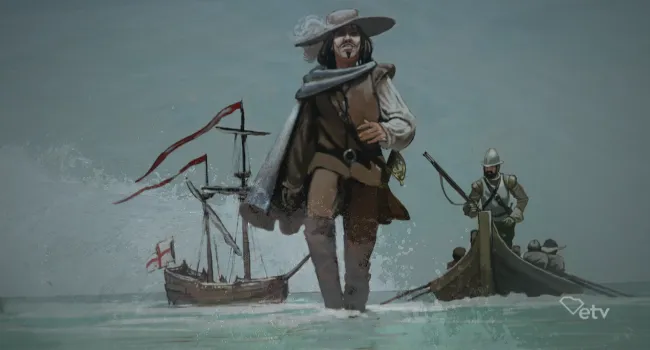
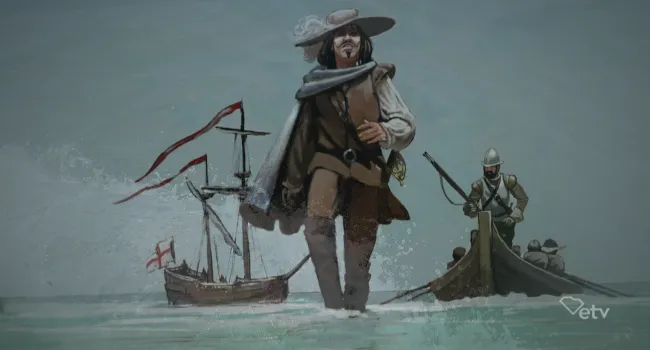
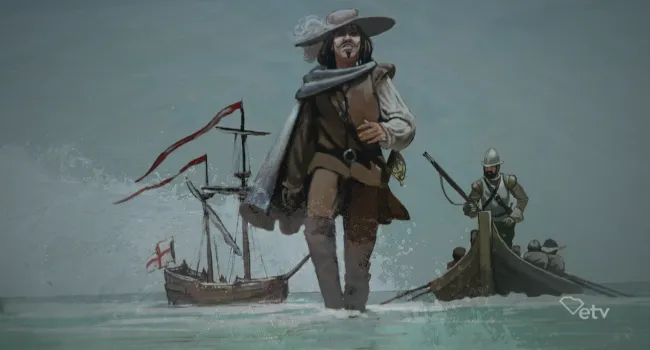
- Most well known Barbados-Carolina connection was Barbadian aristocrat who turned pirate, Stede Bonnet
- Stede Bonnet was a wealthy, well educated plantation owner who became bored with his home life - he got the nickname “The Gentleman Pirate”
- At age 28 Bonnet purchased a ship called Revenge and sailed to become a pirate off the shores of Carolina
- He was only a pirate for 18 months and he teamed up with a pirated named Edward Teach (Blackbeard)
- Bonnet was said to have invented the process of walking the plank
- Blackbeard betrayed Bonnet, and left him with an ailing ship outside Charleston
- Bonnet, and 29 of his shipmates, were captured, tried and hanged for their crimes in Charleston
Triangular Trade
- Import of slave labor and export of goods from Carolina became part of the triangular transcontinental trading network
- Carolina competed in a global world market by exporting agricultural products, beef, rice, lumber
- Barbados was one of the primary seaports that supported world trade
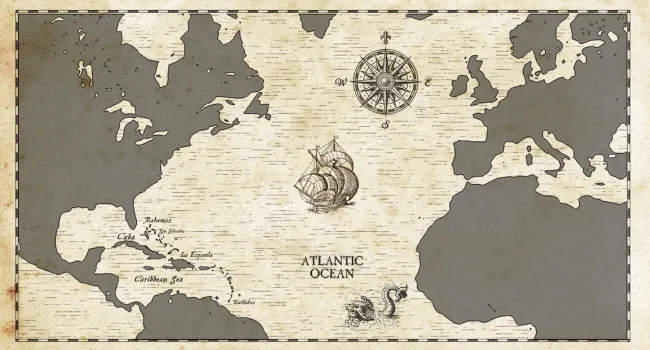
- Triangular trade from Africa, Barbados/Caribbean, to America
- Carolina became the jewel of the 13 colonies, becoming wealthy from the rice trade and Barbados continued to lead in sugar production
- Eventually, plantation owners in America began to import slaves directly from West Africa cutting off the Barbadian link
George Washington
- Washington accompanied his half-brother, who was stricken with tuberculosis, to Barbados
- This was the only time he visited outside the US
- It was thought the warmer climate would help cure tuberculosis
- Washington intermingled with militia on Barbados and visited a garrison
- He and his brother stayed in a house in Bridgetown
- His brother stayed for 6 weeks, his convalescence was unsuccessful
- Washington contracted smallpox while in Barbados
- Washington learned from the militia in Barbados and he developed an immunity to smallpox because of his exposure
- During the Revolutionary War, he oversaw the earliest known inoculations for smallpox of his troops
An alternative site to Google Slides which students can use to share and post information is Scrumblr. Scrumblr is a site that provides an online space to create and share sticky notes with a group. Please note, teachers will have to create a separate board for each class with a specific class URL. This allows students to use a common board and share information. A board has been created as an example. The link is listed in the resources.

Beyond Barbados | Carolina Stories
Colony Of A Colony Most of the colonists who settled in Carolina were wealthy English planters, with names such as Middleton, Drayton, Colleton, and Yeamans. The vast wealth accrued in Carolina was...
View AssetBeyond Barbados: Sweet Success | Carolina Stories
Sweet Success Dutch Sephardic Jewish colonists moved from Brazil to Barbados to escape the religious persecution of the Spanish Inquisition. These Sephardic Jews brought with them the knowledge to...
View AssetBeyond Barbados | Carolina Stories
In The Beginning Most students today understand that the Carolinas were colonized by the English who had come to the Charleston area by way of Caribbean trade routes, primarily Barbados. The story of...
View AssetBeyond Barbados | Carolina Stories
The Barbados Adventurers With the success of the sugarcane crop, Barbados quickly became the wealthiest colony in the New World, and the most densely populated place on the planet. Successful...
View AssetBeyond Barbados | Carolina Stories
A Cultural Hearth The success of Barbados, Carolina, America, the New World for that matter is coterminous with slavery. The labor, the technology, the ingenuity, and the culture that supported this...
View AssetBeyond Barbados | Carolina Stories
From Whence They Came Gullah is the blending of all the cultures that came together during that horrible time in human history called the Transatlantic Slave Trade. The connection between Barbados and...
View AssetBeyond Barbados Glossary
Part 1: In the Beginning ( CLICK FOR VIDEO ) Amalgam – A mixture or blend Amerindians – A member of the indigenous peoples of the Americas Barbados – An island country in the Lesser Antilles of the...
View AssetPart 6: From Whence They Came
Look around Charleston, the Barbados-Carolina connection is ever present. How “place”, past and present, changed and molded the connection is explored through various aspects of culture. The mixture...
View LessonPart 5: A Cultural Hearth
Historians refer to Barbados as the cultural hearth of the Americas. This cultural hearth resulted in a cultural transference. As demographics changed and power shifted, so did perceptions of “place”...
View LessonBeyond Barbados Part 5: A Cultural Hearth Lesson Plan
Beyond Barbados Part 5- A Cultural Hearth video segment focuses on the rebellions that took place in Barbados and the false “Emancipation” that was presented to enslaved Africans after the rebellions...
View LessonPart 4: Colony of a Colony - Beyond Barbados: The Carolina Connection
Power was a commodity in Barbados that easily transferred to Carolina. Cultural beliefs and practices influenced Carolina’s economy and helped shape the “place” that would become South Carolina.
View LessonBeyond Barbados Part 3: The Barbados Adventures Lesson Plan
Beyond Barbados Part 3- The Barbados Adventures video segment focuses on the growth and wealth of Barbados with sugar cane as the cash crop. It notes that Europeans developed plantations throughout...
View LessonPart 3: The Barbados Adventurers - Beyond Barbados: The Carolina Connection
Barbados was one of the wealthiest colonies in the New World and one of the most densely populated areas on the planet. Barbados greatly changed from years of settlement and economic pursuits. “Place”...
View LessonBeyond Barbados Part 2: Sweet Success Lesson Plan
Beyond Barbados Part 2- Sweet Success video segment focuses on Europeans establishing Barbados as a colony. There is an emphasis on identifying how the Europeans sought for a cash crop, sugar cane, to...
View LessonPart 2: Sweet Success - Beyond Barbados: The Carolina Connection
History never really happens in a vacuum. Barbados was an amalgam of many cultures, which was made even more complicated by the social control of those in power over those enslaved. The clash of...
View LessonPart 1: In the Beginning - Beyond Barbados: The Carolina Connection
Most students today understand that the Carolinas were colonized by the English who had come to Charleston by way of the Caribbean trade routes, primarily Barbados. This module describes the...
View LessonA PBL That Explores Beyond Barbados: The Carolina Connection
Sometimes, the history of a place begins elsewhere. It is a complex blending of cultures and place.The history of South Carolina is likewise complex, and it began somewhere else, in a place that many...
View LessonNotes Presentation
Slide presentation for whole-class group work to share information on the specified topics.
View ResourceDriving Question Presentation
Slide presentation for whole-class group work to share information the answer to the driving question.
View ResourceGoogle Keep
Google Keep is a free application that is an extension of Google Docs and allows students to work collaboratively.
View ResourceScrumblr
Scrumblr is a site that provides an online space to create and share sticky notes with a group.
View ResourceScrumblr - Part 4 - Colony of a Colony
Example of a Scrumblr board with the topics for Part 4 - Colony of a Colony.
View ResourceGullahNet
In the past, people have described the Gullah culture as quaint and the language as unintelligible. A closer look reveals a complex history and language with direct links to West Africa that survived slavery and thrived on the Sea Islands of South Carolina and Georgia. The Gullah experience has many variables that make it unique to each family and community.
View ResourceAnita Singleton-Prather | Women Vision SC
Anita Singleton-Prather grew up thinking she would study law and become a civil rights attorney. Instead she became a master storyteller, author and educator. Her work has influenced civil rights and has preserved stories and history about the Gullah culture and South Carolina.
View ResourceStandards
- 4.1.CC Identify patterns of change and continuity in the development of economic systems in British North America.
- 4.1.E Analyze multiple perspectives on the economic, political, and social developments of British North America and South Carolina.
- 6.3.CE Explain the impact of increased global exchanges on the development of the Atlantic World.
- This indicator was developed to encourage inquiry into the growing interconnectedness between Europe, Africa, and the Americas which led to increased global exchanges throughout the Atlantic World. The indicator also encourages inquiry into the development of human labor systems, cultural interactions, and the growth of economic markets.
- 6.3.CO Compare European motivations for exploration and settlement.
- This indicator was developed to encourage inquiry into European motivations for exploration and settlement as a result of the closing of the Silk Road. This indicator was also written to foster inquiry into the development of the Atlantic World, and the resulting economic, political, and social transformations in European, American, and African societies.
- 8.1.CE Analyze the factors that contributed to the development of South Carolina’s economic system and the subsequent impacts on different populations within the colony.
- This indicator was designed to encourage inquiry into the geographic and human factors that contributed to the development of South Carolina’s economic system. This indicator was also written to encourage inquiry into South Carolina’s distinct social and economic system as influenced by British Barbados.
- 8.1.CX Contextualize the development of South Carolina’s political institutions during the colonization of British North America.
- This indicator was designed to encourage inquiry into the development of the political structure of the South Carolina colony from the development of Charles Towne under English control to the movement toward self-rule.
- HG.1.2.PR Explain the cultural, economic, environmental, and political conditions and connections that contribute to human migration patterns.
Assessments
Driving Question Rubric - Part 4: Colony of a Colony
https://docs.google.com/document/d/1-0KYrGpgkrEVcZvwKel_0pMfIE4rTOBLdFku...