Mosquitoes
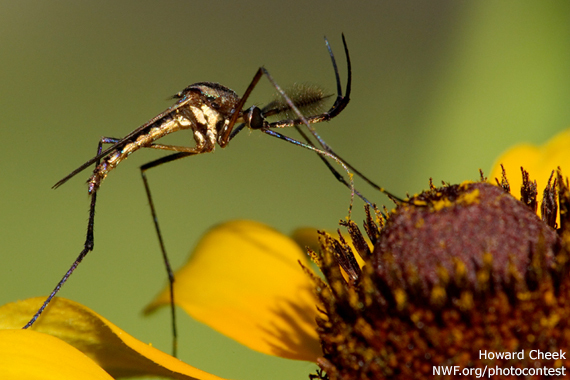
Students will learn about mosquitoes, their life cycle, and how they act as pollinators.
Lesson Created By: Savannah River Ecology Lab
Essential Question
What is the life cycle of a mosquito? How do mosquitoes act as pollinators?
Grade(s):
- 1
Subject(s):
Recommended Technology:
Other Instructional Materials or Notes:
- Mosquitoes in different life stages: egg, larva, pupa, adults
- Magnifying glasses
- Student Mosquito worksheet
- Writing utensils
Lesson Progression
The Activity:
- Have students name all the pollinators they can think of. Write suggestions down. Students most likely will not say mosquitoes, you will need to add it to the list.
- Explain that mosquitoes are good pollinators because they eat nectar as the main part of their diet. Only females drink blood, which they need to reproduce.
- Pass out an example of mosquitoes in various life stages. Allow students to examine the specimens with magnifying glasses.
- Ask students if they can name the stages of the mosquito life cycle based on what they saw. (eggs, larva, pupa, adult). Have students label the figure on their worksheet accordingly.
- Have adult male and female mosquitoes side by side. See if students can find any differences between them. Have them tell you what they found (feather-like projections on males, pointy on females).
- Explain that the projections they see are call proboscis, and in females, it's used to suck blood. In males, it's used for hearing so they can find females.
- Talk to students about diseases, how mosquitoes can play a role in spreading them.
Teacher Notes
Background:
Mosquitoes are often thought of as annoying pests to be exterminated. However, they play a rather large role in the pollination of many flowers, including goldenrod and orchids. Only female mosquitoes suck blood, they need the protein from blood to reproduce. Male mosquitoes never bite, making flower nectar their main source of food. Because nectar is the bulk of their diet, they help pollinate flowers as they fly around looking for food.
Mosquitoes have a four-stage life cycle: egg, larva, pupa, and adult. Adult females will grow to have a long needle-like proboscis that is used to pierce the skin and suck blood. Males have a feather-like proboscis that helps them hear and find females.
Mosquitoes are carriers of many diseases harmful to humans, such as West Nile, Zika, and Malaria. They can spread disease by drinking the blood of an infected individual and then biting an uninfected person. The virus or disease is introduced into the blood of the second person now making them infected too. This can happen to hundreds of individuals allowing for the rapid spread of disease. We can help reduce the spread by making it harder for mosquitoes to complete their development. They need water to finish reproducing. By making sure we dump out or remove standing water, we can prevent mosquitoes from finishing their life cycle. Additionally, we can wear long sleeves and pants, or using natural bug repellents to prevent bites.
Mosquito Student Worksheet
Worksheet for students to follow along with lesson. Students will be asked to label figures and answer questions relating to mosquitoes.
View ResourceStandards
- Science and Engineering Practices
- 1.S.1 The student will use the science and engineering practices, including the processes and skills of scientific inquiry, to develop understandings of science content.