Distance Learning Art: Texture Seascapes
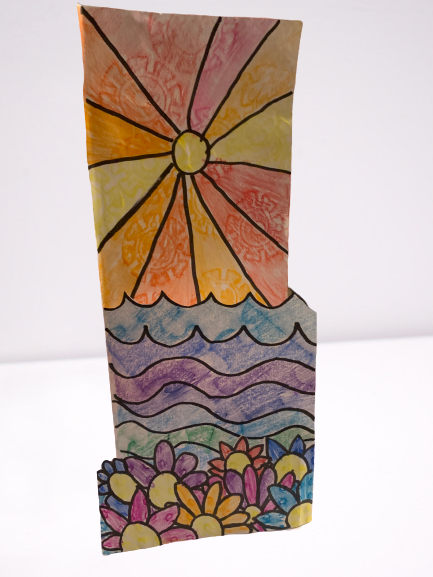
Students will look at and discuss landscapes and seascapes and learn how artists create space. Students will use the Elements of Art; line, color, shape, texture, and space to create a tri-fold texture seascape. Students will learn to create texture using a crayon rubbing technique. Students will use a trifold design to create space in their seascape that shows a foreground, middle ground, and background. This lesson can easily be adapted using the materials students have available at home.
Lesson Created By: AllisonPitre
Lesson Partners: ABC (Arts in Basic Curriculum)
Grade(s):
- 2
Subject(s):
Recommended Technology:
To view lesson resources students will need an internet device such as a cell-phone, or WiFi access and a laptop or tablet.
Other Instructional Materials or Notes:
A variety of materials can be used for this project including paper, pencil, crayons, markers, sharpies, colored pencils, and oil pastels.
Lesson Progression
- Students will first look at landscapes and seascapes and talk about how artists use the Elements of Art to create space.
- Students will begin by folding their paper into a tri-fold.
- Students will draw their seascapes using lines and shapes on each part of the tri-fold and cut out the top of the first two sections so that the sections behind are shown.
- Students will learn about and draw the parts of a landscape; foreground, middle ground, background, and horizon line.
- Next, students will add texture by placing various materials underneath their paper and rubbing a crayon onto their paper to fill each shape.
- Students will create contrast in their artwork by isolating warm and cool colors in their composition. The sea will be filled with cool colors (green, blue, violet), the sun and sky will be filled with warm colors (red, yellow, orange), and the flowers will be filled with a mix of warm and cool colors.
Textured Seascapes with Allison Pitre | Asynchronous Studio Lessons
Allison Pitre (Meadowfield Elementary School) leads an art lesson on creating textured seascapes.
View AssetTexture Seascapes Powerpoint
View ResourceTed Harrison Landscapes
View Resourcehttps://www.carlemuseum.org/blogs/making-art/homemade-texture-rubbing-plates
Use this link to find out how to create homemade texture rubbing plates.
View ResourceStandards
Assessments
Ask students questions like:
What are the warm and cool colors?
What are the parts of a landscape?
How did you create texture in your artwork?
How do artists create space?